The Mongol sack of Baghdad in February 1258 was the principal external catastrophe of the medieval Islamic world and the formal terminus of the Abbasid Caliphate as a sovereign institution. The thirty-seventh Abbasid caliph, al-Musta'sim Billah, was executed by the Mongol commander Hülegü on the 20th of February 1258 — twelve days after the surrender of the city — and the dynastic institutional continuity of the caliphate ended with him. The Mamluk dynasty at Cairo, which had defeated the Mongols at Ayn Jalut in September 1260, would within a year establish a Abbasid shadow caliphate at Cairo under a member of the surviving Abbasid family, but the institutional caliphate of Baghdad — the political and religious centre of the medieval Sunni Islamic world for five centuries — had ended.
The Mongol expansion
The Mongol confederation under Chingiz Khan (c. 1162–1227) had emerged in the early thirteenth century as the dominant political and military power of the Eurasian steppe. The Mongol military expansion under Chingiz had reached the western fringes of central Asia by his death in 1227, with the campaigns against the Khwarazmian state of 1219–1221 having destroyed the principal eastern Islamic political power. The subsequent campaigns under his successors — Ögödei Khan (1229–1241), Güyük (1246–1248) and Möngke (1251–1259) — had extended the Mongol authority across Russia, eastern Europe, Persia and China.
The Mongol push into the central Islamic lands was the responsibility of Möngke's brother Hülegü (c. 1217–1265), who was commissioned in 1253 to lead a expeditionary force against the remaining centres of resistance in the Islamic west: the Nizari Isma'ili "Assassins" of the Persian mountains, the Abbasid caliphate at Baghdad, the Ayyubid and Mamluk authorities in Syria and Egypt. The force that Hülegü led west from Mongolia in 1253–1255 was approximately 150,000 combatants — the largest single field army the Mongols had ever assembled — with Chinese siege engineers, logistical support, and trains of siege artillery.
The Assassin campaign
The first target of the campaign was the Nizari Isma'ili state — the network of mountain fortresses in northern Iran (including Alamut, the principal fortress) that had been governed since the late eleventh century by a sequence of charismatic religious-military leaders and that had produced the network of political assassins (the "Hashashin", whence the European "Assassin") that had been the scourge of the central Islamic political establishment for a century and a half. The Mongol campaign against the Nizari fortresses in 1256 — conducted by an overwhelming concentration of force against each fortress in turn, with the use of siege artillery to reduce the mountain defences — produced the surrender of the last Grand Master Rukn al-Din Khurshah in November 1256 and the destruction of the Nizari political-military apparatus.
The Mongol diplomacy
Hülegü's preparation for the Baghdad campaign included a diplomatic exchange with the caliph al-Musta'sim through the autumn of 1257. The Mongol demand was submission — the dismantling of the city walls, the provision of military forces to the Mongol army, and the public acknowledgment of Mongol sovereignty. The caliph's response was defiance, backed by the confidence (drawn from advice of his limited military advisers) that the sanctity of the caliphate would deter Mongol action and that the military resources of the caliphate were enough to defend the city. Both assessments were wrong.
The vizier of the caliphate, Mu'ayyid al-Din Ibn al-Alqami — a Shia administrator whom the Sunni religious establishment would blame for the subsequent disaster — attempted to broker a diplomatic solution in late 1257. The efforts came to nothing.
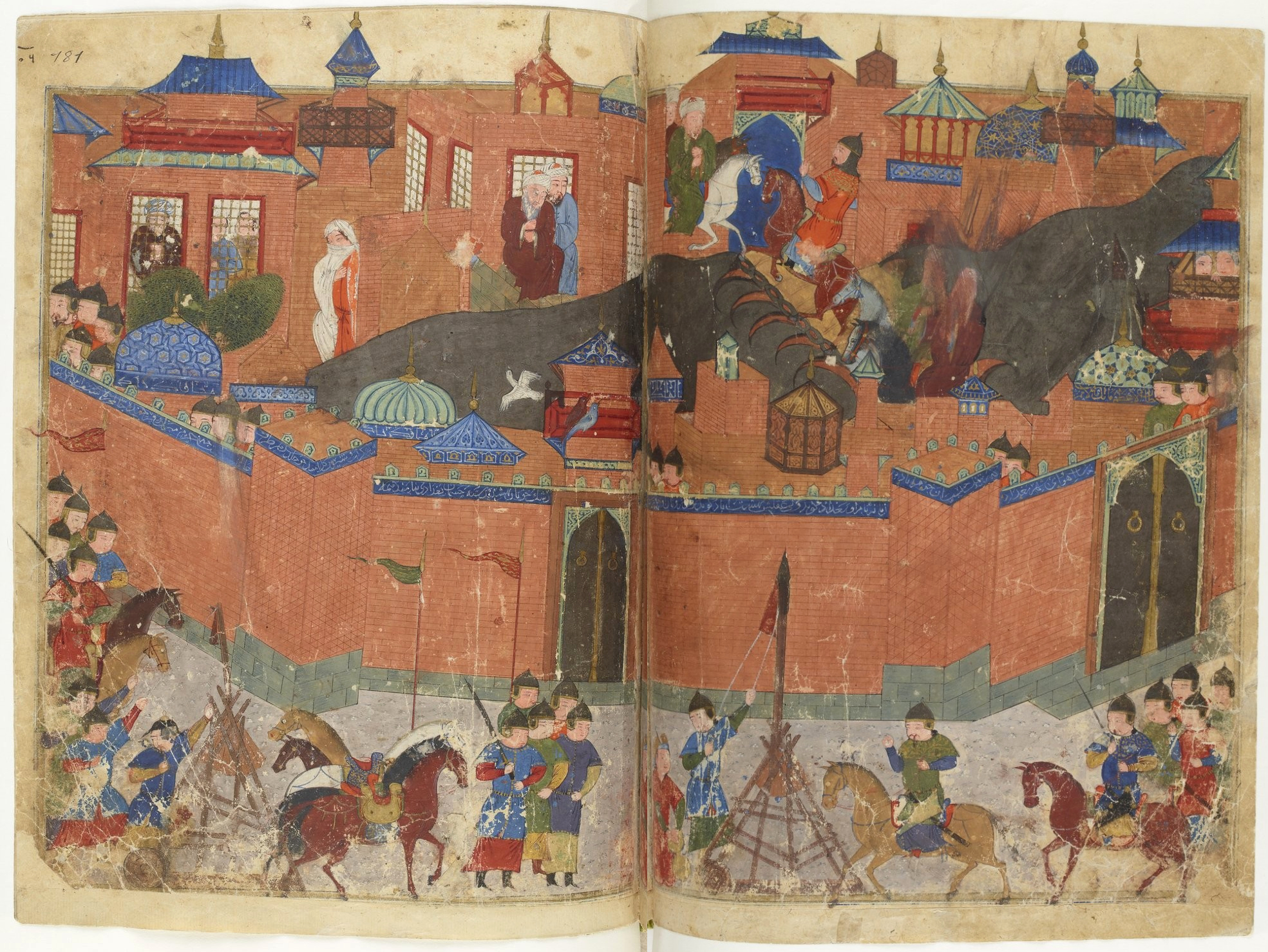
The siege
Hülegü's army arrived at the walls of Baghdad on the 11th of January 1258. The defending force comprised approximately twenty thousand combatants — the caliphal regular army, Turkish guard regiments, and popular militia from the city population. The Mongol force, with siege artillery and superior tactical organisation, encircled the city and began the bombardment of the walls on the 22nd of January. The caliphal cavalry sortie on the 17th of January had been destroyed by a Mongol counterstroke that broke the Tigris dykes and flooded their camp; the subsequent defensive operations were confined to the city walls.
The wall was breached on the 29th of January. The Mongol entry into the eastern suburbs was conducted on the 31st of January through the 6th of February. The caliph al-Musta'sim attempted diplomatic negotiation with Hülegü on the 5th and 9th of February but the terms offered (submission and provision of treasure) were below the Mongol demands. The formal surrender of the city followed on the 10th of February 1258.
The sack
The sack of the city, conducted between the 13th and 20th of February 1258, produced destruction of physical and human proportions. The death toll has been the subject of historiographical argument — the contemporary estimates ranged from 200,000 to 2,000,000, with modern assessments in the range of 90,000 to 200,000 in the week of active killing, plus larger numbers in the famine and plague that followed. The physical destruction included: the Round City itself; the Bayt al-Hikma library (the surviving books thrown into the Tigris, on the contemporary report that the river ran black with the ink for days); the caliphal palace complex; mosques, hospitals, schools and commercial quarters.
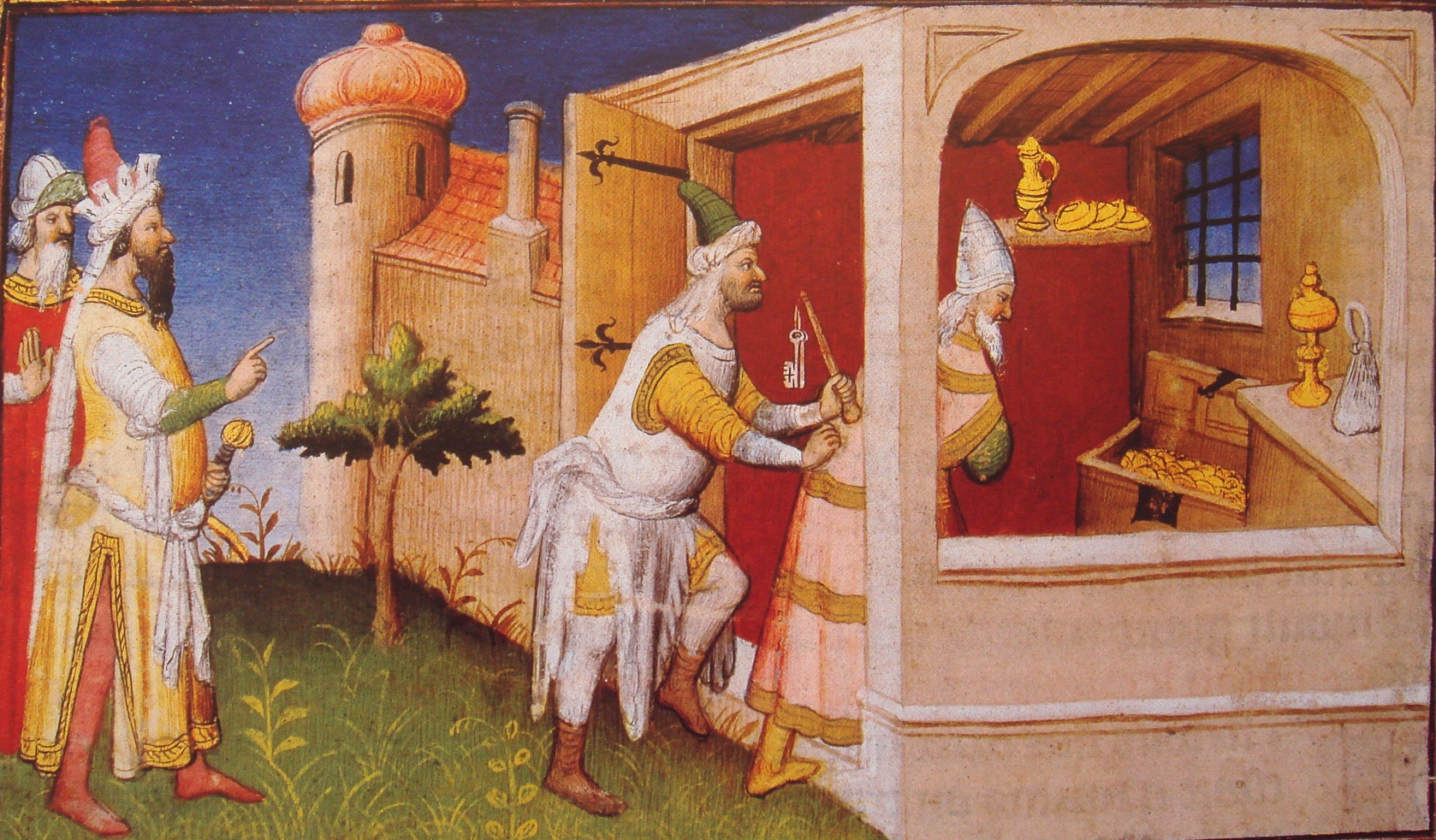
The caliph al-Musta'sim was held by the Mongols through the week of the sack and executed on the 20th of February 1258. The Mongol manner of execution — the caliph was rolled in a carpet and trampled to death by Mongol cavalry, because the Mongol religious-political tradition forbade the shedding of royal blood directly on the ground — was intended as a respectful execution but the subsequent Islamic tradition regarded it as the ultimate sacrilege. Three of his sons were killed with him; a fourth was exiled to Mongolia. The Abbasid family was eliminated as a political force in Iraq.
The aftermath
The Mongol advance west from Baghdad continued through 1259 and 1260. The cities of Aleppo and Damascus were captured in early 1260. The Mongol advance into Palestine and Egypt was halted at the battle of Ayn Jalut on the 3rd of September 1260, where the Mamluk Egyptian army under the Sultan Qutuz and the future Sultan Baybars defeated the Mongol expeditionary force under Kitbuqa. The battle produced the first Mongol military defeat in the central Islamic territories and established the Euphrates as the western frontier of the Mongol Ilkhanate of Persia.
The Abbasid family survivor — al-Mustansir, an uncle of the executed caliph — was located by the Mamluks in 1261 and proclaimed caliph at Cairo on the 13th of June 1261. The Cairo Abbasid shadow caliphate that followed, the Ottoman claim, and the 1924 Turkish abolition are the subject of the final chapter.
End of Chapter IX