The century between the Buyid entry into Baghdad in December 945 and the Seljuk Turkish replacement of them in December 1055 is the period during which the Abbasid caliphate was held in formal religious sovereignty by a Sunni caliph at Baghdad whose substantive political authority was substantially limited to ceremonial functions, with the actual government conducted by a Shia military dynasty of Persian provincial origin. The constitutional anomaly — a Shia military regime governing in the name of a Sunni caliph it did not theologically recognise — was sustained for a hundred and ten years by the substantial political utility of the formal continuity to both parties and by the substantial absence of alternative arrangements that either party could enforce.
The Daylamites
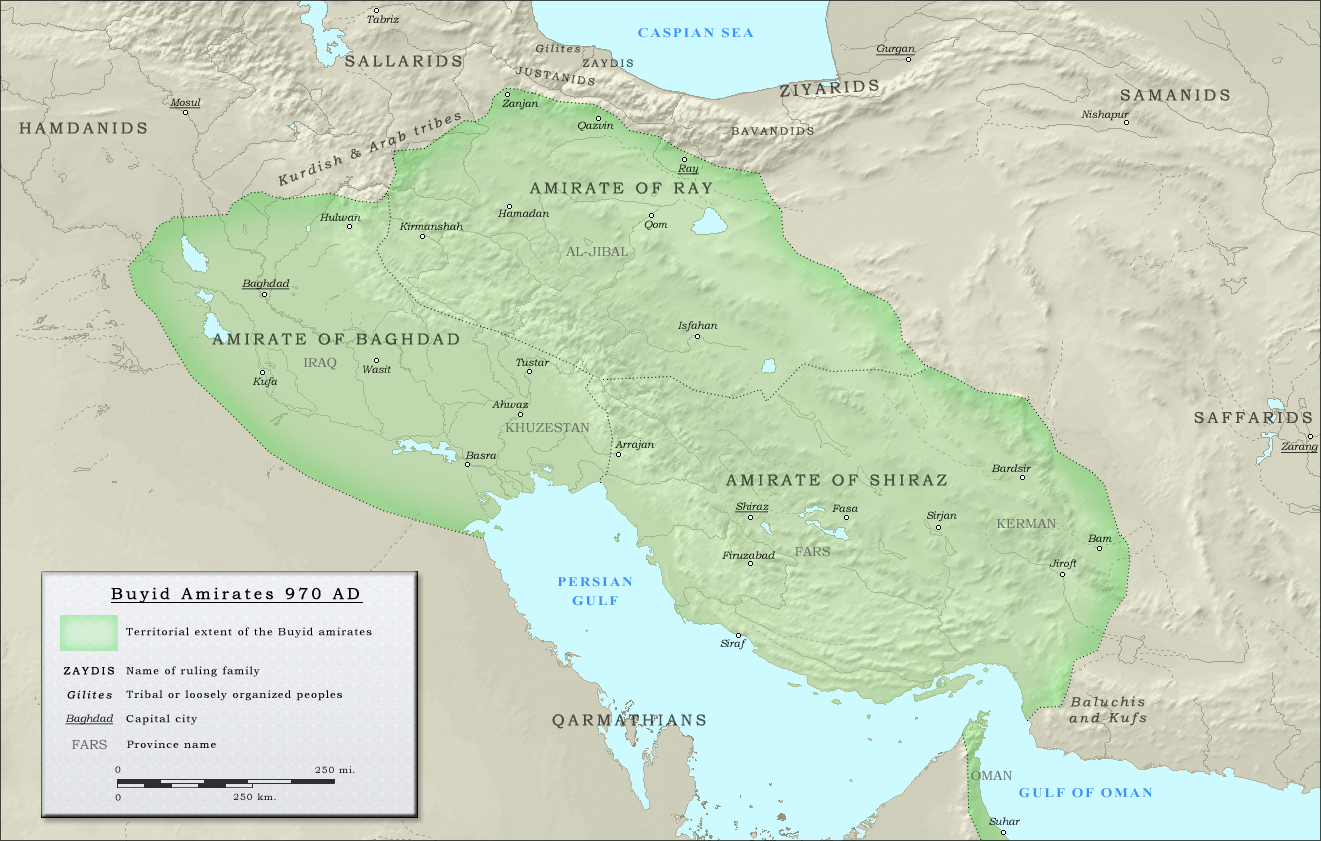
The Buyid family was of Daylamite origin — a Persian mountain population from the southern shore of the Caspian, known to the period as professional soldiers and as substantially recent and substantially partial converts to Shia Islam. The three founding brothers — Ali (later Imad al-Dawla), Hasan (later Rukn al-Dawla), and Ahmad (later Mu'izz al-Dawla) — had served as mercenaries in the wars of the early tenth century between competing Persian and Iraqi factions and had progressively established themselves as territorial princes in western Iran during the 930s and 940s. By 945 they controlled most of western Iran, Fars, and the route to Iraq.
The entry of Ahmad Mu'izz al-Dawla into Baghdad on the 17th of December 945 was substantially uncontested. The caliph al-Mustakfi — whom the dispossessed Turkish guard at Baghdad had been substantially unable to defend — received Mu'izz al-Dawla in the palace and conferred on him the title of amir al-umara ("amir of amirs"), the existing formal title for the chief executive officer of the caliphate. Ahmad's brothers received parallel titles for their territorial governments in Iran. Within weeks the relationship between the caliph and his new chief executive had been substantially clarified: Mu'izz al-Dawla blinded al-Mustakfi and replaced him with the more accommodating al-Muti (946–974), and from that point forward the caliph's role was substantially ceremonial.
The constitutional arrangement
The Buyid-Abbasid relationship operated on a substantially clear division of functions. The caliph retained: the formal religious sovereignty, in the sense that the Friday sermon was conducted in his name across all territories that recognised the Buyid amirs; the formal legitimating authority for new appointments, treaties and political decisions, in the sense that the documents required the caliphal seal; the substantial ceremonial functions of the caliphal court (the audiences, the formal investitures, the Friday sermon and pilgrimage observances); and a substantial private financial endowment from the caliphal lands. The caliph did not retain: any independent military force, any independent administrative apparatus, any substantial independent revenue, or any practical capacity to act against the will of the amir.
The amir held the substantive political authority: the command of the military forces, the administration of the revenue, the appointment of provincial governors and senior officials, the diplomatic relations with foreign powers, and the substantial day-to-day operation of the state. The amir's authority extended substantially over the central provinces of the caliphate — Iraq, Fars, Jibal, Khuzestan, Kerman — but did not extend substantially over the further peripheral provinces (Khurasan was under the Samanids, Egypt was under the Fatimids from 969, the western provinces of the Maghreb were substantially independent of either party).

The Shia paradox
The Buyid amirs were Shia Muslims (predominantly of the Zaydi or Imami persuasions; the Imami "Twelver" Shia tradition that would crystallise in the period was substantially developed under Buyid sponsorship by the scholar Shaykh al-Mufid at Baghdad). The caliph was the Sunni religious sovereign. The constitutional logic of the Shia position was that the Sunni caliph was theologically illegitimate, the legitimate imam being the hidden Twelfth Imam in occultation. The constitutional logic of the Sunni position was that the Shia military overlords were theologically dissident, but acceptable as administrators of the practical functions of government.
Both parties found that the constitutional fiction was operationally useful. The Buyid amirs derived substantial legitimating authority from being formal protectors of the recognised caliph, which the Shia population accepted on the practical ground that the Buyids were Shia in person even if Sunni in formal title. The Sunni religious establishment derived continued institutional existence from the formal protection of the caliphate. The practical political consequence — including the public celebrations of Shia religious holidays at Baghdad (the Ashura mourning, the Eid al-Ghadir celebration) that the Buyids introduced from 962, the substantial expansion of Shia shrines at Najaf and Karbala, and the substantial development of Shia religious scholarship — produced the formal institutional consolidation of the Twelver Shia tradition under Buyid patronage.
The cultural high point
The Buyid period was the substantial cultural and intellectual high water mark of the tenth-century Islamic world. The major figures of the period in literature, science and philosophy were active in territories under Buyid patronage: Ibn Sina (Avicenna, 980–1037, the major philosopher and physician); al-Mutanabbi (the principal Arab poet of the period); al-Tabari (the historian, active under late Buyid patronage); al-Mas'udi (the historian and geographer); al-Biruni (the polymath, active partly under Buyid and partly under Ghaznavid patronage); the Brethren of Purity (the philosophical school that produced the encyclopedic Rasa'il); Abu al-Faraj al-Isfahani (the literary scholar of the Book of Songs). The Buyid amirs themselves were substantial patrons of learning; Adud al-Dawla (the great Buyid amir of the late tenth century, who reunited the Buyid family realm) substantially expanded the libraries and educational institutions at Shiraz and Baghdad.
The decline
The Buyid family's substantial difficulty was the absence of a stable succession arrangement. The original Buyid territorial division — Iraq under one brother, Fars under another, Jibal under a third — produced a substantial sequence of family conflicts in the second and third generations, with the substantial parts of the family realm fighting one another and dissipating the substantial resources of the dynasty. By the early eleventh century the Buyids were substantially weakened by a sequence of military defeats, financial crises, and Turkish nomadic incursions into their territory.
The Seljuk Turks, who had emerged as a substantial political force in Khurasan in the 1030s, progressively moved west through Iran in the 1040s. The Seljuk leader Tughril Beg entered Baghdad on the 18th of December 1055 substantially unopposed by the remaining Buyid forces. The caliph al-Qa'im received Tughril Beg in formal audience, conferred upon him the title of sultan ("authority"), and the constitutional position of the caliphate substantially shifted again — from the Shia Daylamite amirate to the Sunni Turkish sultanate that is the subject of the next chapter.
End of Chapter VI