Iraq — the heartland
The caliphate's core, and the hardest travelling in this book. Iraq issues visas on arrival to many nationalities and the southern and central provinces are calmer than they were, but this is not a country to visit without local advice, a driver and current information. Check your government's guidance the week you go, not the month before.
Samarra · Iraq
The spiral minaret

Al-Mutawakkil's Great Mosque of 851 covered nearly seventeen hectares and was the largest mosque ever built. Almost nothing of it remains except the outer wall and the minaret — a fifty-two-metre brick cone with a ramp spiralling anticlockwise up the outside, unlike anything before or since, and probably borrowed from the ziggurats the Abbasids had been living among for a century.
Samarra exists because Baghdad had become impossible. Al-Mu'tasim's Turkish guard were fighting the city's population in the streets, so in 836 he moved the entire government 125 kilometres up the Tigris and built a new capital thirty-five kilometres long. It was abandoned within sixty years, which is why the archaeology is so good: nobody built over it.
The minaret's top was damaged by an insurgent bomb in 2005. It is a UNESCO site, listed as in danger, and it is the emblem of this volume.
Samarra · Iraq
Abu Dulaf

The second congregational mosque of Samarra, built about 861 at the northern end of the sprawl, with its own smaller spiral minaret. It stands in open ground with a perimeter fence and a guardian, and it receives a fraction of the visitors the Malwiya does.
It is worth the drive because it shows what the capital actually was: not a city in the ordinary sense but a thirty-five-kilometre ribbon of palaces, barracks, racecourses and cantonments strung along the river, built for an army the caliphs no longer fully controlled.
The Qasr al-Ashiq palace and the Qubbat al-Sulaibiyya, thought to be the tomb of three caliphs and the earliest surviving Islamic mausoleum, are in the same area.
Baghdad · Iraq
The Mustansiriya

Round Baghdad — the Madinat al-Salam, the City of Peace, laid out by al-Mansur in 762 as a perfect circle two kilometres across with the palace and mosque at the centre — has vanished completely. Not a stone of it has been identified. The Tigris moved, the mud brick dissolved, and the modern city sits on top.
What survives from the Abbasid period is the Mustansiriya madrasa, founded by the caliph al-Mustansir in 1233, thirty-five years before the Mongols came. It taught all four schools of Sunni law, had a hospital, a library and a famous water clock, and the brick façade on the river front is largely original.
The Abbasid Palace nearby, of similar date, has the finest muqarnas vaulting in Iraq. Both are open, and both are almost empty.
Baghdad · Iraq
The Iraq Museum

The national collection, and the reason the losses of 2003 mattered so much: some 15,000 objects were taken in the days after the American entry into the city, while the building stood unguarded, and roughly half have since been recovered from smugglers, auction houses and foreign governments.
The Islamic wing holds the Samarra excavation material — carved stucco panels, lustre ceramics, the wooden fittings from the palaces — which is the largest body of Abbasid decorative art anywhere.
The museum has reopened, closed and reopened several times since 2003 and again after 2015. Confirm on the day. The staff who hid parts of the collection in 2003, at some risk, are still there.
Kufa · Iraq
Where the dynasty began

A garrison town founded in 638 that became one of the intellectual centres of early Islam, the home of Kufic script and of the Hanafi school of law, and the place where Abu al-Abbas was proclaimed caliph in 749 after the Umayyads fell.
The Great Mosque is one of the oldest in Islam and stands on the site where Ali, the fourth caliph, was struck down while at prayer in 661 — the event from which the Sunni-Shia division ultimately descends. It has been rebuilt many times and is a major Shia pilgrimage site.
Kufa was the Abbasid capital only briefly. Al-Mansur distrusted the town's politics, which were persistently pro-Alid, and moved north to build Baghdad.
Karbala Governorate · Iraq
Ukhaidir

The single best-preserved building of the early Abbasid period anywhere: a rectangular fortified palace of about 775, walls seventeen metres high, with a great vaulted hall, a mosque, courtyards and living quarters, standing alone in the desert with nothing around it.
Its isolation is why it survives. It was probably built by Isa ibn Musa, a nephew of al-Mansur who was passed over for the succession and retired here, and it was abandoned early enough to escape rebuilding.
The vaulting is the thing to look at: barrel vaults and blind arcading in mud brick and rubble, a technique inherited directly from Sasanian Persia, and the physical proof that Abbasid architecture is a Persian tradition rather than an Arabian one.
Basra · Iraq
The port of the world

The caliphate's outlet to the Indian Ocean, from which ships reached Canton, and the town where Arabic grammar was systematised and the Mu'tazila school of theology began.
It was also the centre of the plantation economy that paid for a good deal of the golden age. The salt flats of southern Iraq were cleared and drained by the Zanj — enslaved East Africans, held in gangs of hundreds — and in 869 they revolted under a leader claiming Alid descent. The rebellion held southern Iraq for fourteen years, sacked Basra in 871, and required the full military resources of the state to suppress.
Very little medieval fabric survives. The old Ottoman quarter along the creeks is decaying and beautiful, and the Basra Museum in one of Saddam's palaces is excellent.
Mosul · Iraq
The northern city

The Abbasid province of al-Jazira, and later the seat of the Zangids and a great centre of metalwork — the inlaid brasses called Mosul ware are in every major museum.
The old city was held by Islamic State from 2014 to 2017 and destroyed in the fighting and deliberately. The al-Nuri mosque, twelfth-century, and its leaning minaret al-Hadba were blown up by IS in June 2017 as Iraqi forces closed in. A UNESCO-led reconstruction has been under way since 2018 and the minaret was rebuilt to its original lean.
It is included because the loss is part of the story of this volume, and because the reconstruction is one of the more hopeful things happening in Iraq.
The wider caliphate
Abbasid authority ran from North Africa to Central Asia, and in most of those places more survives than in Iraq — either because the provinces were richer for longer, or because the wars of the last fifty years happened elsewhere.
Raqqa · Syria
Harun's summer capital

Harun al-Rashid moved his court here in 796 and governed the caliphate from the Euphrates rather than the Tigris for twelve years, building a palace complex north of the town of which the outlines survive.
The Baghdad Gate and stretches of the mud-brick city wall stood into this century. Raqqa was Islamic State's capital from 2014 and was largely destroyed in the coalition bombardment that ended in October 2017; the archaeological museum was emptied and the sites damaged both by fighting and by systematic looting.
Syria is not sensibly visitable for most readers at present and this guide will not pretend otherwise. It is here because Harun's caliphate was governed from this spot, and because what happened to it should be recorded.
Cairo · Egypt
Ibn Tulun

Ahmad ibn Tulun was a Turkish officer sent from Samarra to govern Egypt in 868, who within a few years was ruling it as his own and remitting only what he chose. He built this mosque between 876 and 879, and he built it in the style of the capital he had grown up in.
It is therefore the best surviving Samarra-style building in the world, and it is in Cairo rather than Iraq: a vast brick courtyard with piers rather than columns, carved stucco in the Samarra manner, and a spiral minaret that is a deliberate copy of the Malwiya.
It is the oldest mosque in Egypt surviving in its original form, and after the crowds of the Citadel it is startlingly empty.
Kairouan · Tunisia
The African metropolis

Founded in 670 and the fourth holiest city of Islam. Its Great Mosque was rebuilt by the Aghlabid emirs in the ninth century into the form it keeps — a hypostyle hall of 414 columns robbed from Roman and Byzantine buildings, under a square minaret that is among the oldest standing.
The Aghlabids were Abbasid governors who became hereditary rulers in 800, sent tribute when convenient, and conquered Sicily on their own account. They are the clearest early example of the pattern that dismantled the caliphate: provinces that acknowledged the caliph's name in the Friday prayer and on the coinage, and did as they pleased in everything else.
The Aghlabid basins outside the walls — two open reservoirs of the ninth century, one 128 metres across — are the finest surviving Islamic hydraulic works.
Córdoba · Spain
The rival caliphate

When the Abbasids took power in 750 they killed the Umayyad family systematically, including at a banquet to which the survivors had been invited under safe conduct. One grandson, Abd al-Rahman, escaped across North Africa and reached Spain, where he established an emirate in 756 that his descendants ruled for nearly three centuries.
The Great Mosque he began in 785 is the physical answer to Baghdad: a rival dynasty, a rival architecture, and after 929 a rival caliphate claiming the same universal authority.
Córdoba has its own volume in this library. It appears here because the Abbasid caliphate can only be understood as one of several, and because the family that built this was the one the Abbasids failed to finish.
Harran · Turkey
The pagan translators

A very old town on the Turkish-Syrian border, mentioned in Genesis, and the last centre of open pagan worship in the Near East — its people worshipped the moon god Sin into the Islamic period and negotiated protected status by describing themselves as Sabians, a group the Qur'an names.
Their astronomical tradition was Greek, and when the Abbasids began commissioning translations the Harranians were among the most important suppliers. Thabit ibn Qurra, a Harranian who went to Baghdad in the 870s, translated Archimedes, Apollonius and Ptolemy, and did original work on number theory that anticipated results not proved again for centuries.
The ruins of the Great Mosque and the university stand beside a village of conical mud-brick houses that have been built the same way for a very long time.
Mary · Turkmenistan
Merv

Al-Ma'mun ruled the caliphate from Merv for six years during and after the civil war with his brother, and the eastern provinces were the base from which he won it. The city may have been the largest in the world in the twelfth century.
The Mongols reached it in 1221. The chronicler Ibn al-Athir gives a figure of 700,000 dead, which is certainly too high, but the destruction was thorough enough that the site was never rebuilt and the successor town grew up elsewhere.
What remains is thirty square kilometres of walled cities from successive periods, largely unexcavated, with the twelfth-century mausoleum of Sultan Sanjar standing in the middle of it. Turkmenistan is among the hardest countries in the world to enter.
Bukhara · Uzbekistan
The Samanid tomb
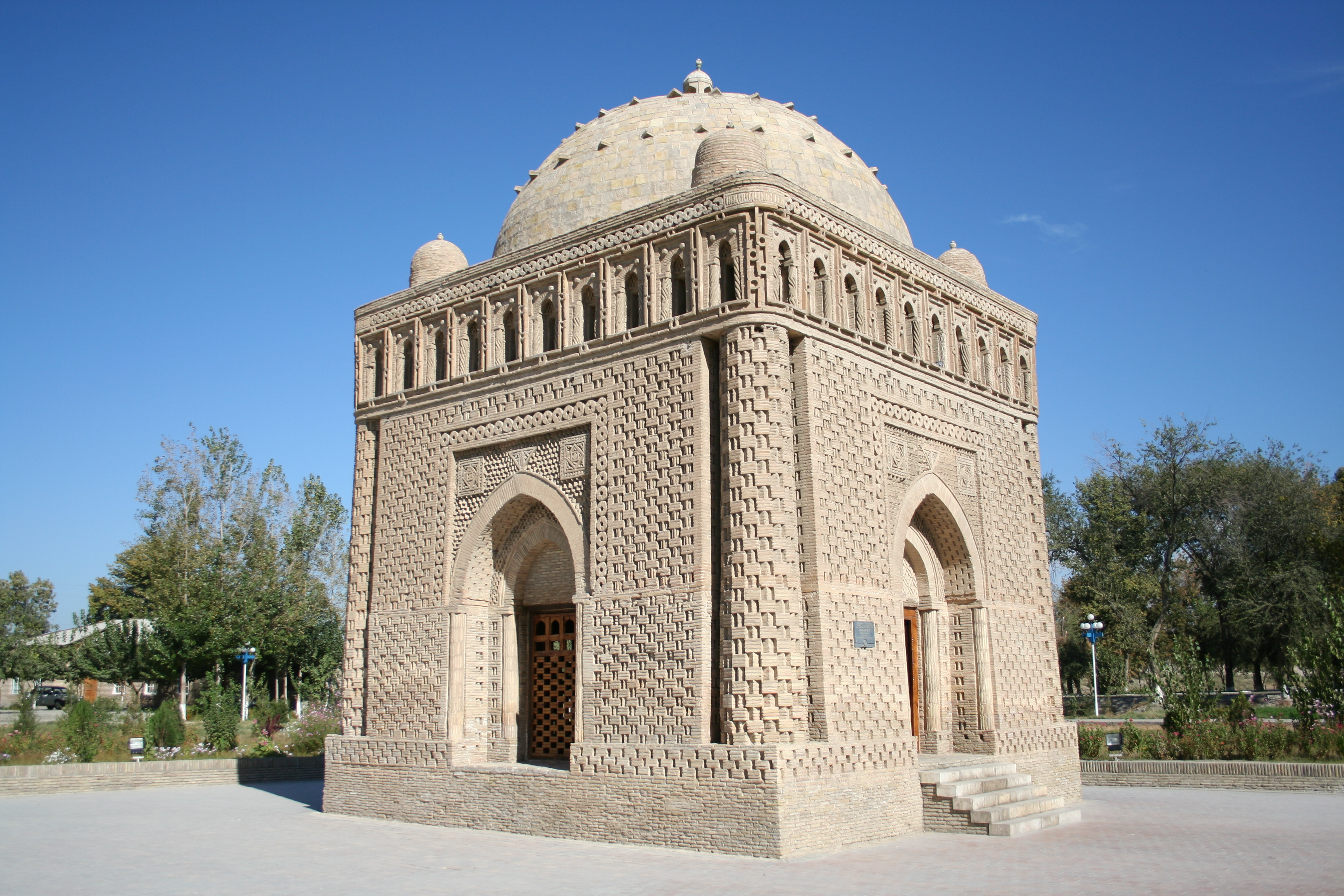
The Samanids governed Transoxiana for the Abbasids and then for themselves, and under them Persian re-emerged as a literary language after two centuries of Arabic — Rudaki wrote here, and Ferdowsi's Shahnameh belongs to the world they made.
Their dynastic tomb, built about 900, is a cube of baked brick about ten metres on a side with a dome on squinches, and every surface is patterned in brick laid at different angles so that the shadows move across it through the day. It is the earliest important monument of Islamic architecture in Central Asia and one of the most perfect.
Ibn Sina — Avicenna — was born near here in 980 and learned medicine in the Samanid library at Bukhara, which he described as the best he ever saw.
Samarkand · Uzbekistan
Where paper came west

In July 751 an Abbasid army defeated a Tang Chinese force on the Talas river, north-east of here. The battle settled the frontier between the two empires for centuries, and — according to a tradition first recorded two hundred years later — Chinese prisoners taken there included papermakers.
Whether or not that particular story is true, paper mills were operating at Samarkand within a generation, at Baghdad by 794, and across the caliphate by 800. Paper is cheap, and cheap writing material is the precondition for everything the translation movement achieved: a book that cost a fortune in parchment could now be copied by a student.
The Registan and the great Timurid monuments belong to the fifteenth century. Afrosiyab, the pre-Mongol city, is a mound on the northern edge with a small museum.
Nishapur · Iran
The Khorasan revolution

The Abbasid revolution was made in Khorasan. Abu Muslim raised the black banners here in 747 among a population of Arab settlers and Persian converts with a common grievance against Umayyad tax policy, and the army that took Iraq two years later was a Khorasani army.
The dynasty depended on Khorasan for its troops, its administrators and its viziers — the Barmakid family who ran the state under Harun al-Rashid were Persians from Balkh, and their fall in 803 is the standard example of a caliph destroying the people who made him.
Nishapur was one of the great cities of the Islamic east until the Mongols, and produced Omar Khayyam and Attar. The pottery excavated here in the 1930s is in the Metropolitan Museum and is some of the most beautiful ever made.
Cairo · Egypt
Fustat

The first Islamic capital of Egypt, founded in 641, and the town beneath modern Old Cairo. Its archaeology has been picked over for a century, and its glazed pottery and lustreware are in every collection.
Its real importance is documentary. The Ben Ezra synagogue here kept a geniza — a storeroom for papers bearing the name of God, which may not be destroyed — and it was never cleared out. When European scholars reached it in the 1890s they found some 300,000 fragments: business letters, marriage contracts, shopping lists, school exercises, court records, from the ninth century onward.
The Cairo Geniza is the reason we know more about ordinary life in the medieval Islamic world than in medieval Europe. S. D. Goitein's five volumes drawn from it are listed in the sources.
Baghdad · Iraq
The instruments

No building called the House of Wisdom has ever been located, and the phrase in the sources may describe a library, a translation office, or simply the caliph's book collection. What is not in doubt is the output.
Al-Khwarizmi, working in Baghdad in the 820s, wrote the book whose title gives us the word algebra, and whose author's name, latinised, gives us algorithm. Al-Kindi applied mathematics to cryptography and described frequency analysis four centuries before anyone in Europe. The Banu Musa brothers built automata and measured the circumference of the earth to within a few per cent. Al-Razi distinguished smallpox from measles.
The astrolabe is the emblem of it: an instrument for calculating time, latitude, prayer direction and star positions, inherited from Greek theory and turned by Abbasid craftsmen into a general-purpose analogue computer.
Baghdad · Iraq
Al-Kadhimiya

A shrine complex on the west bank holding the tombs of Musa al-Kadhim, the seventh imam, who died in an Abbasid prison in 799, and his grandson Muhammad al-Jawad, the ninth, who died in Baghdad in 835. Both deaths are held by Shia tradition to have been poisonings ordered by the caliph.
The shrine is therefore a monument to the other half of the Abbasid story. The dynasty came to power on a slogan promising the Prophet's family and then governed against the branch of it that most people had assumed was meant, and the resulting hostility ran through five centuries of Iraqi politics.
The present buildings are Safavid and later, with two golden domes and four minarets. The annual commemoration of al-Kadhim's death draws enormous crowds; in 2005 a stampede on the bridge from Adhamiya killed nearly a thousand people.
Damascus · Syria
The mosque they inherited

The Abbasid revolution moved the capital from Damascus to Iraq, and the move was ideological as much as strategic: away from Syria, away from the Arab tribal aristocracy that had run the Umayyad state, and towards the Persian east where the revolution had been made.
What they left behind was this. Al-Walid's mosque of 706–715, built on a temple of Jupiter that had become a church of St John, with a courtyard of gold mosaic showing a paradise of rivers and palaces and not a single living figure. It is the oldest surviving monumental mosque and the model against which every later one was measured.
The Abbasids never built anything to match it in Damascus, and their own great mosques at Samarra are gone. This is the standard they were working from, and it survives while theirs does not.
A postscript — trade, water and the long afterlife
Three stops that belong to no single chapter: what the caliphate traded, the landscape its worst revolt was fought in, and the building where its architecture went on evolving for another six centuries.
Isfahan · Iran
The Friday Mosque

The oldest parts date to an Abbasid hypostyle mosque of 771, and every subsequent period added to it without demolishing what was there — so the building is a stratigraphy of Iranian Islamic architecture, from Abbasid brick piers through the two Seljuk domes of the 1080s to Safavid tilework.
The north dome, built in 1088 by Taj al-Mulk, is the one to look at. It is structurally close to perfect, and its geometry — the transition from square chamber to circular dome through a system of interlocking arches — is a solved mathematical problem, probably worked out with the help of the mathematicians the Seljuk court employed. Omar Khayyam was in Isfahan in exactly those years reforming the calendar.
It is a UNESCO site, and it is usually far quieter than the Naqsh-e Jahan square twenty minutes away.
Samarra · Iraq
The lustre and the porcelain

Excavation at Samarra in 1911–13 turned up Chinese stoneware and early porcelain in quantity, shipped from Canton to Basra and carried up the Tigris. It is the hardest evidence there is for the reach of Abbasid trade.
It also caused a technical revolution. Iraqi potters had no kaolin and could not fire high enough to make porcelain, so they made something else: an opaque white tin glaze over ordinary earthenware, imitating the look of Chinese white, and then decorated it with metallic lustre — a second firing in a reducing atmosphere that leaves a film of copper or silver on the surface.
Lustreware travelled from Iraq to Egypt, to Spain, and from Spain to Italy, where it became maiolica. The blue-on-white palette went the other way and reappeared in Chinese porcelain using Persian cobalt. It is one of the best documented exchanges of technology in the medieval world.
Southern Iraq
The marshes

The marshes between the Tigris and Euphrates were the ground on which the Zanj rebellion survived. The enslaved workforce that revolted in 869 could not have held out against the caliphate's armies in open country; in the reed channels they held southern Iraq for fourteen years and built a capital, al-Mukhtara, that took a three-year siege to reduce.
The same water later hid Iraqi communists, then Shia insurgents. Saddam Hussein drained the marshes in the 1990s, reducing them to about ten per cent of their extent and displacing a way of life that had been continuous since Sumer.
Re-flooding began in 2003 and the recovery has been partial but real; the Ahwar were listed by UNESCO in 2016. You travel by mashuf, a long canoe, among reed houses built without a nail.