The reign of Harun al-Rashid (786–809) is the period to which the later Islamic memory has assigned the apex of the dynasty — a designation that has more to do with the cultural production of the period (the legend of the Thousand and One Nights, set in Harun's Baghdad) than with the administrative or military achievements, which were not in fact superior to those of his father al-Mahdi or his son al-Ma'mun. The reign is, however, the substantial moment at which the Abbasid civilisation reached the form by which the medieval Islamic world would be remembered: a cosmopolitan court, a multilingual administrative class, a literary culture combining Arab, Persian, Greek and Indian elements, and a diplomatic system that engaged the Mediterranean and the Inner Asian neighbours on roughly equal terms.
The Barmakids
The principal administrative system of Harun's reign was conducted by the Barmakid family — Persian noble converts from the Buddhist Naubahar monastery of Balkh, who had served the dynasty since al-Mansur and who under Harun reached the position of effectively running the administration of the empire. The patriarch Yahya ibn Khalid was the vizier and the chief tutor of the young Harun; his sons Fadl, Ja'far, Muhammad and Musa held the principal provincial governorships and the senior ministerial positions. Ja'far in particular — the Vizier al-Rashid of the Thousand and One Nights — was Harun's intimate companion through the first seventeen years of the reign.
The Barmakid administration was substantively responsible for the empire's prosperity during the period: the systematic collection of revenue, the maintenance of the army, the patronage of the cultural establishment, and the diplomatic correspondence. Their fall in 803 — the abrupt and substantial purge of the family, the execution of Ja'far, the imprisonment of Yahya and the survivors — was conducted by Harun in person and has been the subject of a thousand years of subsequent speculation. The proximate cause was probably a combination of accumulated political resentment within the broader Abbasid family at the Barmakids' near-monopoly of senior positions, financial irregularities that the Barmakids' extensive private wealth had made conspicuous, and Harun's own personal sense of having been overshadowed. The longer consequence was the loss of the most capable administrative cadre that the dynasty had ever possessed.

The Byzantine frontier
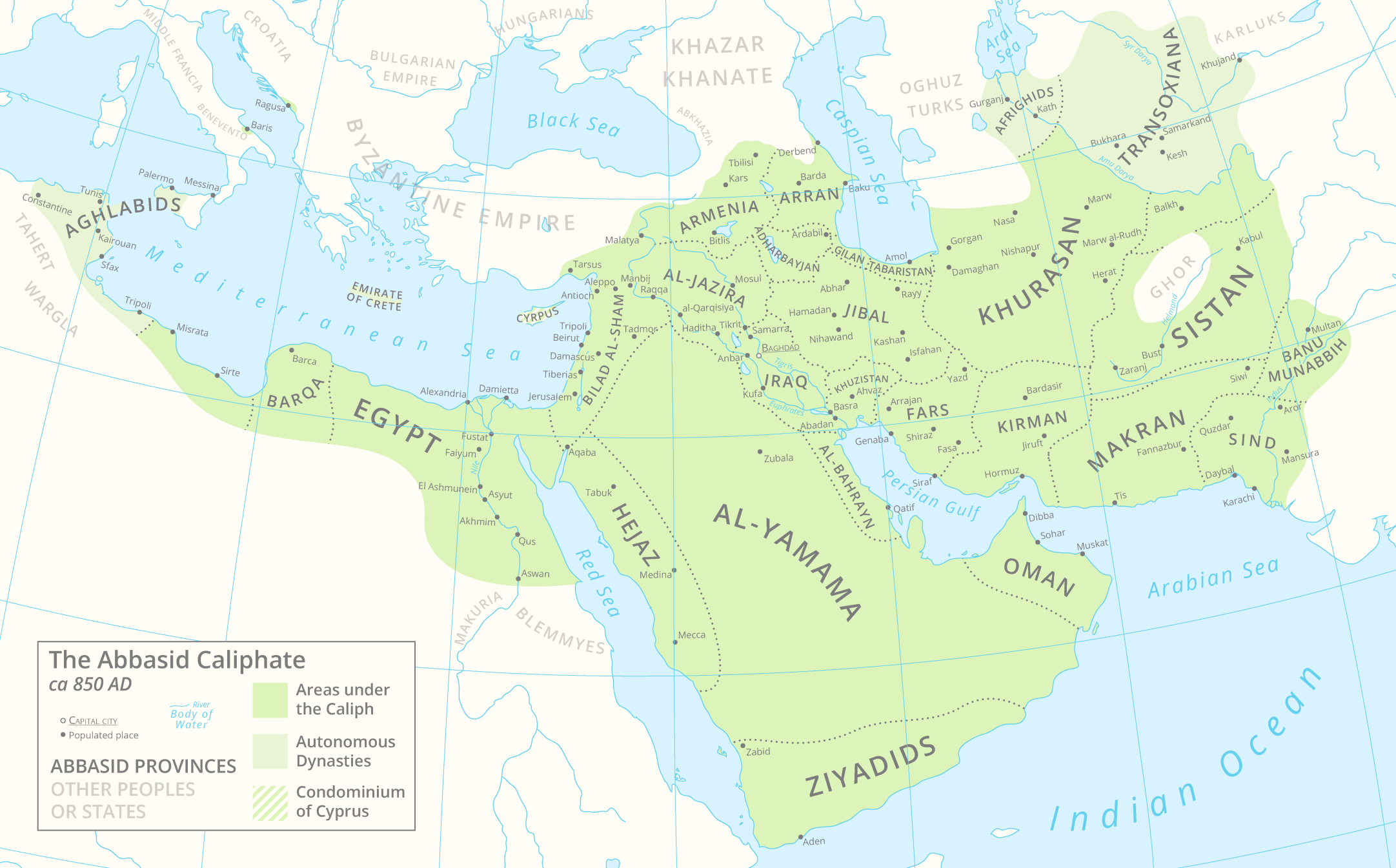
The principal external war of Harun's reign was the continuing border conflict with the Byzantine Empire across the Anatolian frontier. Harun had commanded the Byzantine front as a young prince in the 780s under his father al-Mahdi, including the expedition of 782 that had reached the Bosphorus and extracted a substantial annual tribute from the Empress Irene. As caliph he conducted further campaigns in 797, 803, and 806, the last of which produced the Roman emperor Nikephoros I's renewed payment of tribute and the substantial Byzantine territorial losses in eastern Anatolia. The military operations were the principal annual ceremonial activity of the caliphate — the summer raid (sa'ifa) into Byzantine territory was the public demonstration of caliphal religious legitimacy and was conducted with substantial ceremony.
Charlemagne
The diplomatic exchanges with Charlemagne — beginning in approximately 797 and continuing for the rest of the reign — were among the more anomalous of the period's international relations. The Frankish king (crowned Western Roman emperor at Rome in December 800) and the Abbasid caliph had no common border and no substantive shared political interest except that both regarded the eastern Roman empire as a potential opponent: Charlemagne because the Byzantine claim to the Roman imperial title rivalled his own; Harun because Byzantium was the principal infidel adversary on the Anatolian frontier. The exchanges produced a series of embassies — including the famous mission that returned to Aachen with an elephant called Abul Abbas in 802 — and a substantial Carolingian access to the holy places at Jerusalem (which were within Abbasid territory). The diplomatic relationship was without binding obligation on either side but illustrated the cosmopolitan character of the period's international system.
The literary court
The Baghdad of Harun's reign was the principal literary and intellectual centre of the Islamic world and substantially the most cosmopolitan city of the period. The court patronised: the principal Arab poets of the period (Abu Nuwas, Abu al-Atahiya, Bashshar ibn Burd), whose work would establish the canon of classical Arabic court poetry; the principal religious scholars (including the four founders of the Sunni legal schools, three of whom were active in Harun's lifetime — Abu Hanifa had died in 767, Malik ibn Anas was active in Medina, al-Shafi'i taught at Baghdad and Cairo, Ahmad ibn Hanbal was Harun's contemporary as a young scholar); the principal philological scholars (al-Kisa'i, al-Asma'i, Abu Ubayda); and the Indian, Persian and Greek translators whose work would form the basis of the Bayt al-Hikma translation movement under al-Ma'mun.
The literary form by which the period has been most thoroughly remembered — the cycle of frame-tales known to the medieval Arabic tradition as Alf Layla wa-Layla ("A Thousand and One Nights") and to the modern Western tradition as The Arabian Nights — was probably substantially formed in the period after Harun's death, but used the Baghdad of Harun and the figure of Harun himself as the principal narrative setting. The historicity of the tales as a description of the actual reign is limited; the importance of the tales as a long-term contribution to the world's literary culture is substantial.
The succession crisis
The principal political problem that Harun bequeathed to the dynasty was the unresolved succession. Harun had two principal sons: al-Amin (born 787, son of the Arab princess Zubayda bint Ja'far) and al-Ma'mun (born 786, son of the Persian concubine Marajil). The two were close in age, equally capable, and represented different constituencies within the empire — al-Amin the Arab and Iraqi establishment, al-Ma'mun the Khurasani and Persian. Harun's attempt to resolve the question through the Mecca Agreement of 802 — under which al-Amin would succeed at Baghdad with sovereignty over the western provinces, al-Ma'mun would govern Khurasan with a designated succession after al-Amin, and a third son al-Mu'tamin would govern Mesopotamia and the Jazira — was a substantial political miscalculation that would produce the Fourth Fitna (civil war) of 809–813.
Harun died at Tus in north-eastern Iran on the 24th of March 809 while on campaign against the rebellion of Rafi ibn al-Layth. He was forty-three. The succession produced four years of civil war between al-Amin (at Baghdad) and al-Ma'mun (at Merv in Khurasan), the substantial damage to the city of Baghdad in the siege of 812–813, and the eventual victory of al-Ma'mun in 813. The translation movement, the religious controversies, and the structural shift of the dynasty under al-Ma'mun are the subject of the next chapter.
End of Chapter III