Selim III, who became sultan in 1789, was twenty-seven years old, a poet, a composer of religious music, and an admirer of the French Revolution that had broken out in his accession year. He had spent his pre-accession adolescence corresponding clandestinely with the French ambassador. He had, on his desk, a copy of the new American constitution. He had the most ambitious reform programme of any Ottoman sultan since Süleyman.

What he wanted to do was simple: build a new army, on European lines, alongside the existing Janissary corps; reform the tax system; modernise the navy; open permanent embassies in European capitals. What he called this programme was the Nizam-i Cedid — the New Order. The army it produced — disciplined, drilled in European tactics, uniformed in something like a modern military uniform — was, by 1806, around 23,000 strong. It was the foundation of every subsequent Ottoman reform.
It was also what got him killed. The Janissaries, correctly perceiving the New Order as a threat to their privileged existence, revolted in May 1807. Selim was deposed, then murdered in his chamber on the 28th of July 1808, when a counter-coup by reformist troops was about to restore him. He was strangled with a bowstring before he could be rescued. His final reported words were directed at his assassin: "You are striking a great man. You will be punished."
Mahmud II and the destruction of the Janissaries
The man who came to the throne in the chaos that followed Selim's murder was his twenty-three-year-old cousin Mahmud II. He had been the only Ottoman prince to survive a comprehensive Janissary purge of the dynasty during the disturbances. He had, by his own later account, spent the next eighteen years calculating how to destroy the institution that had killed his predecessor.
His opportunity came on the night of the 15th of June 1826. Mahmud had spent the preceding year quietly recruiting, equipping, and training a new force — the Mansure army, named for the Prophet — and stockpiling artillery in concealed depots around Istanbul. On the agreed day he issued the Janissaries a formal order to begin training in European drill. They responded, as expected, with revolt. They overturned their soup cauldrons in the parade ground of the At Meydanı (Hippodrome) — the traditional Janissary signal of mutiny — and marched on the palace.
This time the palace did not bow. Mahmud unfurled the green banner of the Prophet, which had been kept in the Privy Chamber since the time of Selim I, and declared a holy war against the rebels. The Mansure artillery opened fire on the Janissary barracks with grapeshot at point-blank range. Within four hours the barracks were burning and the surviving Janissaries had been driven into the streets, where they were hunted by the regular troops and by enraged civilian crowds. Estimates of the dead range from six thousand to fifteen thousand. The order was abolished by edict the following morning. The Bektashi Sufi order, with which the Janissaries had been associated for four centuries, was dissolved. The famous Janissary military music was suppressed.
The Ottomans, with a characteristic taste for understated official language, called this the Vaka-i Hayriye — the Auspicious Incident.
"On Wednesday morning, by the grace of God and the favour of the Prophet, that thorn in the side of the dynasty was extracted. The state is renewed." — Mahmud II, edict of the 17th of June 1826
The Tanzimat
Mahmud's son and successor Abdülmecid I, sixteen years old at his accession in 1839, formally launched the Tanzimat — the Reorganisation — with a decree read aloud at Gülhane Park, near the Topkapı Palace, on the 3rd of November 1839. The decree, drafted by the foreign minister Mustafa Reşid Pasha, proclaimed: equality of all subjects before the law, regardless of religion; the abolition of tax-farming; the regularisation of military conscription; security of life, honour, and property for all Ottomans; and an end to confiscations of property without trial.
What followed was thirty-seven years of legal, administrative, educational, and military reform, conducted by a small group of westernising bureaucrats who came to dominate Ottoman politics. The Tanzimat created: the first Ottoman penal code (1840), based on French models; the first Ottoman commercial code (1850); the first Ottoman civil code (the Mecelle, completed 1876), which uniquely combined Islamic legal sources with modern codification techniques and remained in force in some Arab successor states until the 1940s. It established a state postal system (1840), a state newspaper (1831, the Takvim-i Vekayi, the oldest still-published Turkish newspaper), modern medical, military, and naval academies, and the first Ottoman secular universities.
It also issued, in 1856, the most controversial of all Ottoman reform documents: the Reform Edict, which extended legal equality more explicitly to Christians and Jews, allowed Christians to serve in the imperial army for the first time, and forbade religious discrimination in state employment. The edict was unpopular with conservative Muslim populations across the empire. It was also one of the principal causes of the inter-communal violence — particularly in Lebanon and Syria — that marked the late 1850s and 1860s.
The Crimean War and the foreign debt
The Tanzimat operated in the shadow of a single very expensive war. The Crimean War of 1853-56, fought against Russia in alliance with Britain, France, and Sardinia, was the first major Ottoman war as a member of a European coalition. It was also the war in which Florence Nightingale established the modern profession of nursing in the army hospital at Scutari (modern Üsküdar), on the Asian side of the Bosphorus.
The Ottoman portion of the war was decided, in essence, when Russia lost. The empire was confirmed in possession of its existing territory and granted formal admission to the Concert of Europe. The price, however, was financial ruin. The Ottoman government had borrowed extensively from British and French banks to pay for the war. By 1875 the foreign debt had reached approximately 200 million pounds sterling — more than four times the annual revenue of the state. In October 1875 the empire declared partial default. In 1881 it was forced to accept the Public Debt Administration, a multinational consortium of foreign creditors that took direct control of a substantial portion of Ottoman state revenues — the salt monopoly, the tobacco monopoly, fisheries, silk taxes — to repay foreign bondholders. The administration would continue, in various forms, until 1939.
The first constitution
The Tanzimat reached its constitutional climax in 1876, when, in a brief liberal moment, the empire became the first Muslim state to adopt a written constitution. The architect was the reform-minded grand vizier Midhat Pasha. The new sultan — Abdul Hamid II, twenty-three years old, the third Ottoman sultan in three months following the depositions of his brother Murad V and uncle Abdülaziz — signed the constitution on the 23rd of December 1876. It provided for a bicameral parliament, an independent judiciary, freedom of the press, religious toleration, and the legal equality of all Ottoman subjects.
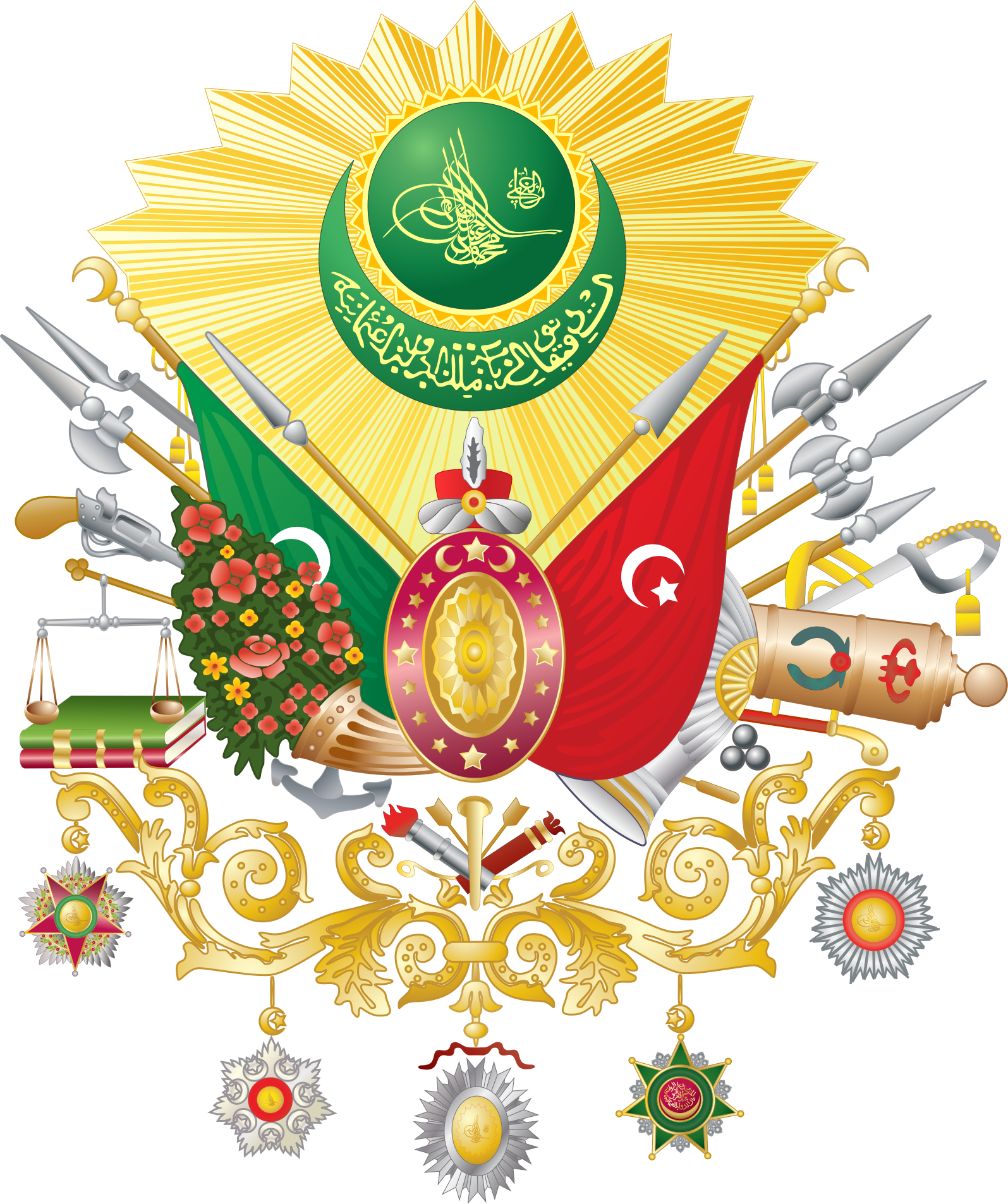
The first Ottoman parliament met on the 19th of March 1877. It contained eighty Muslim deputies, fifty Christians, and four Jews. It was, by the standards of the day, a serious effort. It lasted thirteen months. On the 13th of February 1878, citing the Russo-Turkish War then in progress and the parliament's increasingly vocal criticism of his ministers, Abdul Hamid II prorogued the parliament indefinitely. He suspended, in the same act, the constitution. He would not call parliament again for thirty years.
What he did instead is the subject of the next chapter.
End of Chapter VII