The Ottoman defeat at Vienna in September 1683 was followed almost immediately by an Austrian counter-offensive. Over the next sixteen years, a Holy League of the Habsburgs, Poland-Lithuania, Venice, and (from 1686) Russia took, in succession: Buda, capital of Ottoman Hungary, in 1686; the central Hungarian plain in 1687; Belgrade in 1688; Transylvania, the Morea (Peloponnese), and Bosnia in subsequent years. The Ottoman armies, fighting on four fronts simultaneously, were forced into a defensive posture they would never again leave.
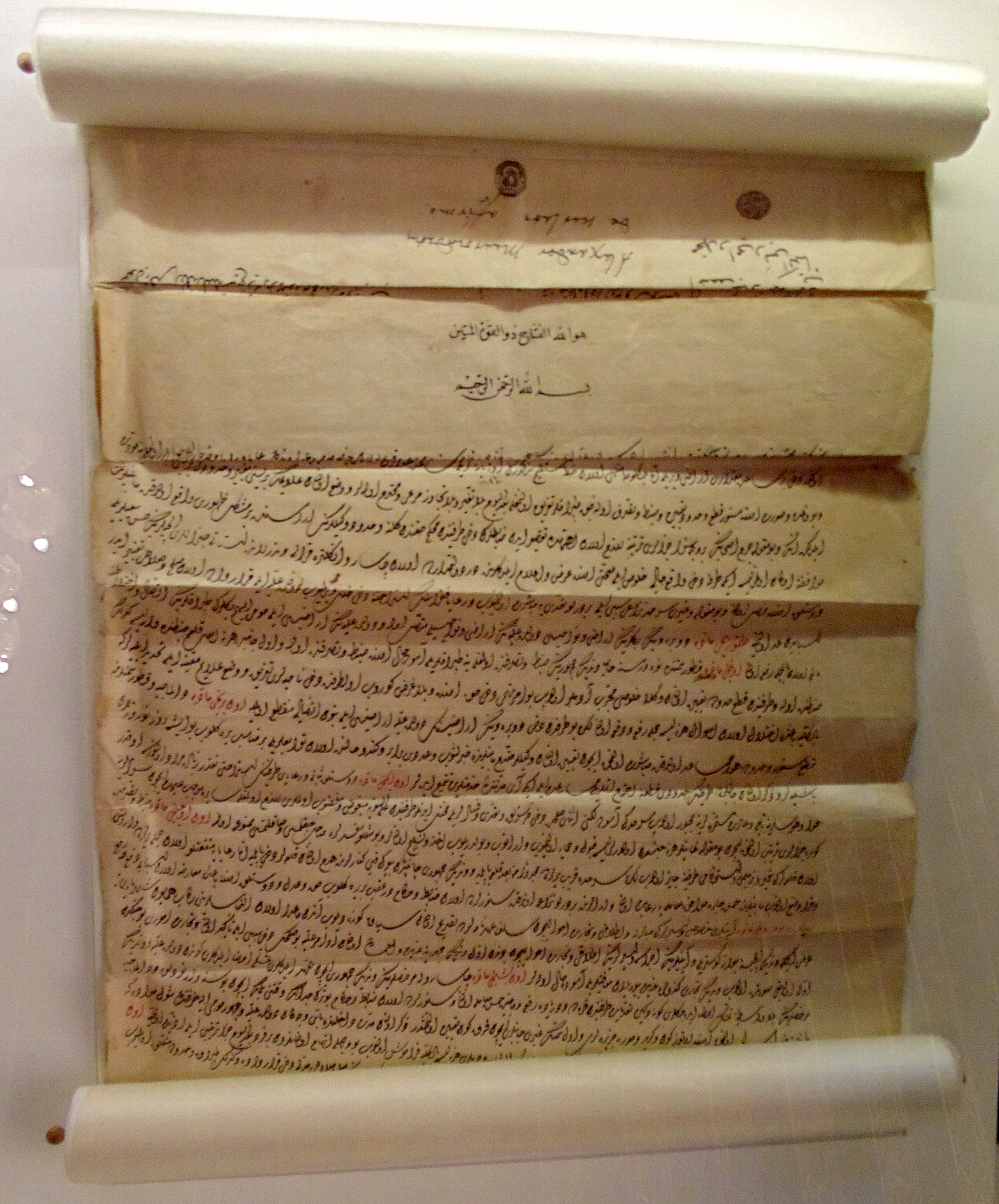
The Treaty of Karlowitz, signed on the 26th of January 1699 at the small town of Karlowitz (now Sremski Karlovci in Serbia), formally codified the new reality. It was the first treaty in Ottoman history in which the empire ceded substantial territory to Christian states. Hungary went to Austria. The Morea went to Venice. Podolia went to Poland. Azov went to Russia. The empire lost, in a single document, perhaps fifteen per cent of its European territory.

More importantly, Karlowitz changed the way the empire saw itself. Previous Ottoman peace treaties had been couched in the language of imperial grace — the Sultan generously granted such-and-such a concession to such-and-such a barbarian prince. Karlowitz was negotiated as a treaty between equals, with European protocols, in Latin, mediated by English and Dutch diplomats. The Ottoman empire had, for the first time, entered the European state system as a member rather than a transcendent suzerain. It would never leave.
The Tulip Era
The two decades after Karlowitz saw a remarkable cultural and political experiment in Istanbul, conventionally called the Tulip Era. Under the grand vizier Damat Ibrahim Pasha and Sultan Ahmed III, the court turned its attention away from war and toward leisure, garden-building, French fashion, and tulip cultivation. The first Ottoman printing press in Turkish characters was established by Ibrahim Müteferrika in 1727. The first formal Ottoman embassy to Paris reported back on French manners, libraries, and fortifications. New summer palaces were built along the Bosphorus and the Golden Horn. A taste for French rococo design penetrated the imperial court. The aristocracy spent fortunes on imported tulip bulbs from the Netherlands — sometimes in literal exchange for their daughters' dowries.
The Tulip Era ended, abruptly, in the Patrona Halil uprising of 1730. A Janissary revolt led by an Albanian bath-attendant called Patrona Halil overthrew the government, executed Damat Ibrahim Pasha, deposed Ahmed III, and put a new sultan, Mahmud I, on the throne. The new regime, more conservative, dismantled most of the Tulip Era's innovations. The printing press lasted, with interruptions; the embassies continued, more sporadically; the gardens and palaces remained. But the experiment in opening the empire to European influence stalled for fifty years.
The Russian challenge
The most consequential Ottoman antagonist after Karlowitz was not Austria but a state which, at the time of Süleyman, had been a remote Muscovite kingdom of no diplomatic importance. Russia, transformed by Peter the Great, Catherine the Great, and a hundred-and-fifty-year programme of state-building, became in the eighteenth century the principal pressure on the Ottoman northern frontier. Russia took Azov in 1696, lost it again in 1711, and finally took it permanently in 1739. It defeated the Ottomans in successive wars: 1735-39, 1768-74, 1787-92, and 1806-12. Each war ended with Ottoman territorial losses on the Black Sea.
The most consequential of these was the Treaty of Küçük Kaynarca of 1774, ending the war of 1768-74. Russia gained the northern Black Sea coast, the right of free navigation of the Black Sea and the Bosphorus, the city of Azov, the recognition of the Crimean Khanate as independent of the Ottomans (a polite fiction; Russia would annex it outright in 1783), and — most importantly — the right to "make representations" on behalf of an Orthodox church under construction in Istanbul. This last clause, ambiguous in the Russian translation and ambiguous in the Ottoman, would be cited by the Russian government for the next century as the basis of a Russian protectorate over all Orthodox Christian subjects of the sultan. It is one of the long-term causes of the Crimean War.
The empire at the end of the century
By 1789 the empire had lost almost all of its European holdings north of the Danube. It had lost Crimea. It had begun to lose effective control of its North African provinces — Algeria and Tunis had become semi-autonomous regencies; Egypt was on the verge of becoming so. The Janissaries, the great institution of the fifteenth and sixteenth centuries, had degenerated into a corrupt, hereditary, half-civilian guild whose members no longer trained, occasionally rebelled, and refused all military reform.
The empire was, by any standard of the day, militarily backwards. Its artillery was outdated. Its infantry tactics were a century behind European norms. Its navy, once the master of the Mediterranean, could not match the Russian Baltic fleet that sailed all the way around Europe to destroy it at Çeşme in 1770. Its officer corps was untrained in the engineering, mathematics, and surveying skills now required of European armies. Its fiscal system, designed for an expanding economy, was inadequate to a contracting one.
The European powers, by the 1780s, had begun to call the empire the sick man of Europe — a phrase often attributed to the Russian Tsar Nicholas I in 1853, but with antecedents in eighteenth-century diplomatic correspondence. The phrase was, like most such phrases, both true and seriously misleading. The empire had real, deep institutional problems. It also had eighty years of life left, two periods of intensive reform, a substantial industrial development in the late nineteenth century, and the capacity, when it finally fell, to do so in slow stages over fifteen years rather than in a single collapse.
What it needed, urgently, was a sultan capable of reform. It nearly got one. The next chapter takes up Selim III and what followed.
End of Chapter VI