Constantinople in 1453 was not the city it had been. At its sixth-century peak under Justinian, it had held perhaps half a million people. By the fifteenth century the population had collapsed to around fifty thousand, the city's neighbourhoods were full of empty fields and ruined churches, and the once-great suburbs across the Golden Horn had been ceded, by treaty, to the Genoese. The Byzantine Empire that the city had been the capital of had also shrunk almost beyond recognition: its remaining territory consisted of the city itself, a few outlying districts in Thrace, the Peloponnese (the so-called Despotate of the Morea), and a small Trebizond exclave on the Black Sea. The empire had, for all practical purposes, ended in 1204, when Western crusaders had sacked the city during the Fourth Crusade. What had been rebuilt afterward was a ghost of the imperial state.
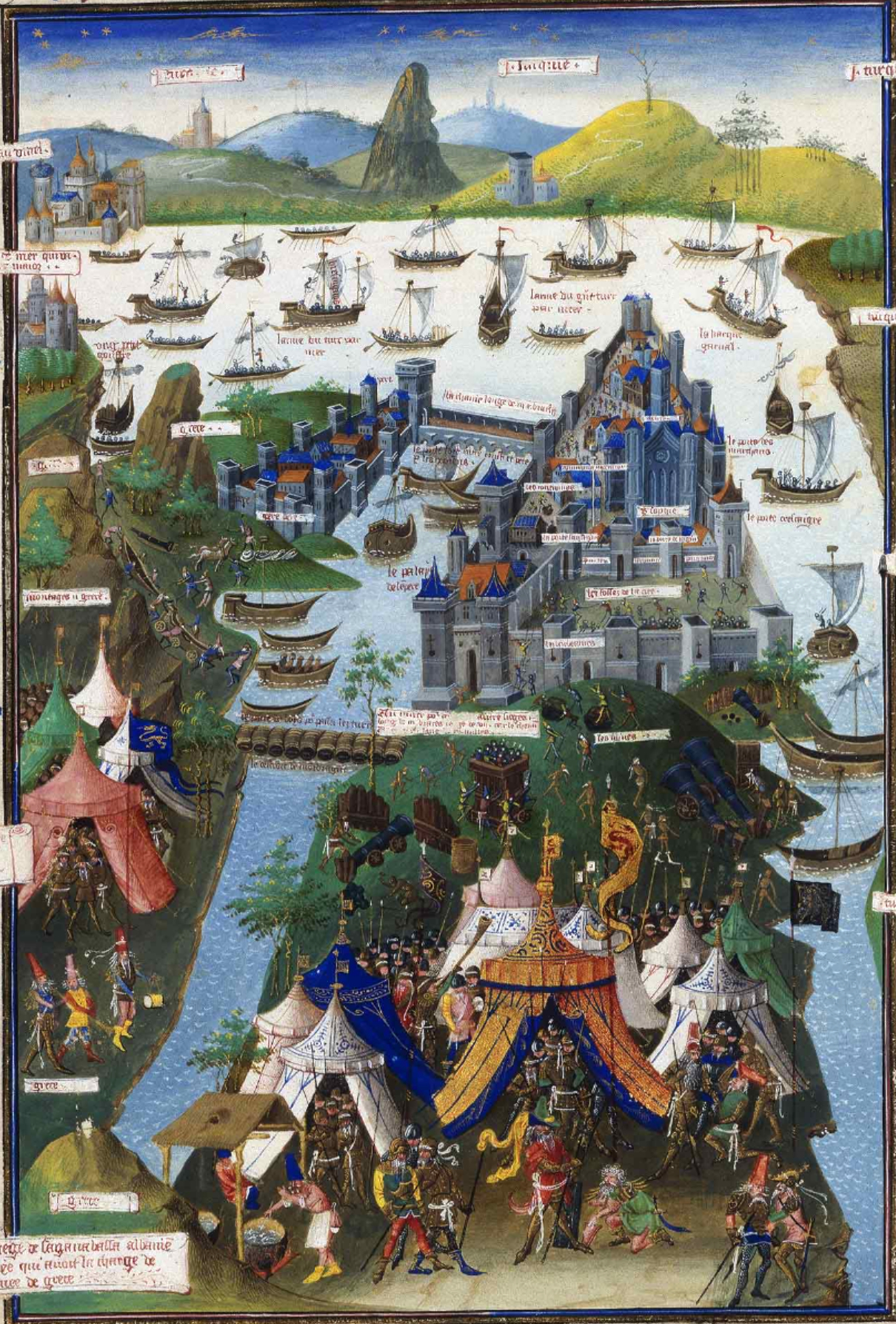
What it still had, however, were its walls. The Theodosian Walls of Constantinople, built between 408 and 413 by the prefect Anthemius, were the most formidable urban fortification in the medieval world. They had repelled at least twenty-three serious sieges over a thousand years, including two by Arab forces in the seventh century, two by Bulgarians, one by Avars and Persians together, and one by the Kievan Rus. They had never been breached by direct assault. The Ottomans themselves had besieged the city twice already — under Murad II in 1422 and earlier under Bayezid I in 1394-1402 — and had been unable to break the walls in either attempt.
Mehmed II
The sultan who would change this was nineteen when he took the throne for the second time in 1451. Mehmed II had first been made sultan, briefly, at twelve, when his father Murad II had abdicated in his favour in 1444; the experiment had ended in eight months when an emergency required Murad's return. Mehmed had spent the seven years between his abdication and his second accession reading. He read Greek and Arabic and Persian. He read the histories of Alexander the Great and Julius Caesar. He read Ottoman military manuals. He read works of theology and astronomy. He spent, by his own later account, every spare hour of his adolescence preparing to take Constantinople.
When he became sultan again in February 1451, on his father's death, the European courts assumed he would be a weak ruler — too young, too bookish, too inexperienced. The Venetian Senate sent congratulations. The Hungarian government concluded a peace treaty with him. The Byzantine emperor Constantine XI Palaiologos paid the customary diplomatic call.
Mehmed spent the next two years preparing his army. He commissioned the construction of an enormous fortress — Rumeli Hisarı, now a Bosphorus landmark — on the European side of the strait, four miles north of the city, to choke off the Byzantine grain supply from the Black Sea. He commissioned a Hungarian cannon-founder called Orban, who had previously offered his services to the Byzantines but had been unable to negotiate a wage, to build cannons larger than any made before. The largest of these, called the Basilica, was twenty-seven feet long, weighed seventeen tons, and fired stone balls weighing six hundred pounds. It required sixty oxen and four hundred men to move. Its rate of fire was, on a good day, three shots an hour.
The siege
The Ottoman army arrived before the walls of Constantinople on the 6th of April 1453. The defenders, under Constantine XI, numbered around seven thousand — three thousand Byzantines and four thousand mostly Italian volunteers. The attackers numbered between fifty thousand and eighty thousand, depending on the source. The siege lasted fifty-three days.
What the Ottomans did, methodically, was to bombard a single section of the land walls — the Mesoteichion, on the central section near the Lycus river valley — every day for seven weeks. The walls, despite repeated repairs by the defenders during the nightly truces, slowly crumbled. The defenders fought heroically. The Ottoman fleet attempted to enter the Golden Horn and was repelled. Mehmed, in a feat of military engineering still discussed today, had seventy of his ships dragged overland across the hill of Galata on greased wooden tracks, in a single night, to outflank the Byzantine harbor boom.
The final assault came at half past one on the morning of Tuesday the 29th of May 1453. The Ottomans attacked in three waves: first the irregular bashi-bazouks, who were repulsed; then the Anatolian regulars, who broke through in places but were driven back; finally the Janissaries themselves, who fought up the breach in the Mesoteichion with the morale of men who had been told this was the night. The decisive moment was a small one. A Genoese commander called Giovanni Giustiniani Longo, the most effective leader on the Byzantine side, was wounded and asked to be evacuated. His departure caused a panic among the Italian troops. The Janissaries, sensing the wavering, pressed harder. A small gate called the Kerkoporta was found unbarred (or, depending on the source, simply opened by accident); fifty Ottomans poured through; a Turkish standard was raised above the wall. Within an hour the defenders were in retreat. Constantine XI, last emperor of Byzantium, threw off his imperial purple and died fighting somewhere near the Romanos Gate. His body was never identified.

The city was given over to three days of plunder, as was the custom for cities that resisted assault. On the fourth day Mehmed entered the city. He rode straight to the Hagia Sophia, the greatest church in Christendom for nine hundred years, dismounted, and ordered it converted to a mosque. The Friday prayer was held there four days later. He then walked through the empty corridors of the Great Palace — once the residence of Justinian, of Theodora, of the Macedonian dynasty, of seventeen centuries of Roman and Byzantine emperors — and, according to a contemporary account by the chronicler Tursun Beg, recited a Persian couplet of his own composition: "The spider weaves its curtain in the Caesars' palace; an owl calls its watches in Afrasiab's towers."
"On the 29th of May 1453, the Roman Empire ended. The Roman Empire is a Greek empire and an Orthodox empire and a Christian empire, and it was a thousand and twenty-three years old." — Steven Runciman, The Fall of Constantinople, 1965
The city of the world's desire
What Mehmed did next is, almost as important as the conquest itself. He did not destroy the city. He did not, despite later legend, massacre its surviving inhabitants. He repopulated it. He invited Greek artisans, Armenian merchants, and Sephardic Jews — the Jews particularly, after the Spanish expulsion of 1492 — to settle in the city under terms more favourable than anywhere else in Europe. He confirmed the Greek Orthodox Patriarchate in office under the Patriarch Gennadios Scholarios, who would now answer to the sultan rather than to the (extinct) emperor. He established the institution of the millet system, by which Greek Orthodox, Armenian Orthodox, and Jewish communities would each govern their own internal affairs through their religious leaders, paying communal taxes to the imperial treasury.
By 1480, Constantinople — by then called Konstantiniyye in Ottoman Turkish, only colloquially Istanbul — had a population of around eighty thousand, larger than under the last Byzantines. By 1550 it would have nearly half a million, the largest city in Europe. Mehmed built the Topkapı Palace, on the promontory overlooking the Bosphorus, between 1460 and 1478; for the next four centuries it would be the residence of the Ottoman sultans. He built the Fatih Mosque on the site of the Church of the Holy Apostles, where the Byzantine emperors had been buried. He built the Eyüp Sultan Mosque outside the walls, around the supposed grave of one of the Prophet's companions, killed in the first Arab siege of the city in 674. He built bedestens, hans, hammams, fountains, libraries.
The conquest of Constantinople is, depending on the historian, the end of the Middle Ages, the founding moment of the modern world, the worst catastrophe in Christian history, the greatest Islamic military achievement of the medieval period, the beginning of the European age of exploration (because Genoese and Venetian merchants now had to find new routes), or simply the fall of a tired Byzantine state that had been dying for two centuries. All of these are true, in proportions that depend on the angle of approach. What is certain is that the empire which now possessed the city would, for the next four hundred and sixty-nine years, be a Mediterranean and a European power as much as an Asian one. The next chapter will follow it east, to Egypt and Mecca.
End of Chapter II