The Anatolian plateau in the year 1299 was a country of small Turkic principalities, called beyliks, which had emerged from the wreckage of the Seljuk Sultanate of Rum. The Seljuk state, once the most powerful Muslim polity between the Tigris and the Aegean, had been broken twice in the thirteenth century — first by the Mongols at Köse Dağ in 1243, then by the slow ebb of its own authority — and what remained, by the time our story begins, was a patchwork of perhaps twenty independent or semi-independent Turkic warlords, each ruling a few towns, a slice of pasture, and a band of mounted retainers. The Byzantine Empire faced them across a ragged frontier that ran roughly from the Sea of Marmara to the upper Euphrates. The Byzantines had not been a real military power east of the Bosphorus since the disaster at Manzikert in 1071. The frontier was a place of raids, conversions, intermarriages, and occasional small wars, conducted in a mixture of Greek, Turkish, Arabic, and Persian.
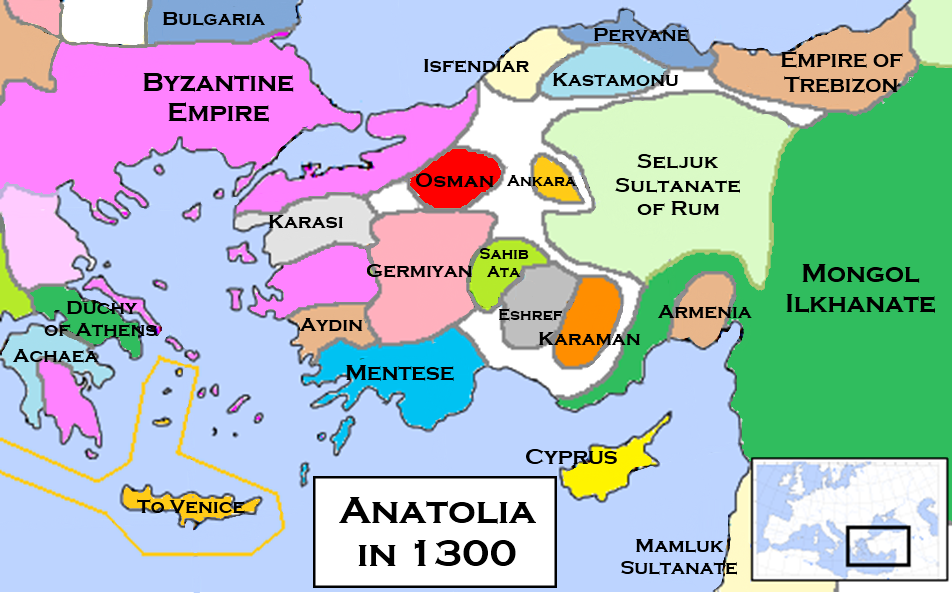
One of the smaller beyliks, on the very westernmost edge of the Anatolian plateau, was ruled by a man called Osman. He was perhaps forty years old in 1299, the son of a chieftain called Ertuğrul who had himself been the leader of a few hundred Turkic herding families who had wandered into Anatolia some decades earlier from further east. They had been given a grazing territory near a town called Söğüt, in the Bithynian uplands, by the last serious Seljuk sultan. Söğüt — the name means "willow" — was small, poor, and unimportant. From it, however, the largest Islamic empire of the early modern period would grow.
The dream of Osman
The Ottomans, looking back on themselves three centuries later, told a story about how the dynasty had been founded. Osman, the story went, had spent a night in the house of a Sufi sheikh called Edebali, in whose unmarried daughter Mal Hatun he had taken a romantic interest. While sleeping in the sheikh's house, Osman had a dream. He saw a moon rise from Edebali's chest and descend into his own. From his own chest a great tree grew, until its branches covered the whole sky. Beneath the tree four rivers flowed, and on its leaves men of every nation were inscribed.
Edebali, when Osman told him the dream the next morning, was reported to have said: "My son, the moon you saw was my daughter; the tree was your dynasty; God has given you and yours the dominion of the earth." Osman married Mal Hatun shortly afterwards. The story is almost certainly an embellished fifteenth-century literary creation — its earliest surviving version dates from around 1480, two centuries after the events it describes — but it tells you something important about the way the dynasty wanted to be understood. The Ottomans were not, in their own self-image, conquerors. They were the chosen instrument of a providential plan disclosed in a dream.
Bursa, and the move to the cities
What actually happened, as best as historians can reconstruct, was a long, patient nibbling at the edges of Byzantine Bithynia. Osman ruled for around twenty-five years and never took a major city; his territorial gains were modest, perhaps a few hundred square miles of countryside, won in slow raids against thinly-defended Byzantine outposts. He died in 1326, in his sixties, on the very day his eldest son Orhan finally captured the most significant town in the region: Bursa. The city had been under intermittent Ottoman siege for nine years. Its surrender, on the 6th of April 1326, gave the Ottomans their first capital, their first major mosque, and their first burial place. Osman's body was moved to Bursa shortly after the conquest. So would Orhan's be, in his time. Six early Ottoman sultans are buried in Bursa today, in a complex of mausolea above the modern city that few foreign tourists ever visit.
Orhan, who reigned from 1326 to 1362, was the figure who turned the beylik into something resembling a state. He minted the first Ottoman coinage — silver akçes bearing his name and a date. He created the first standing infantry units, called yaya, paid from the treasury rather than living on plunder. He established the first regular bureaucracy. He concluded the first Ottoman alliance with a foreign power, marrying the daughter of the Byzantine pretender John VI Cantacuzenus in 1346 in exchange for military assistance in the Byzantine civil war. The Ottoman troops Orhan sent to assist Cantacuzenus crossed the Dardanelles in 1352. They never went home.
Across the straits
The crossing of the Dardanelles is the single most important event in the early Ottoman story, and almost no one remembers it. The Ottomans, having been invited as auxiliaries into Byzantine territorial disputes in Europe, established a foothold on the European side at the fortress of Tzympe in 1352. Two years later, in March 1354, an earthquake destroyed the fortifications of the nearby Byzantine town of Gallipoli. The Ottoman commander on the spot, Süleyman Pasha — Orhan's eldest son — seized the ruined city before the Byzantines could rebuild it. The Byzantines, in shock, offered to ransom the town back. The Ottomans refused. From that moment, every map of the Balkans would have to be redrawn.
Within thirty years of the seizure of Gallipoli, the Ottomans had taken Adrianople (now Edirne), the second city of the European Byzantine empire, in 1361. Within sixty years they had taken Thessalonica (twice: 1387 and again in 1430). Within ninety, they had won the Battle of Kosovo against the Serbian medieval state on the 28th of June 1389, ending Serbian independence and bringing the Bulgarian kingdoms into vassalage. The Balkans, which had been Orthodox Christian territory for eight hundred years, would now be ruled — in part or in whole — by an Islamic dynasty for the next five centuries. The demographic and cultural consequences of that fact are still being worked out in 2026.
"Truly, the Turkish people have appeared on the scene; they are an active and energetic people; their leader is brave, prudent, and lucky." — Nikephoros Gregoras, Byzantine chronicler, c. 1340
The Janissaries
The other great innovation of the fourteenth century was institutional. Orhan's son Murad I, who succeeded him in 1362 and would reign until his assassination on the field at Kosovo in 1389, created the institution that would define the Ottoman military system for the next four hundred years: the Janissaries — from the Turkish yeni çeri, "new troops."
The Janissaries were a standing infantry force, paid from the treasury, drilled to professional discipline, equipped with bows (later firearms), and — crucially — recruited from outside the Muslim community. They were taken, as boys, from Christian subject populations in the Balkans through a periodic levy called the devşirme, brought to the sultan's court in Anatolia, converted to Islam, given an education in Turkish, the Quran, military arts, and a trade, and turned over the course of a decade into one of the most-feared infantry forces in Europe. They were technically slaves of the sultan, and they remained so for life — they could not legally marry, hold private property, or leave service. They were also, in compensation, the elite of the imperial military and, increasingly, of the imperial bureaucracy. By the sixteenth century, grand viziers were routinely former Janissary recruits, often from Albanian, Bosnian, or Greek backgrounds.
The system sounds, to modern ears, monstrous. It was, by the standards of fourteenth-century Europe, a strikingly efficient solution to a perennial problem of medieval states: how to maintain a professional standing army without granting the warriors enough independent power to overthrow you. The Janissaries had no tribal kin, no inherited estates, no extended families. Their only loyalty, by construction, was to the sultan who had taken them as boys. For three centuries the bargain held. When it began to break, in the late seventeenth century, the empire began to break with it.
Kosovo
The story of this chapter ends at Kosovo Polje — the Field of Blackbirds — on the 28th of June 1389. The Serbian Prince Lazar Hrebeljanović had assembled a coalition of Serbian, Bosnian, Albanian, and Hungarian contingents to halt the Ottoman advance into the central Balkans. The Ottomans, under Murad I, met them on a plain outside modern Pristina. The battle was the largest fought in the Balkans for a century. Both leaders were killed. Murad was assassinated in his command tent after the battle, by a Serbian noble called Miloš Obilić who had feigned defection. Lazar was captured wounded on the field and executed by the new sultan Bayezid I that evening. The Serbian army was destroyed. The medieval Serbian state, as a political entity, ended.
The Kosovo battle is, in Serbian national memory, the central event in the country's history — the moment a Christian medieval kingdom was lost to a Muslim empire, and the date around which six centuries of subsequent Serbian identity has been organised. It is also the moment after which the Ottomans, in two decades, would push into the heart of the Balkans and begin to threaten Hungary. The frontier beys had become an empire.
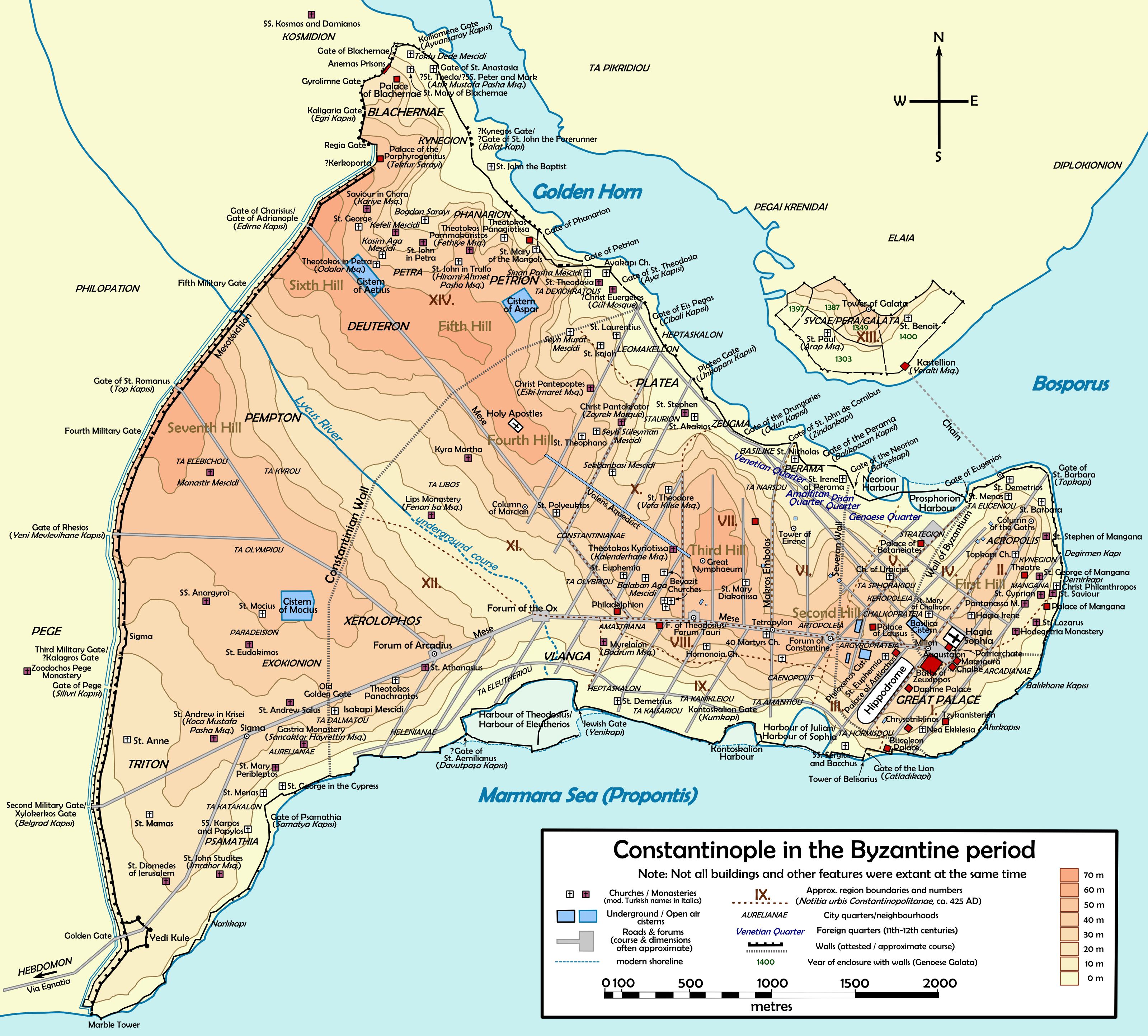
What they had not yet done was take Constantinople. That would require another sixty-four years, and a sultan whose name would echo, in different parts of the world, very differently. To him we turn next.
End of Chapter I