The German invasion of the Soviet Union — codenamed Operation Barbarossa, after Frederick I Barbarossa, the twelfth-century Hohenstaufen emperor whose corpse, according to medieval legend, would rise from a cave at the Kyffhäuser to redeem Germany in its hour of need — opened at 3.15 a.m. on the 22nd of June 1941, along a fifteen-hundred-mile front from the Baltic to the Black Sea. The invading force was approximately 3.8 million men in 153 divisions, supported by 3,500 tanks, 7,000 artillery pieces, 2,700 aircraft, and the contingents of every German Axis ally — Romanian, Finnish, Hungarian, Slovak, Italian, plus a Spanish "Blue Division" of volunteers — that could be assembled. The opposing Soviet force in the western military districts was approximately 2.9 million men, comparable in armour and air strength but operationally less prepared, organisationally damaged by the 1937-1938 officer purges, and tactically deployed forward in a way that allowed the German operational plan to bypass and encircle its concentrations in the first ten weeks of the campaign.
The campaign as Hitler conceived it was the largest, the most ideologically motivated, and the most morally appalling of the German wars of conquest. The political objectives were three: the destruction of the Soviet state as a political entity; the seizure of European Russia and Ukraine as German Lebensraum, depopulated by deliberate famine and resettled by German colonists; and the physical extermination of the European Jews, who could now be brought within German operational reach for the first time. The military doctrine — that the Soviet Union could be defeated in a single summer campaign of encirclements east of the Dnieper, allowing the Wehrmacht to occupy a line from Archangel to Astrakhan before the autumn rains — was, in retrospect, the most consequential strategic miscalculation of the regime's history. It rested on assumptions about Soviet mobilisation capacity, industrial depth, and political resilience that were wrong by an order of magnitude.
The opening months
The tactical-operational successes of the first ten weeks were spectacular. The Bialystok-Minsk pocket (closed on the 9th of July) destroyed three Soviet armies and produced 287,000 prisoners; the Smolensk pocket (closed on the 5th of August) produced 310,000; the Kiev pocket (closed on the 26th of September) produced 665,000 — the largest single encirclement in military history. By the end of September the Wehrmacht had advanced 600 miles into the Soviet Union, occupied a population of roughly 75 million Soviet citizens, taken approximately 2.5 million prisoners, destroyed an estimated 17,000 Soviet aircraft, and reached a line running from Leningrad in the north (under siege from the 8th of September) through Smolensk to Kiev to Odessa. The German press treated the campaign as essentially won; on the 3rd of October Hitler announced from the Sportpalast in Berlin that the Soviet Union had been "decisively destroyed and would never rise again".
The military reality on the ground was already different. The Soviet Union had mobilised, by the autumn of 1941, approximately 800 new divisions to replace its destroyed cadres; it had begun the wholesale evacuation of war industry east of the Urals, eventually relocating 1,500 major industrial plants and 16.5 million workers; the new T-34 tank, which began entering frontline service in numbers from the summer of 1941, was qualitatively superior to anything the Wehrmacht had deployed and would dominate the eastern battlefield through 1942 and 1943. The German operational tempo had begun to fail by mid-August: armoured units were short of fuel, tracks, and replacement men; the Russian roads, never engineered for heavy mechanised traffic, were degrading German vehicle availability rates to 30-40 per cent of nominal; the railway gauge conversion from the Russian broad gauge to European standard had fallen six weeks behind schedule. The strategic question — whether to drive on Moscow, drive on the Donbas-Caucasus oil fields in the south, or drive on Leningrad in the north — was repeatedly relitigated at the Wolfsschanze command post, with operational momentum dissipating each time.
Moscow
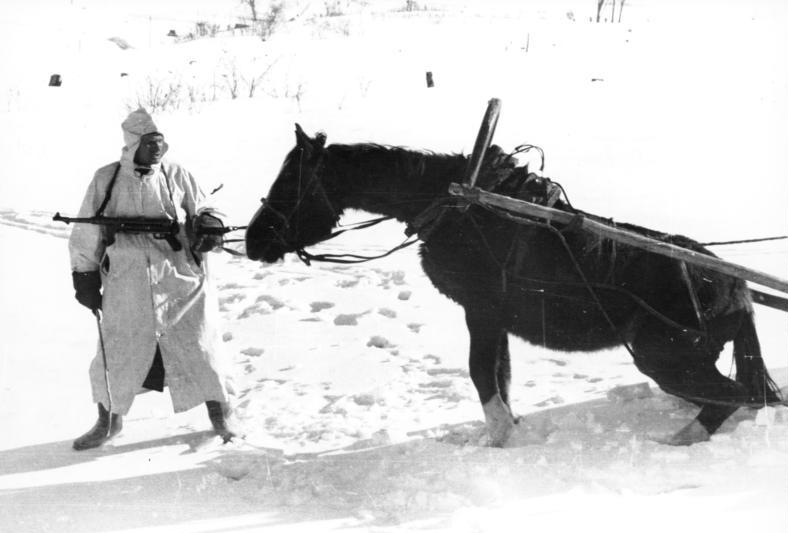
Operation Typhoon — the drive on Moscow — opened on the 30th of September. The double encirclement at Vyazma-Bryansk in early October produced approximately 670,000 further prisoners and broke open a 200-mile gap in the Soviet line covering the capital; for ten days in mid-October the road to Moscow was substantially open, and Stalin's government partially evacuated to Kuibyshev. The autumn rains then arrived. From the 10th of October through to the first hard frosts of mid-November, the western Russian roads became, in the German official history's phrase, "a sea of mud" — the famous rasputitsa. Wheeled vehicles could not move. Horse-drawn supply, on which two-thirds of the Wehrmacht's logistics still depended, slowed to fifteen kilometres a day. The November freeze hardened the roads but introduced a new problem: the German army was not equipped for winter operations. Engines would not start; rifle oil congealed in the bolt actions; men in summer uniforms froze.
The final German push for Moscow began on the 15th of November. Forward elements of the 7th Panzer Division reached the town of Khimki, 19 miles from the Kremlin, on the 2nd of December. The Soviet counteroffensive — planned by Marshal Zhukov on the basis of fresh Siberian divisions transferred from the Far East after Soviet intelligence (Richard Sorge's network in Tokyo) confirmed that Japan would not invade Soviet territory in 1941 — opened on the 5th of December along the entire Moscow front. The Wehrmacht was driven back 100-200 miles across the next four weeks, with substantial losses of vehicles, heavy equipment and frostbite casualties. Operation Barbarossa as originally conceived — a single summer campaign — had failed.

The American entry
On the 7th of December 1941, two days into Zhukov's Moscow counteroffensive, the Imperial Japanese Navy attacked the United States Pacific Fleet at Pearl Harbor in the Hawaiian Islands. The United States declared war on Japan the following day. On the 11th of December — for reasons that have been argued by historians for eighty years, and that probably amount to a combination of treaty obligations under the Tripartite Pact (legally weaker than was assumed at the time), a calculation that American intervention in Europe was inevitable and that a pre-emptive declaration preserved Axis prestige, and Hitler's personal contempt for Roosevelt — Germany declared war on the United States. The American industrial and demographic resources now mobilised against the European Axis dwarfed everything Germany could field, with the war on the eastern front already failing. The declaration is generally considered, in retrospect, the second of the regime's three principal strategic miscalculations — the first being the invasion of the Soviet Union, the third being the decision in mid-1942 to drive on Stalingrad and the Caucasus simultaneously.
The Crimea, the Caucasus, and the second summer
The Soviet winter counteroffensive ran out of momentum by March 1942, with the eastern front stabilising on a line that was substantially further east than the line of November 1941. The Wehrmacht had lost approximately 1 million men killed, wounded or captured between June 1941 and March 1942 — a casualty rate that exceeded its replacement capacity for the first time and that would never be fully recovered. The 1942 summer offensive was therefore concentrated on the southern sector — Case Blue, opening on the 28th of June — with the dual objective of capturing the Caucasus oil fields (Maikop, Grozny, Baku) and Stalingrad on the Volga, the latter to prevent Soviet reinforcement from the south. The operation was, characteristically, ambitious beyond capacity. Army Group A reached Maikop on the 9th of August and the foothills of the Caucasus by the end of August, but ran out of fuel and could neither hold the line nor take Grozny; Army Group B reached the western suburbs of Stalingrad by mid-September.
The Stalingrad campaign — the urban-warfare phase from September to November 1942 — is the subject of the next chapter. The campaign of 1941-1942 had failed to produce the strategic decision the regime had counted on. The Soviet Union had not collapsed. The American war machine was mobilising. The Mediterranean theatre, neglected for two years, was opening up with the British counteroffensive against Rommel at El Alamein (October 1942) and the Anglo-American landings in French North Africa (Operation Torch, November 1942). The strategic question, by the late autumn of 1942, was no longer whether the regime could win; it was how long it would take to lose.
End of Chapter VII