Berlin — the machinery of the state
The capital of the Reich, and the place where the apparatus of government sat. Very little of it was left standing, and what remains is mostly foundations, basements and the buildings too useful to demolish.
Berlin · Germany
The Topography of Terror

Begin here. This is the site of the Gestapo headquarters, the SS leadership and, from 1939, the Reich Security Main Office — the address from which the persecution was administered. The buildings were bombed and the ruins cleared in the 1950s; for thirty years the plot was waste ground used for dumping rubble and, briefly, as a place to drive cars over piles of sand.
What stands now is a documentation centre of deliberate plainness: a low grey box over the excavated cellars, with an outdoor exhibition running along a surviving 200-metre stretch of the Berlin Wall. The permanent exhibition is dense, text-heavy and almost entirely photographic. It does not editorialise. It does not need to.
Go before anything else in the city. Everything else in Berlin makes more sense afterwards.
Berlin-Wannsee · Germany
The house on the lake

On the 20th of January 1942, fifteen senior officials met in this villa for about ninety minutes, over brandy, to coordinate the administration of the murder of the Jews of Europe. Reinhard Heydrich chaired. Adolf Eichmann took the minutes, of which one copy survived — the thirtieth, sent to the Foreign Office, found in 1947.
The conference did not decide on the killing; that was already under way. It settled who would do what, and it produced a table listing the Jewish population of every European country including the neutrals and Britain, totalling eleven million.
The house is a comfortable suburban villa in a wealthy lakeside district, and the room is unremarkable. That is the point of coming.
Berlin · Germany
The Bendlerblock courtyard

The headquarters of the Army General Office, and the building from which Claus von Stauffenberg ran the 20th of July 1944 plot after returning from the Wolf's Lair with the news that Hitler was dead. He was wrong. By eleven that night the coup had collapsed, and Stauffenberg, Olbricht, Haeften and Mertz von Quirnheim were shot in the courtyard by the light of a lorry's headlamps.
The courtyard is open and marked with a bronze figure and a plain plaque. Upstairs, the German Resistance Memorial Centre is a serious and unglamorous exhibition covering the whole range of opposition — the July plotters, but also the Kreisau Circle, the White Rose, the communist networks, the deserters and the people who simply hid someone.
It is the corrective to the idea that nobody resisted. Roughly three million Germans passed through camps or prisons for political reasons.
Berlin · Germany
Tempelhof

Almost nothing Albert Speer designed was built. Tempelhof was, and it is the best surviving demonstration of what the regime's architecture was actually like when it stopped being drawings: a curved limestone terminal a kilometre and a quarter long, with a cantilevered canopy under which aircraft could be serviced out of the rain, and a roof grandstand intended to seat a hundred thousand people for air displays.
It was never finished. The airfield outside is now a public park — flat, enormous, full of kite-buggies and vegetable plots — and Berliners voted in a referendum in 2014 to forbid any building on it.
The terminal interior is seen only on a guided tour, and is worth booking. The scale is oppressive in a way that photographs consistently fail to convey.
Berlin · Germany
The Olympic stadium

The 1936 Games were the regime's most successful piece of foreign propaganda: anti-Jewish signage was taken down for a fortnight, the foreign press was managed, and forty-nine nations came. Leni Riefenstahl filmed it. Jesse Owens won four golds, and the story that Hitler refused to shake his hand is a simplification — Hitler stopped congratulating any athlete after the first day, on the IOC's instruction that he congratulate all or none.
The stadium was refurbished for the 2006 World Cup and is Hertha BSC's home ground, which makes it the rare site in this guide that is not a memorial. The Nazi-era sculpture around the grounds remains in place, captioned.
The bell tower gives the best view of the whole complex and of the Maifeld beyond it.
The camps — Germany
The camps inside Germany were not the extermination centres; those were in occupied Poland. These were the concentration camps proper, and each is now a memorial with a serious permanent exhibition.
Oranienburg · Germany
Sachsenhausen
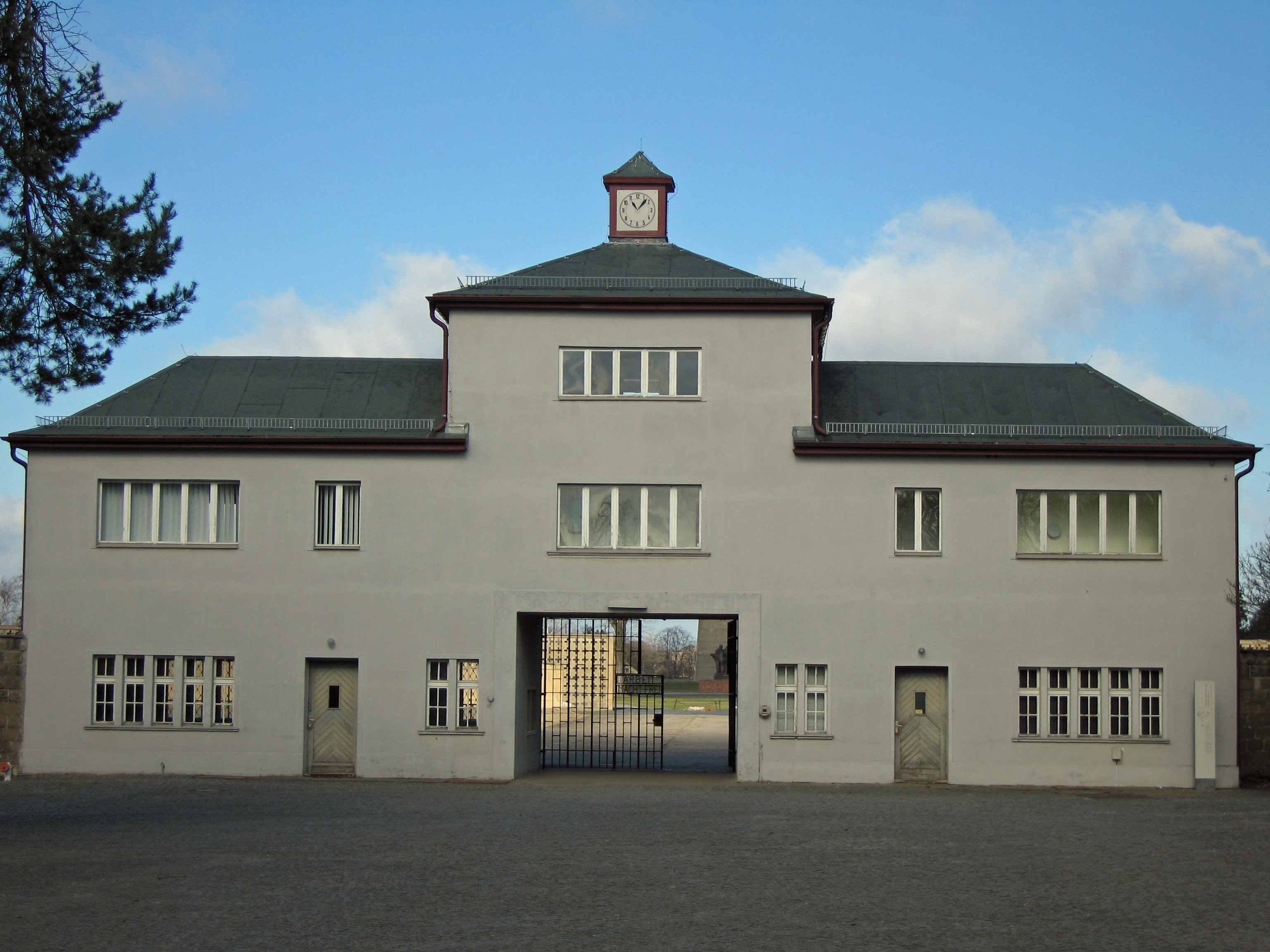
Opened in 1936 as the model camp — a triangular plan, designed by SS architects to be watched entirely from one tower — and from 1938 the site of the Inspectorate of Concentration Camps, which ran the whole network from an office just outside the wire. About 200,000 people were held here; tens of thousands died.
The Soviets then used the site as Special Camp No. 7 until 1950, where a further 12,000 died, mostly of starvation and disease. The memorial addresses both, which was politically difficult for many years and is handled straightforwardly now.
A long, cold, exposed site. Go on a clear day and allow more time than you expect.
Dachau · Germany
The first camp

Opened on the 22nd of March 1933 — fifty-one days after Hitler became chancellor, and before the Enabling Act had passed. It held political prisoners first: communists, social democrats, trade unionists. It became the training school for the camp service; Theodor Eicke devised the disciplinary regime here and then exported it to every other camp in the system.
The date is what makes Dachau essential. The camps were not a wartime development or a secret. This one was announced in the newspapers, and the town it stands beside had to live with it for twelve years.
The permanent exhibition is in the former maintenance building and is unusually good on the perpetrators.
Weimar · Germany
Buchenwald

Eight kilometres from Weimar — the town of Goethe, Schiller, Liszt, the Bauhaus and the constitution of 1919. The camp was deliberately built on the Ettersberg, the hill where Goethe had walked, and an oak associated with him was left standing inside the wire until it burned in an air raid.
The gate is inscribed Jedem das Seine — to each what he is due — set so that it reads from inside. About 56,000 of the 280,000 people held here died. The camp was liberated on the 11th of April 1945, partly by an armed prisoner uprising in the hours before American troops arrived.
The juxtaposition with Weimar is the reason to come, and it is best felt by doing both in one day, in that order.
Lohheide · Germany
Bergen-Belsen

There is nothing here. The British burned the camp to the ground with flamethrowers in May 1945 to stop a typhus epidemic, and the site is now open heath crossed by paths, with long low grassed mounds marked Hier ruhen 1000 Tote — here rest 1,000 dead — and larger ones for 2,000 and 5,000.
Belsen was not an extermination camp. It became a death camp by collapse: in the last months, transports from the east filled it far beyond capacity, the water failed, and about 50,000 people died of typhus, dysentery and starvation. Anne Frank and her sister Margot died here, probably in February 1945, weeks before liberation.
The British film of the liberation, shown in the documentation centre, is what made the camps real to the British public. It is still very hard to watch.
Nuremberg and Munich — the party's own cities
Munich was where the party was founded and kept its headquarters; Nuremberg was where it staged itself, and where it was tried. Both have documentation centres that are unflinching about their own city.
Nuremberg · Germany
The Zeppelin field

The rally grounds cover eleven square kilometres of parkland south-east of the city, and are mostly still there because they were too large and too solid to remove. The Zeppelin grandstand is Speer's, modelled on the Pergamon Altar, built for the 1934 rally and the setting for the cathedral of light — 152 searchlights pointed vertically, borrowed from the Luftwaffe's entire strategic reserve.
The colonnade was blown up in 1967 as unsafe. The rest is crumbling, and the city has settled on a policy of stabilising it without restoring it: no reconstruction, no beautification, no demolition. You can walk up onto the tribune and stand where the photographs were taken.
The unfinished Congress Hall nearby, roofless and never completed, now holds the documentation centre.
Nuremberg · Germany
Courtroom 600

The International Military Tribunal sat here from the 20th of November 1945 to the 1st of October 1946. Twenty-four men were indicted; twelve were sentenced to death, three acquitted. Göring took cyanide the night before his execution. The proceedings established, for the first time, that individuals could be tried for crimes against peace and crimes against humanity, and that following orders was not a defence.
Nuremberg was chosen partly because the Palace of Justice was one of the few large court buildings left intact, with a prison attached, and partly for the symbolism of trying the party in the city of its rallies.
The room is still a working courtroom. The exhibition upstairs is excellent on the legal argument, which is the part usually skipped.
Munich · Germany
Königsplatz

Ludwig I's neoclassical square, built in the 1820s in imitation of Athens, was paved over with 22,000 granite slabs in 1935 and used as the party's ceremonial ground. Two Ehrentempel held the sarcophagi of the sixteen men killed in the 1923 putsch; the American army blew their superstructures up in 1947, and the plinths are still there under the trees, unlabelled for decades and now discreetly explained.
The grass was restored in the 1980s after a long municipal argument about whether removing the paving amounted to erasing evidence.
Both museums on the square — the Glyptothek and the Antikensammlung — are first-rate and entirely unrelated to any of this, which is its own kind of lesson about how a city goes on.
Munich · Germany
The Documentation Centre

Munich called itself the Hauptstadt der Bewegung, the capital of the movement: the party was founded here in 1920, attempted its putsch here in 1923, and kept its headquarters here in the Brown House on Brienner Strasse until the building was bombed.
The site stood empty for seventy years while the city argued about it. The documentation centre that finally opened in 2015 is a plain white cube with no windows on the ground floor, and its exhibition is unusual in being about the city rather than the regime — how Munich made the movement possible, who profited, which streets were renamed, which neighbours denounced whom.
It is the most self-implicating museum in Germany, and the better for it.
The mountain, the wolf's lair and the sea
The regime built for itself as well as for the crowds: a mountain retreat, a field headquarters in a forest, a holiday camp for twenty thousand, and a rocket works on the Baltic.
Obersalzberg · Germany
The mountain

Hitler bought a house on the Obersalzberg in 1933 and expanded it into the Berghof; the party then bought out or evicted the neighbours and turned the mountainside into a closed compound with barracks, an SS guard, and Bormann, Göring and Speer in houses of their own. Much of the business of the regime was done up here rather than in Berlin.
The Berghof itself was bombed, burned by the SS, dynamited by the Bavarian government in 1952 and is now a patch of woodland with a single retaining wall — deliberately unmarked, to keep pilgrims away.
The Kehlsteinhaus above it, presented for Hitler's fiftieth birthday, survives intact and is a restaurant. Hitler disliked it and went rarely. The Dokumentation Obersalzberg at the foot of the hill is the serious part of the visit; the tunnels beneath it are open.
Gierłoż · Poland
The Wolf's Lair

Hitler's field headquarters for the eastern war, and where he spent more than 800 days between 1941 and 1944. It was a fenced compound of bunkers and huts in a damp Masurian forest, chosen for concealment and mosquito-ridden in summer; Jodl called it a cross between a monastery and a concentration camp.
Stauffenberg's briefcase went off in the conference hut here on the 20th of July 1944 at 12.42. The hut was a light timber building rather than a bunker, which dispersed the blast, and the briefcase had been moved behind a heavy table leg. Four men died. Hitler's trousers were shredded and his eardrums perforated.
The Germans demolished the site with explosives in January 1945 and largely failed; the bunkers are cracked open rather than destroyed. Signage is now good, and the spot where the hut stood is marked.
Binz, Rügen · Germany
Prora

Strength Through Joy — Kraft durch Freude — was the regime's leisure organisation, and by 1938 it was the largest tour operator in the world. Prora was to be its seaside resort: eight identical six-storey blocks running four and a half kilometres along the Baltic shore, 10,000 identical rooms, every one with a sea view, capacity for 20,000 workers at a time.
It was never finished. Building stopped in 1939, the shell was used for barracks and refugees, and the East German army held it until 1990. It then stood empty for twenty years while nobody could decide what to do with four and a half kilometres of listed concrete.
Most of it is now luxury flats and a youth hostel, which is a strange fate and worth seeing before the last unconverted block goes. A small museum survives in one section.
Peenemünde · Germany
The rocket works

The Army Research Centre on the northern tip of Usedom developed the A-4 rocket, better known as the V-2 — the first object to reach space, and a weapon that killed about 9,000 people in London and Antwerp.
Roughly 20,000 people died building it. V-2 production moved to the Mittelbau-Dora tunnels in the Harz after the RAF bombed Peenemünde in August 1943, and the underground factory killed more prisoners than the rocket killed civilians. Wernher von Braun, the centre's technical director, was taken to the United States under Operation Paperclip and ran the Apollo programme.
The museum, in the site's power station, is unusually honest about all of this, and about its own difficulty: it is a museum of an achievement that was also a crime.
The order castles and the east
Two attempts at an SS aristocracy, and the site in occupied Poland that the whole apparatus existed to serve.
Schleiden · Germany
Vogelsang

One of three Ordensburgen — order castles — built to train a party elite on a monastic model borrowed, with no embarrassment, from the Teutonic Knights. Candidates were selected on physical and racial grounds and taught ideology, riding and sport. The scheme was a failure: it produced few usable officials, and the war closed it in 1939.
The site was a Belgian army training ground from 1950 until 2005, which is why it survives so completely — a vast terraced complex above the Urft reservoir, with sports grounds, a colossal unfinished assembly hall and a good deal of heroic sculpture still in place.
It reopened in 2016 as a documentation centre and the visitor centre for the surrounding national park, a combination that works better than it sounds.
Büren · Germany
Wewelsburg

Himmler leased this triangular seventeenth-century castle in 1934 and spent the next decade converting it into a ceremonial centre for the SS leadership, using forced labour from a concentration camp built for the purpose at Niederhagen, where about 1,285 people died.
The north tower was to be the centre of the scheme, with a crypt and a hall floored with the sun-wheel design that has since become an internet emblem. Very little of the plan was executed and there is no evidence of the elaborate ritual the postwar occult literature describes.
The museum is very good precisely because it is sceptical: its main exhibition is about the SS as an organisation, and a separate section deals directly with the myth-making the castle has attracted since 1945.
Oświęcim · Poland
Auschwitz-Birkenau

Sixty kilometres west of Kraków, and the reason the rest of this guide exists. Auschwitz I is a former Polish army barracks, brick and orderly, holding the main exhibition. Auschwitz II-Birkenau, three kilometres away, is the extermination camp: 175 hectares, the railway spur running in under the gate, the ruins of four crematoria dynamited by the SS in November 1944 and January 1945.
About 1.1 million people were murdered here, roughly a million of them Jews, along with Poles, Roma and Soviet prisoners of war.
Book a timed entry weeks ahead; in summer, months. Go to Birkenau as well as Auschwitz I — most visitors do not, and Birkenau is where the scale is. Allow the whole day and do not plan anything for the evening.
Berlin · Germany
The Memorial to the Murdered Jews of Europe

Peter Eisenman's field of 2,711 concrete slabs occupies a city block between the Brandenburg Gate and the site of the Führerbunker. It took seventeen years of argument to build, and the argument is part of the object: whether a memorial should name the victims, whether abstraction is evasion, whether the German state should be building it at all.
The stelae carry no inscriptions and the ground beneath them rises and falls, so that walking in from the edge you are quickly over your own head with the traffic noise gone. Below it, the Information Centre does the naming — the Room of Names reads out the biographies of individual victims, and reading every one aloud would take about six years and seven months.
The Führerbunker site is two minutes away, under a car park, marked by a single information board and deliberately nothing else.
Hamburg · Germany
The burnt tower

In eight days of July and August 1943 the RAF and USAAF killed about 37,000 people in Hamburg. The raid of the 27th of July created a firestorm — a self-sustaining column of fire drawing hurricane-force winds inward at ground level, with temperatures around 800°C. People died in shelters of carbon monoxide poisoning without a mark on them.
St Nikolai was briefly the tallest building in the world in 1874. It was gutted, and the city chose to leave the tower standing rather than rebuild. The crypt beneath holds a documentation centre on the bombing war which is careful to set Hamburg in sequence after Guernica, Warsaw, Rotterdam and Coventry, and to say so.
The lift up the tower gives the view the bomb-aimers had.
Dresden · Germany
The rebuilt church

The raids of the 13th and 14th of February 1945 destroyed the old city. The Frauenkirche stood for two days and then collapsed as its sandstone pillars, heated and cooled, gave way. The rubble was left as a memorial for forty-five years, and the church was rebuilt between 1994 and 2005, with British donations. The 3,800 salvaged original stones were returned to their exact former positions, and they are the black ones in the façade.
The death toll is the point of contention. Goebbels's ministry inflated the figure to 200,000 within days; the far right has cited that number ever since. A commission of historians appointed by the city reported in 2010, after examining burial records and missing-persons files, that the true figure was up to 25,000.
Say it in Dresden and somebody will still argue.