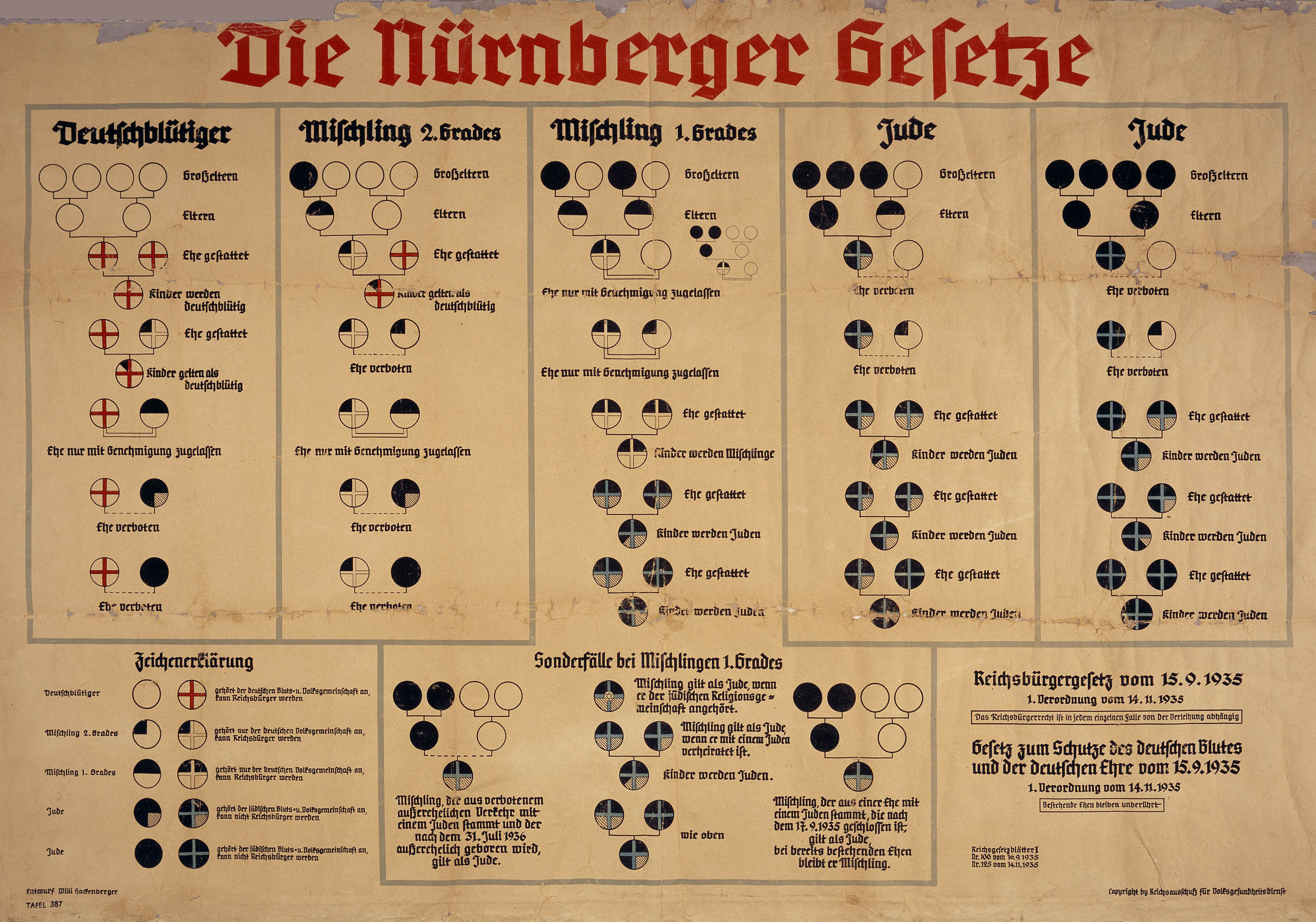
On the evening of the 15th of September 1935, on the eighth day of the seventh Nuremberg Party rally, the Reichstag was convened in a single special sitting at the Nuremberg Kulturvereinshaus to pass three laws prepared in haste by Interior Ministry lawyers under twenty-four hours of pressure from Hitler. The texts of two of them — the Reich Citizenship Law and the Law for the Protection of German Blood and German Honour — had been redrafted four times between the morning of the 14th and the afternoon of the 15th, and a fifth draft of one of them was being typed in an antechamber while the chamber was being addressed. The Reichstag passed all three unanimously. They were known thereafter as the Nuremberg Laws, after the city in which they were adopted. They were the legal foundation of everything the regime did to German Jews — and ultimately to European Jews — for the next ten years.
The legal hierarchy
The Reich Citizenship Law divided the population of Germany into two categories. Reichsbürger — Reich citizens, with full civil and political rights — were "subjects of German or kindred blood who, through their conduct, prove their willingness and ability to faithfully serve the German people and Reich". Staatsangehörige — state subjects, with reduced civil rights and no political rights — were everyone else. The law abolished, by implication, German Jewish citizenship; German Jews were now Staatsangehörige but not Reichsbürger, and lost the vote, the right to public-sector employment, and political eligibility. The Law for the Protection of German Blood and German Honour prohibited marriages and extramarital sexual relations between Jews and "Reich citizens or those of kindred blood"; prohibited Jews from employing female non-Jewish domestic servants under the age of 45; and prohibited Jews from displaying the German national flag.
Neither law defined who was a Jew. The First Supplementary Decree of the 14th of November 1935 did. The decree adopted a four-grandparent test: a person with three or four Jewish grandparents was a Jew; a person with two Jewish grandparents who either belonged to the Jewish religious community or was married to a Jew was a Jew; a person with two Jewish grandparents who did neither was a Mischling of the first degree (with various reduced disabilities); a person with one Jewish grandparent was a Mischling of the second degree. Jewishness was assigned at the level of the grandparent on the basis of the grandparent's membership of the Jewish religious community at any time after 1871. The definition was therefore religious in source but treated, after 1935, as biological-racial. The Reich Office for Genealogical Research (Reichsstelle für Sippenforschung), which had been opened in 1933 under the Interior Ministry, became the administrative court of last instance for borderline cases; by 1939 it employed about 600 staff and had a backlog of approximately 75,000 individual classifications.
Escalation, 1935–1937
Between September 1935 and the spring of 1938 the regime issued approximately 250 supplementary decrees, ordinances and ministerial directives expanding the architecture of the racial state. Some examples among many: Jewish doctors were progressively excluded from health-insurance practice (1935–1937); Jewish lawyers from the bar (1936–1938); Jewish veterinarians and pharmacists from professional registers (1936–1938); Jewish-owned businesses were progressively subject to mandatory registration (April 1938) and forced "Aryanisation" — transfer at distress prices to non-Jewish owners (June 1938 onward). Jewish passports were stamped with a red "J" from October 1938. Jewish given names were restricted: a male Jew not named from a list of approved Jewish given names was required to add "Israel" to his official identity, a female Jew to add "Sara" (August 1938). Jewish children were progressively excluded from state schools (1936 onward) and from universities (1933 onward, complete by 1938).
Through 1936 and 1937 the regime's external face was substantially milder than its internal record suggested. Berlin hosted the Olympic Games in August 1936; the regime took down the most flagrant antisemitic notices ("Jews not welcome here") in tourist quarters for the duration of the Games and re-erected them afterwards. The Olympic propaganda was famously successful; the American press was substantially neutralised by the absence of obvious public anti-Jewish violence during the event. The Foreign Office under Konstantin von Neurath continued, until February 1938, to operate a diplomatic apparatus inherited from the Weimar period that frustrated the more extreme Party ambitions for direct economic warfare against German Jews.

The Hossbach memorandum
On the 5th of November 1937, in a five-hour meeting at the Reich Chancellery, Hitler convened the war minister Blomberg, the army commander Fritsch, the navy chief Erich Raeder, the Luftwaffe chief Göring, and the foreign minister Neurath, with the Wehrmacht adjutant Friedrich Hossbach taking minutes. Hitler told the five men that he was determined on a war of conquest in central and eastern Europe within the next six years — at the latest by 1943–1945 — and that the immediate first objectives were the destruction of "Austria and Czechoslovakia". Blomberg, Fritsch and Neurath all raised serious operational and diplomatic objections: the army was not yet ready, the powers of France and Britain would intervene, the diplomatic preparation was non-existent.
The conversation was at the time treated as a private discussion. Hossbach's minutes — written up from memory five days later — became, after the war, one of the central documents of the prosecution case at Nuremberg, as evidence that the war of 1939 had been planned in advance rather than improvised under pressure. The scholarly debate over how much weight to put on the Hossbach memorandum has run for sixty years; the contemporary consensus is that the meeting was real and the intentions broadly as Hossbach recorded, but that the operational planning that produced 1939 was largely improvised on top of the broad strategic disposition expressed in November 1937.
The three sceptics — Blomberg, Fritsch and Neurath — were removed within ninety days. Blomberg was forced to resign on the 27th of January 1938 after the regime discovered (or claimed to discover) that his new wife had a police record for prostitution; Fritsch was removed on the 4th of February on a fabricated homosexuality charge prepared by Reinhard Heydrich's Sicherheitsdienst; Neurath was replaced by the more pliable Joachim von Ribbentrop on the same day. The combined reorganisation of the high command — the "Blomberg-Fritsch affair" — placed the armed forces under the new Wehrmacht High Command (OKW) under Wilhelm Keitel, who reported directly to Hitler as commander-in-chief. The last institutional brake on the regime's foreign policy had been removed.
1938: Aryanisation and Kristallnacht
The pace of expropriation accelerated through 1938. The Decree on the Registration of Jewish Property of the 26th of April required German Jews to declare assets above 5,000 Reichsmark. The Decree on the Confiscation of Jewish Property of the 12th of November 1938 imposed a "penalty tribute" of one billion Reichsmark on the German Jewish community collectively for the assassination of the German diplomat Ernst vom Rath in Paris by a seventeen-year-old Polish-Jewish refugee called Herschel Grynszpan. The same November decrees barred Jews from public schools, public transport, theatres, cinemas, parks and beaches; required Jews to deposit valuables at municipal pawnbrokers at distress prices; and barred Jews from owning or driving motor vehicles. By the end of 1938 about two-thirds of Jewish-owned German businesses had been "Aryanised" — transferred to non-Jewish ownership at twenty to forty per cent of market value.
The night of the 9th-10th of November 1938 — Kristallnacht, the "night of broken glass" — was the regime's first nationwide pogrom. The pretext was the death of vom Rath, who had been shot in Paris on the 7th of November and died on the 9th. Goebbels delivered an incendiary speech to the Party leadership at Munich's Old Town Hall on the evening of the 9th; he had cleared the operation in advance with Hitler. SA units across Germany — operating in civilian clothes as ostensibly "spontaneous demonstrators" — destroyed approximately 1,400 synagogues (267 were burnt to the ground), looted approximately 7,500 Jewish-owned businesses, killed at least 91 Jews on the night, and arrested approximately 30,000 Jewish men for transportation to Buchenwald, Dachau and Sachsenhausen. Most of those arrested were released within weeks on condition of emigration. The international press coverage was the worst the regime had received since 1933; the Aryanisation of Jewish-owned businesses accelerated to completion within six months.
By the end of 1938, German Jewish emigration — which had stood at about 38,000 in 1933, fallen in the mid-1930s as escape became harder, and surged again in 1938 — had passed 150,000 since the Machtergreifung. Approximately 285,000 of the 500,000 German Jews of 1933 emigrated before the borders were closed in October 1941; of those who remained, the great majority would be deported and killed in the camps. The Nuremberg Laws had set the framework. The four years that followed had made the framework increasingly impossible to survive in. But the genocide proper would not come until 1941, and is the subject of Chapter VIII.
End of Chapter IV