The conventional historical period of the German military hegemony in Europe is the twenty-one months between the invasion of Poland on the 1st of September 1939 and the invasion of the Soviet Union on the 22nd of June 1941. In that period the Wehrmacht defeated Poland in five weeks, Denmark in a day, Norway in two months, the Netherlands in five days, Belgium in eighteen, Luxembourg in eight hours, France in six weeks, Yugoslavia in eleven days, Greece in three weeks, and inflicted on the British Expeditionary Force the largest forced evacuation in European military history. The strategic position of the regime at the end of June 1941 — when the eastern campaign opened — was that no continental power between the Atlantic and the Bug river was at war with Germany except Britain on its island. This was the apogee. From October 1941 onward, the strategic position would deteriorate, slowly at first and then catastrophically, for the next forty-three months.
Poland
The Polish campaign of September 1939 was, by any military standard, the most accomplished operational achievement of the German army's interwar reconstruction. The Wehrmacht deployed 1.5 million men against a Polish army of about 950,000 mobilised men; the German numerical superiority was modest. The qualitative superiority — in tanks, aircraft, motor transport, signals, and the integrated combined-arms operational doctrine known to a later generation as Blitzkrieg — was decisive. Within six days the Polish strategic reserve had been broken; within fifteen days the Polish government had evacuated to Romania; the Soviet Union, in accordance with the secret protocol of the 23rd of August pact, invaded eastern Poland on the 17th of September; the last organised Polish resistance ended on the 6th of October.
The conduct of the campaign was not solely military. The Einsatzgruppen — task forces of SS, SD, Gestapo and Order Police personnel under Heydrich's command — followed the army into Poland and conducted a planned campaign of mass shootings against Polish political and intellectual elites, Catholic clergy, and Jews. The most prominent target was the Polish gentry, the urban professionals, and the officer corps in reserve; approximately 60,000 Polish civilians were killed by the Einsatzgruppen between September and December 1939. In the Bydgoszcz–Toruń region, in Pomerania and in the Warthegau, the killings extended to entire categories of professional, civic, and religious leadership. The "intelligenz-aktion" was the prototype of the larger killings against Soviet Jews two years later.
The "phoney war"
The autumn of 1939 and the winter of 1939-40 are the period the British called the "phoney war" and the French la drôle de guerre. The Western allies, having declared war on the 3rd of September, made no significant attempt to relieve Polish pressure by an offensive in the Rhineland, where the under-defended Westwall faced the French Maginot Line. The British Expeditionary Force deployed to northern France through September and October but the front was static. The strategic reason for the inaction was prudent: the French command, under General Maurice Gamelin, calculated that a defensive posture would deny Germany its operational advantage in mobility, that allied production and the British naval blockade would in time accumulate strategic superiority, and that a defensive war of attrition on French and Belgian soil — the formula of 1914-1918 — was both winnable and avoidable in the strict French interest. The calculation was wrong because the assumed terms of operational engagement were wrong; the Wehrmacht in May 1940 would impose a campaign on a tempo and at a depth that the French command had not contemplated and could not adapt to in real time. But none of this was apparent in October 1939.
The interval was used by Germany to plan the western offensive. The original plan, drafted under General Halder's direction in October 1939, was a conservative reprise of the 1914 Schlieffen plan — sweeping through the Low Countries, advancing on Paris from the north-east. A series of accidents and revisions over the winter — including the capture of a courier-aircraft carrying the original plan in Mechelen in January 1940 — produced a radically revised plan associated with General Erich von Manstein's name. The Manstein plan called for the main armoured thrust to come through the Ardennes forest, bypass the Maginot Line to the north, cross the Meuse at Sedan, and race for the Channel coast, cutting off the Anglo-French armies that would by then have advanced into Belgium to meet the diversionary northern thrust. The plan was high-risk: a successful French interdiction of the Ardennes axis would have produced a German operational disaster. It was approved in March 1940. It succeeded beyond its planners' expectations.
Norway and Denmark
Before the western offensive, two preliminary operations: Denmark and Norway. The strategic motive was the Swedish iron-ore traffic, which ran through the northern Norwegian port of Narvik in winter and which the British navy could (and in late 1939 began to) interdict. On the 9th of April 1940 the Wehrmacht crossed the Danish border at dawn and reached the Jutland tip by evening; the Danish government surrendered the same day after token resistance, recognising the futility of fighting alone against a power twenty times its size. Norway was a more substantial campaign; German naval and airborne forces seized Oslo, Bergen, Trondheim, Narvik and Stavanger on the same morning, in a coordinated operation, against British and Norwegian opposition. The Royal Navy inflicted heavy losses on the Kriegsmarine at the Narvik naval battles (April 10 and 13); a British and French expeditionary force landed at Narvik and recaptured the port on the 28th of May. The withdrawal of the British, French and Polish expeditionary force on the 8th of June — necessitated by the catastrophe unfolding in France — surrendered Norway. The Norwegian campaign cost Germany half its destroyer fleet and three of its eight cruisers, severely complicating the projected invasion of Britain later that summer.
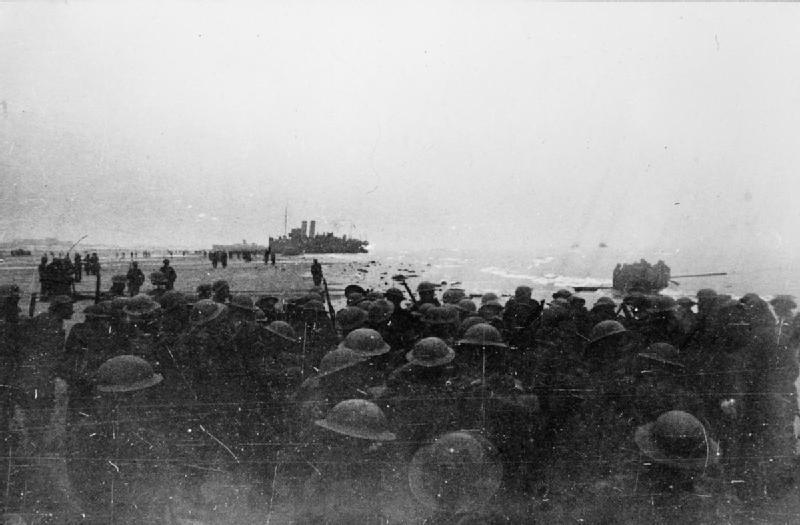

France
The western offensive opened at dawn on the 10th of May 1940. German forces crossed into the Netherlands, Belgium and Luxembourg simultaneously; airborne troops seized the Belgian fortress of Eben-Emael in a coup-de-main; the diversionary Army Group B advanced into the Low Countries to draw the Anglo-French northern wing forward into Belgium, exactly as the French command had been planning since 1939. Meanwhile Army Group A — seven armoured divisions under Guderian, Reinhardt and Hoth — drove through the Ardennes, reached the Meuse on the 12th, forced crossings at Sedan, Monthermé and Dinant on the 13th and 14th, and broke into open country on the 15th. The race to the Channel began. By the 20th of May, Guderian's tanks had reached the Atlantic coast at Abbeville, cutting off the British Expeditionary Force and the French First Army in a pocket that compressed across the next ten days against Dunkirk.
The evacuation of Dunkirk between the 26th of May and the 4th of June rescued approximately 338,000 men, two-thirds British and one-third French. The Royal Navy, the merchant marine, and an improvised flotilla of small craft — Operation Dynamo — was assisted by Hitler's two-day halt-order to the German armour outside Dunkirk on the 24th of May, a decision attributed variously to Göring's preference for the Luftwaffe finishing the operation, to operational concerns about armoured casualties before the second phase of the French campaign, and to political calculations about a possible negotiated peace with Britain. The motivation has been argued for eighty years; the consequence is that the British army survived as a fighting force.
The second phase of the French campaign — Fall Rot, "Case Red" — opened on the 5th of June. The French had reorganised on the Somme-Aisne line under General Maxime Weygand, but with only sixty divisions against the German hundred and forty, and without the British Expeditionary Force, the line was thinly held. The Germans broke through on the Somme on the 6th, the Aisne on the 9th. The French government evacuated Paris on the 10th; Reynaud's cabinet resigned on the 16th; Marshal Pétain, the eighty-four-year-old hero of Verdun, formed a new cabinet at Bordeaux and sued for an armistice the same evening. The armistice was signed at Compiègne on the 22nd of June, in the same railway carriage in which the Germans had signed in 1918 — the carriage retrieved from a museum on Hitler's orders. The terms of the armistice partitioned France: a northern occupied zone administered by the Wehrmacht, a southern unoccupied zone with its capital at Vichy under Pétain. The whole campaign had lasted six weeks.
Britain alone
The Battle of Britain ran from July to October 1940. The Luftwaffe, with about 2,500 operational aircraft, was tasked with destroying RAF Fighter Command as a prerequisite to a cross-channel invasion (Operation Sea Lion). The RAF, with about 700 fighters in service at the start of the battle and about 850 by its peak, fought from a chain of well-organised radar-controlled sector airfields covering southern England. The Luftwaffe shifted target sets repeatedly — first the Channel ports, then RAF airfields, then aircraft factories, and from the 7th of September onward, in retaliation for the Berlin raids of the 25-26th of August, to the city of London. The shift away from RAF infrastructure to civilian targets cost the Luftwaffe the air superiority it was on the brink of winning. By mid-October, German aircraft losses (1,887 destroyed) had outrun production; British losses (1,547 destroyed) were within production capacity; Operation Sea Lion was indefinitely postponed on the 17th of September and was never reactivated. Britain, alone in Europe, remained at war.
Through the winter of 1940-41 the Luftwaffe's strategic bombing of British cities — the Blitz — continued; the German army occupied the Balkans (Yugoslavia and Greece, April-May 1941), invaded Crete by air (May 1941), and built up forces along the Bug river facing the Soviet frontier. On the night of the 21st-22nd of June 1941 the eastern offensive began. The western theatre, for the next three years, would be a secondary front. Britain was not defeated. But Britain alone could not invade. The strategic question of the next four years would be whether the United States and the Soviet Union, each in its own way, would convert into an Allied force capable of doing so.
End of Chapter VI