Between the 12th of March 1938 and the 15th of March 1939 — roughly twelve months — Nazi Germany acquired Austria, the Sudetenland, the remainder of Bohemia and Moravia, and the Memel territory, expanding its area by approximately 30 per cent and its population by approximately 17 million, without fighting a war. Three of the four acquisitions were essentially ratified by the Western Powers at the Munich Conference of the 29th of September 1938. The fourth — the seizure of the rump Czech state in March 1939 — was unratified, but the British and French response was diplomatic protest, not military action. The lesson the regime drew from this period, with sufficient evidence, was that the Western Powers would not fight to prevent a fait accompli. That lesson was wrong by twelve months and one country: in September 1939 the British and French would fight to prevent the conquest of Poland. The miscalculation that produced the Second World War was made on the basis of three peaceful conquests in fifteen months.
The Austrian Anschluss
The annexation of Austria was the easiest of the three. Austria had been forbidden by Article 88 of the Treaty of Saint-Germain (1919) from political union with Germany, but the same treaty had stripped it of two-thirds of the former Habsburg territory and reduced it to a small, poor, German-speaking rump of 6.5 million people, of whom a substantial majority had favoured union with Germany at the time of the treaty. The Austrian Chancellor, Kurt von Schuschnigg, had inherited from his murdered predecessor Engelbert Dollfuss (assassinated by Austrian Nazis in 1934) a fascist-but-not-Nazi corporate state — clerical, conservative, and increasingly isolated as Italian protection from Mussolini eroded after the Italian-German rapprochement of 1936–1937.
On the 12th of February 1938, in a meeting at the Berghof, Hitler bullied Schuschnigg into appointing the Austrian Nazi Arthur Seyss-Inquart as interior minister with police authority. Schuschnigg responded on the 9th of March by calling a snap plebiscite for the 13th of March on Austrian independence — a vote he would probably have won. On the 11th of March Hitler, fearing the loss of the plebiscite, demanded its cancellation, demanded Schuschnigg's resignation, and threatened invasion. Schuschnigg, finding that France, Britain and Italy would not intervene to defend Austrian independence, resigned. Seyss-Inquart was sworn in as chancellor on the night of the 11th-12th. On the morning of the 12th of March 1938 the Wehrmacht crossed the border. Hitler entered Linz, then Vienna, in motorcade processions through cheering crowds. The Anschluss — annexation — was retroactively legalised on the 13th of March by a law abolishing Austrian independence; a plebiscite on the 10th of April produced 99.7 per cent approval, against the background of mass arrests of Austrian socialists, Catholics, monarchists, and Jews in the preceding three weeks. About 75,000 Austrian opponents of the regime were arrested in March and April 1938 and either deported to Dachau or held in Austrian prisons. Austrian Jews were subjected to the same Aryanisation regime as German Jews, applied with greater violence and greater speed. The Anschluss was the model the regime would attempt to replicate for the next three crises.
The Sudeten crisis
The May Crisis of 1938 — caused by a Czech partial mobilisation in response to (fabricated) reports of German troop movements — taught Hitler that the British and French were not going to be passive; the British Foreign Secretary Lord Halifax issued a sharp warning. The summer was therefore spent on the diplomatic preparation of the Sudeten case. The Sudeten Germans — 3.5 million ethnic Germans living along the Bohemian-Moravian-Silesian fringes of Czechoslovakia, where the medieval German-speaking settlement had survived through the Habsburg period — had a credible grievance against the Prague government, which had been less generous to minority languages than Vienna had been. The Sudeten German Party under Konrad Henlein, secretly subsidised by Berlin from 1933, claimed to speak for them.
Through July, August and September 1938 the regime escalated. Henlein produced increasingly maximalist demands that the Czech government, under the pressure of the British envoy Lord Runciman's mediation mission, repeatedly accepted; Henlein then escalated again. On the 12th of September, at the Nuremberg rally, Hitler delivered a speech threatening war if the Sudeten demands were not met. SDP activists across the Sudetenland staged a coordinated uprising on the 13th, which the Czech police suppressed. War seemed imminent. The British Prime Minister, Neville Chamberlain, flew to Berchtesgaden on the 15th of September — the first international flight of any British prime minister — and accepted, in principle, the transfer of the Sudeten German districts to Germany. He flew home, secured French and Czech reluctant agreement, and returned to Bad Godesberg on the 22nd of September to formalise the transfer. Hitler, recalculating that he could now demand more, refused. The Wehrmacht was to occupy the Sudeten districts on the 1st of October at the latest. The Czech government would not accept this; the French announced general mobilisation on the 24th; the British Royal Navy was placed on alert.
The Munich Conference of the 29th of September was Mussolini's last act of independent diplomatic mediation. The Italian dictator, alarmed at the prospect of being dragged into a European war for which Italy was not ready, drafted a face-saving compromise (originally written in Berlin by Göring and Neurath) under which Germany received the Sudeten districts but on the British and French timetable rather than the German one, with international guarantees of the rump Czech state. Chamberlain, Daladier, Hitler and Mussolini signed; the Czech delegation, present in Munich but not admitted to the conference, was instructed to accept. The Czech government's options were limited; it accepted on the 30th. The Wehrmacht occupied the Sudetenland between the 1st and 10th of October 1938. Chamberlain returned to London with a separate paper from Hitler, signed at the morning meeting on the 30th, declaring British-German friendship; the paper was waved at Heston aerodrome and quoted in the famous "peace for our time" speech at Downing Street the same evening.

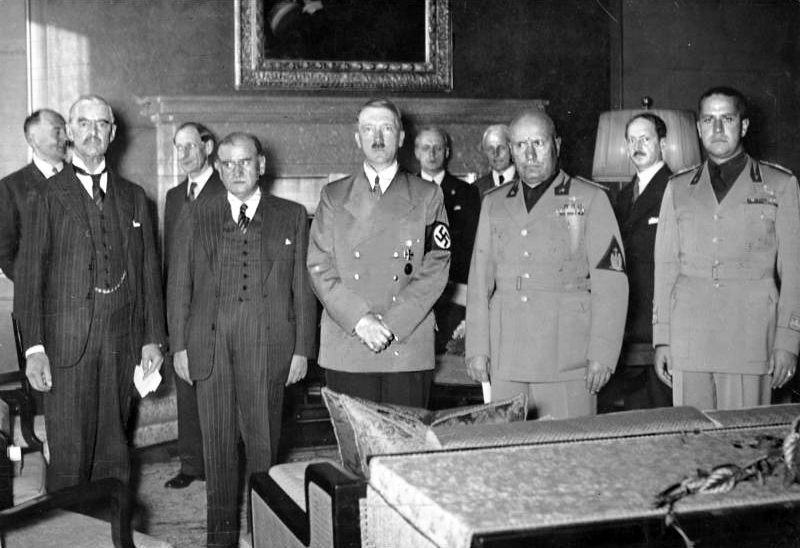
The Prague seizure
The Munich agreement had guaranteed the rump Czech state — about 60 per cent of its previous area, with Slovakia and Carpathian Ruthenia retaining federal autonomy. The guarantee was useless. Through the winter of 1938–39 the regime sponsored the Slovak nationalist Jozef Tiso's agitation for independence; Hitler summoned Tiso to Berlin on the 13th of March 1939 and instructed him to declare Slovak independence the next day, which Tiso did. The Czech president Emil Hácha, faced with the disintegration of his federation, requested a meeting with Hitler in Berlin. He arrived on the night of the 14th-15th of March. In a five-hour meeting between approximately 1 and 5 a.m. at the Reich Chancellery, Hitler, Göring and Ribbentrop bullied Hácha, who suffered a heart attack during the meeting and was revived by Hitler's physician Theodor Morell, into signing a document accepting a German "protectorate" over Bohemia and Moravia. At 6 a.m. on the 15th of March, the Wehrmacht crossed the Czech frontier and reached Prague by the afternoon, in a snowstorm. Hitler arrived at Prague Castle in the evening and slept there. The rump Czech state, the largest functional democracy in central Europe twelve months earlier, ceased to exist.
The Prague seizure was the first acquisition the regime made that could not be justified on ethnic-German grounds. The Czechs were not Germans. The British and French had been deceived; Chamberlain's reputation for diplomatic competence, already shaky, never recovered. On the 31st of March 1939 the British government issued a guarantee to Poland — guaranteeing Polish independence against German aggression — which was extended on the 6th of April to Greece and Romania. The guarantee was the diplomatic frame that converted any subsequent German move against Poland into a casus belli for Britain. Hitler did not believe the guarantee. He calculated, on the basis of three peaceful conquests in fifteen months, that the British would not honour it. He was wrong.
The Pact of Steel and the Nazi-Soviet Pact
Through April, May and June 1939 the regime concluded two principal diplomatic preparations for the Polish campaign. The first was the Pact of Steel with Italy, signed on the 22nd of May 1939 — a full military alliance committing each side to enter any war the other began, which Mussolini agreed to on the strength of a private German assurance that no war would come for three to four years. The assurance was false. The second was the Nazi-Soviet Non-Aggression Pact, signed by Ribbentrop and Molotov in Moscow on the 23rd of August 1939 after four months of secret negotiations. The pact's published text was a non-aggression treaty; the secret protocol divided eastern Europe into German and Soviet spheres of influence, allocating eastern Poland, the Baltic states, Bessarabia and Finland to the Soviet sphere, and western Poland to the German sphere. The pact eliminated the diplomatic possibility of a two-front war the regime had feared since 1914, made the Polish campaign militarily feasible, and produced — eight days later — the invasion of Poland and the outbreak of the Second World War.
The Wehrmacht crossed the Polish frontier at 4.45 a.m. on the 1st of September 1939. Britain and France declared war at 11 a.m. and 5 p.m. respectively on the 3rd. The regime that had spent fifteen months acquiring its central-European objectives by intimidation was now committed, against its own short-term calculation, to fighting for them. The war is the subject of Chapter VI.
End of Chapter V