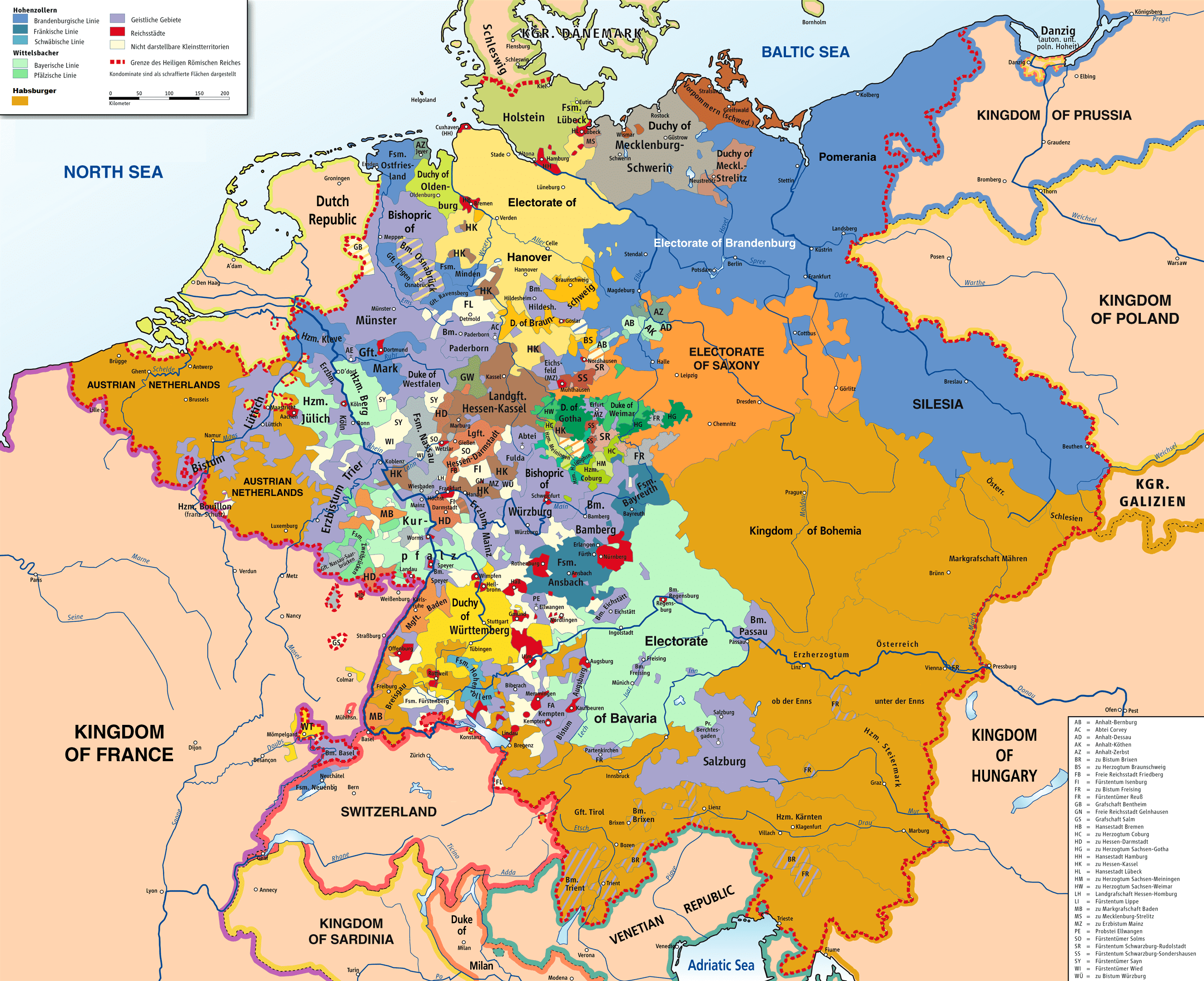
The thirteen years between the imperial declaration of war on revolutionary France in April 1792 and the Peace of Pressburg of December 1805 were the period in which the Holy Roman Empire ceased, in substance, to function. The institutional structure was still nominally in place at Pressburg; eight months after Pressburg, on the 6th of August 1806, it would be formally dissolved. But the dissolution was a constitutional acknowledgement of a military and political reality that had been definitive since at least 1801, and visible since 1797. The decade of the Revolutionary Wars produced the destruction of the imperial defensive system, the loss of the entire left bank of the Rhine to France, the secularisation of the ecclesiastical principalities, the mediatisation of the imperial knights and the imperial cities, and the constitutional reorganisation of the surviving German territories into a Napoleonic protectorate (the Confederation of the Rhine). The empire that emerged was unrecognisable.
The opening campaigns
The empire's military response to revolutionary France in 1792 was conventional — an Austrian-Prussian-emigré force of approximately 80,000 under the Duke of Brunswick, advancing into the Champagne with the objective of restoring the French monarchy. The campaign culminated at the Battle of Valmy on the 20th of September 1792, in which Brunswick's army, having sustained an indecisive artillery exchange with the French revolutionary forces under Dumouriez and Kellermann, withdrew rather than press a doubtful infantry attack. Valmy was, militarily, a minor engagement; politically, it preserved the revolutionary regime through its first decisive autumn and demonstrated that the volunteer-and-conscript French army was capable of standing against the established European powers. The French monarchy was abolished the next day; Louis XVI was executed the following January.
The First Coalition War (1792–1797) saw initial Austrian-Prussian successes in 1793, French recovery in 1794 under the Committee of Public Safety's organisation of the levée en masse, and the French conquest of the Low Countries by 1795. Prussia withdrew from the war in April 1795 (the Treaty of Basel), making a separate peace and conceding French sovereignty over the left bank of the Rhine in exchange for compensation in eastern Germany; the smaller German states followed Prussia's example through 1795–96; Austria continued the war alone until 1797, when Napoleon Bonaparte's brilliant Italian campaign of 1796–97 (the battles of Lodi, Rivoli, the encirclement of Mantua) broke the Austrian position in northern Italy and forced the Habsburg monarchy to negotiate. The Treaty of Campo Formio of October 1797 conceded the Austrian Netherlands, the left bank of the Rhine, and Habsburg withdrawal from Lombardy in exchange for Habsburg territorial compensation at the expense of the Venetian Republic (which Napoleon had unilaterally abolished). The empire's western frontier had been pushed back from the Rhine to the Rhine's right bank; the imperial estates of the left bank had been incorporated into France.
The Rastatt Congress and the Reichsdeputationshauptschluss
The institutional implication of Campo Formio was that the imperial estates of the left bank — substantially Catholic, including the great prince-archbishoprics of Mainz, Trier and Cologne, multiple imperial cities, and a large number of imperial counties and knightly territories — were now French. The dispossessed imperial princes were owed compensation, by imperial-constitutional principle, from the remaining imperial territory. The Rastatt Congress of 1797–99 was the diplomatic conference at which the compensation was to be negotiated; it broke up in April 1799 in chaos when the French envoys were murdered by Austrian hussars during their withdrawal. The Second Coalition War (1799–1802) intervened; it produced French victories at Marengo (June 1800) and Hohenlinden (December 1800), and the Treaty of Lunéville of February 1801 which substantially confirmed the Campo Formio territorial settlement and authorised the empire to pursue the compensation question internally.

The compensation programme was administered by an Imperial Deputation appointed by the imperial diet in 1802. Its decisions, formalised in the Reichsdeputationshauptschluss of February 1803 — the most substantial single piece of imperial legislation in the empire's history — secularised every ecclesiastical principality in the empire except the Archbishopric of Mainz (transferred from Mainz proper to Regensburg, where the diet sat), mediatised forty-five imperial cities (reducing them from imperial-immediate status to subordinate territories within the larger states), and distributed the captured territory among the surviving principalities — predominantly Prussia, Bavaria, Württemberg, and Baden. The cumulative effect was the elimination of the institutional categories of "imperial city" and "ecclesiastical principality" from German constitutional space, the consolidation of the surviving states into substantially larger units, and the destruction of the empire's traditional constitutional balance. The number of imperial estates was reduced from approximately 300 to fewer than 40. The empire as a federation of small estates ceased, after a thousand years, to exist.
Austerlitz
The Third Coalition War of 1805 — Austria, Russia, Britain and Sweden against Napoleon's France and the Confederation of the Rhine — was the empire's final military test. Napoleon's Grande Armée crossed the Rhine in September 1805, encircled the Austrian army of General Mack at Ulm on the 20th of October (Mack surrendered with 60,000 men), and marched on Vienna, which Napoleon occupied on the 13th of November. The combined Austrian-Russian army under the personal command of Tsar Alexander I and Emperor Francis II concentrated in Moravia. The Battle of Austerlitz on the 2nd of December 1805 — the "Battle of the Three Emperors", the most tactically perfect of Napoleon's victories — destroyed the Habsburg-Russian army in nine hours; Francis II accepted Napoleon's terms personally on the field of battle two days later. The Peace of Pressburg of the 26th of December 1805 transferred Venetia to the Italian kingdom (a Napoleonic creation), confirmed French sovereignty over the left bank, transferred the Tyrol and Vorarlberg to Bavaria, and authorised Bavaria, Württemberg and Saxony to declare themselves kingdoms — formally elevating them above the imperial structure.
Pressburg was the diplomatic preliminary to the empire's formal dissolution. The Confederation of the Rhine — the Napoleonic protectorate of sixteen German princes, founded by treaty on the 12th of July 1806 with Napoleon as Protector — withdrew its members from imperial allegiance. Francis II, faced with the imminent prospect of Napoleon's claiming the imperial title for himself (he had already crowned himself Emperor of the French in December 1804), preempted the move by abdicating the imperial title on the 6th of August 1806 and dissolving the empire. The act is the subject of the next, very short, chapter.
End of Chapter VIII