The coronation places
An elected monarchy needs somewhere to elect and somewhere to crown. For eight centuries that meant Aachen, then Frankfurt, with the regalia kept at Nuremberg and finally at Vienna.
Aachen · Germany
Charlemagne's chapel

Begin here. Charlemagne built the octagonal Palatine Chapel around 800 as the centre of a palace complex, importing columns from Ravenna and Rome to make the point that this was a continuation rather than an imitation. He was buried in it in 814.
Thirty-one German kings were crowned here between Otto I in 936 and Ferdinand I in 1531. Upstairs in the western gallery is the throne — six plain marble slabs, said to have come from the Church of the Holy Sepulchre, worn smooth and set on a stepped base so that a new king climbed to it as Solomon climbed to his.
It is a small room and an unglamorous object, and it is the physical origin of the office. UNESCO's very first German world heritage site, in 1978.
Frankfurt am Main · Germany
The election city

The Golden Bull of 1356 fixed the election at Frankfurt, the coronation at Aachen and the first diet at Nuremberg, and named the seven electors who would do the choosing: the archbishops of Mainz, Cologne and Trier, the King of Bohemia, the Count Palatine, the Duke of Saxony and the Margrave of Brandenburg.
The Römer, a range of gabled houses bought by the city in 1405, was the town hall and the site of the coronation banquet. Its Kaisersaal holds nineteenth-century portraits of all fifty-two emperors from Charlemagne to Francis II, which is the neatest summary of the Empire available anywhere.
The square was destroyed in March 1944 and rebuilt from photographs, a fact the city does not hide.
Frankfurt am Main · Germany
The Kaiserdom
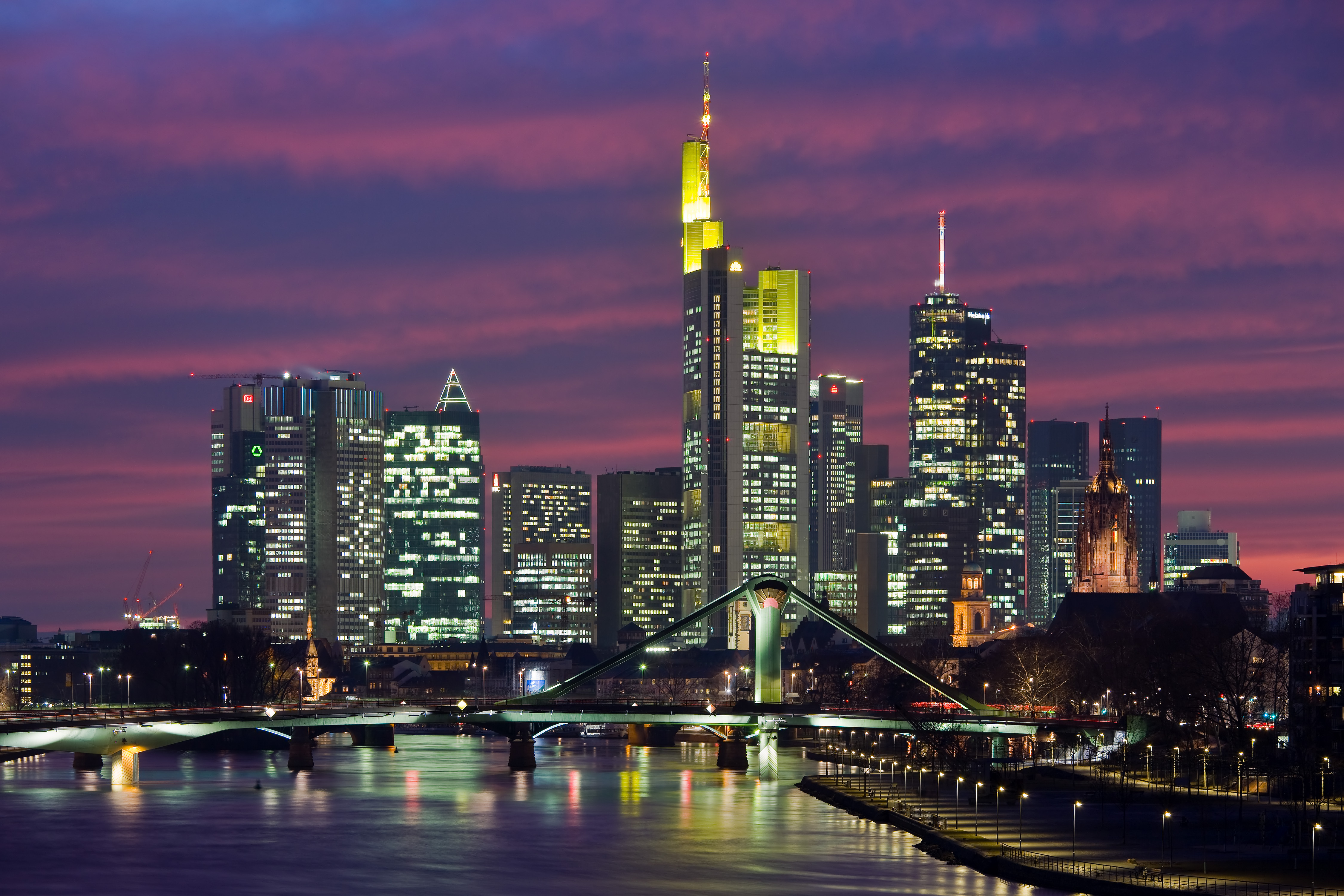
Not a cathedral in the technical sense — Frankfurt never had a bishop — but the church where the electors met in conclave from 1356 and where the coronation itself was held from 1562, once Aachen had become inconvenient.
The election chapel is off the choir, small and plain, and the seven electors were locked into it until they agreed. The imperial crown was carried in procession from here across the square to the Römer.
The tower gives the best view of the old town and, immediately behind it, the banking district — which is its own comment on what Frankfurt became once it stopped crowning emperors.
Vienna · Austria
The imperial crown

The Imperial Treasury in the Hofburg holds the regalia: the crown, the Holy Lance, the imperial sword, the orb, the gospel book on which the oath was sworn.
The crown is the object to see. It is octagonal rather than round — eight plates, echoing the eight sides of Charlemagne's chapel and the New Jerusalem — hinged so it could be packed for travel, set with unfaceted stones and cloisonné plaques of Old Testament kings, and shaped with an arch and a mitre-slot so it sat over a bishop's headgear. It was probably made in the 960s for Otto I.
The regalia were kept at Nuremberg from 1424, moved to Vienna in 1796 ahead of the French, taken to Nuremberg again by the Nazis in 1938 as a prop, and returned by the Americans in 1946.
Nuremberg · Germany
The Kaiserburg

The Empire had no capital, and its ruler governed by moving. The court travelled between imperial palaces — Pfalzen — consuming the local surplus and then moving on, and Nuremberg's castle was among the most used.
The double chapel is the thing to see: two storeys, one above the other, connected by an opening in the floor, so that the emperor could worship on the upper level while his household filled the lower. It is a physical diagram of the social order.
From 1424 to 1796 the imperial regalia were kept in the city, brought out once a year for public display. The Golden Bull also required each new emperor to hold his first diet here.
The Rhine and the imperial church
Three of the seven electors were Rhineland archbishops, and their cathedrals are the largest Romanesque buildings in Europe. The river was the Empire's spine.
Speyer · Germany
The Salian burial church
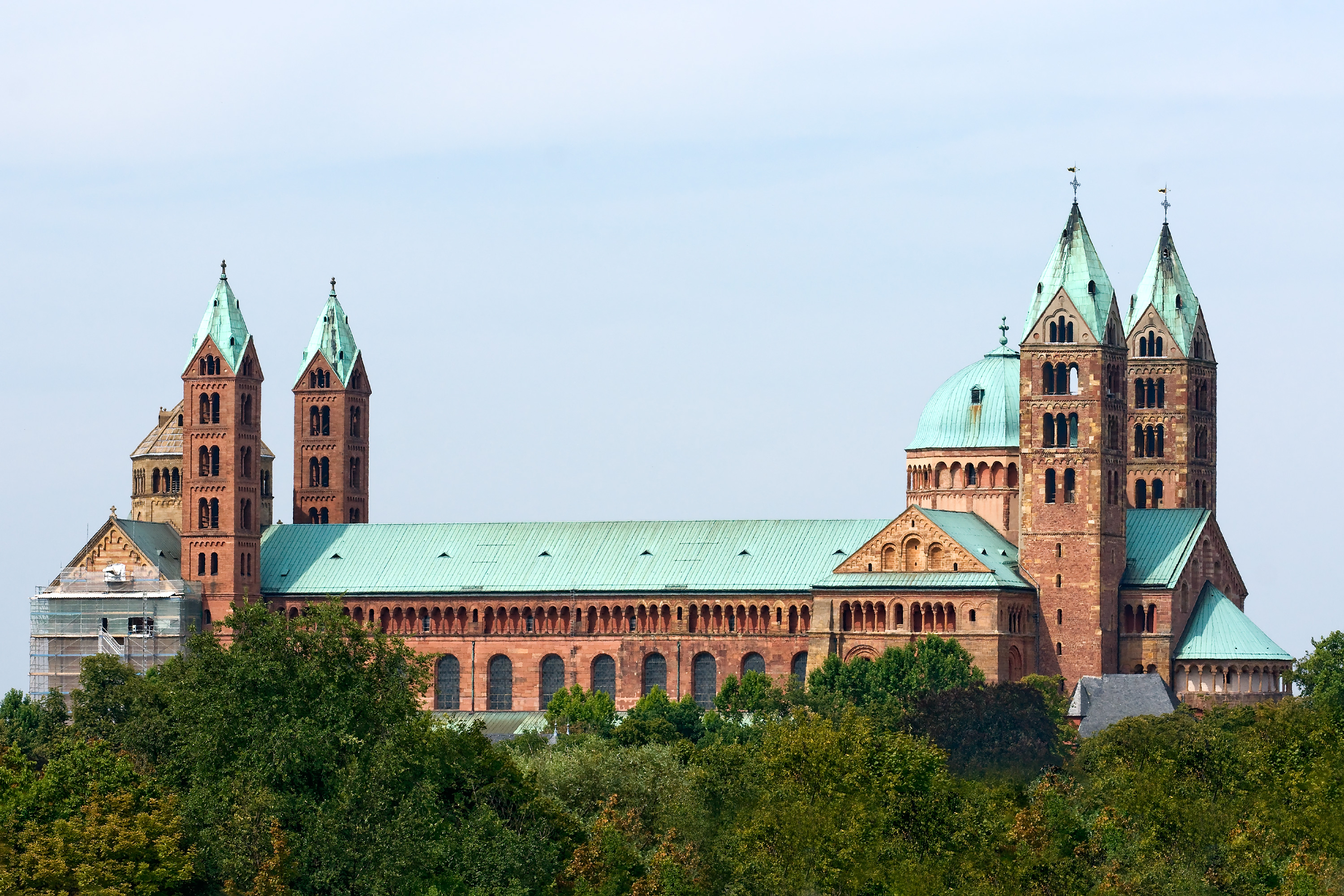
Conrad II began it in 1030 as the largest church in the Christian world, and it is still the largest Romanesque one standing. Eight emperors and German kings lie in the crypt, along with four queens and a number of bishops — the closest thing the Empire had to a Westminster Abbey.
Henry IV, of Canossa, is here. So is Rudolf of Habsburg, the first of that family to be elected, who is said to have ridden here as he was dying so as to arrive under his own power.
The crypt is a forest of cushion capitals in banded sandstone and is one of the great interiors of the Middle Ages. The cathedral was gutted by the French in 1689 and restored twice in the nineteenth century, which is why the exterior looks newer than it is.
Worms · Germany
Where Luther said no

Worms staged two of the Empire's hinges. The Concordat of Worms in 1122 ended the Investiture Controversy by splitting the difference: the emperor gave up appointing bishops with ring and staff, and kept the right to be present and to invest them with their temporal lands.
Four centuries later, in April 1521, the Diet of Worms summoned Martin Luther to recant. He did not. The building he stood in is gone, and the site is marked in a garden behind the cathedral; the famous sentence about being unable to do otherwise is probably a later addition to the record.
The Heiliger Sand, the Jewish cemetery, has stones from 1058 and is the oldest surviving in Europe. It is a quiet corner and the most affecting thing in the town.
Mainz · Germany
The first elector

The archbishop of Mainz was the senior ecclesiastical prince of the Empire, its arch-chancellor for Germany, the man who convened the electoral college and cast the last vote in it. Willigis began the present cathedral in 975 in deliberate rivalry with Rome.
The building is a red sandstone bulk with six towers and two choirs — one at each end, an imperial German peculiarity, because one belonged to the emperor and one to the bishop.
Mainz is also where Gutenberg printed the Bible in the 1450s, an event with more consequences for the Empire than most of its wars. The museum has two original copies.
Cologne · Germany
The great unfinished cathedral

Begun in 1248 to house the relics of the Magi, which the archbishop had carried off from Milan in 1164 and which made Cologne the third pilgrimage site of Europe. Work stopped in 1560 with the choir finished and a crane left standing on the unbuilt south tower, where it remained for three hundred years as the city's landmark.
The medieval elevation drawings were rediscovered in the 1810s, and the building was completed between 1842 and 1880 as a monument to a Germany that did not yet exist. For four years it was the tallest building in the world.
Cologne was also a free imperial city from 1475, having thrown out its archbishop-elector two centuries earlier — the elector kept his vote and had to live in Bonn.
Trier · Germany
The oldest city

The third elector's seat, and the Empire's strongest link to the Rome it claimed to continue. Trier was an imperial capital under Constantine, and its Roman remains are the finest north of the Alps: the Porta Nigra, the imperial baths, the amphitheatre and the Aula Palatina, a brick throne hall of about AD 310 that is still the largest single-room structure surviving from antiquity.
The Porta Nigra survives because the hermit Simeon lived in it from 1028 and it was turned into a church after his death; Napoleon ordered the church stripped away in 1804, leaving the gate.
For an empire that insisted it was Roman, this is the place where the claim looks least absurd.
Diets, councils and treaties
The Empire's real business was done in meetings — a perpetual diet at Regensburg, church councils, and the two Westphalian cities where the Thirty Years' War was finally ended.
Regensburg · Germany
The perpetual diet

From 1663 the imperial diet stopped meeting and dispersing, and simply stayed in session at Regensburg — the Immerwährender Reichstag, the perpetual diet, which sat continuously for a hundred and forty-three years until the Empire was dissolved.
The Reichssaal is preserved with its benches, its green cloth and the raised imperial throne. Envoys rather than princes attended; the ambassadors of three hundred-odd territories negotiated precedence with such ferocity that the seating arrangement itself took decades to settle.
It is easy to mock, and the mockery misses the point. This was a standing congress of sovereign states, resolving disputes by procedure rather than by war, two centuries before anyone tried it again. The building also holds the imperial torture chamber in the basement, which the tour visits with some relish.
Konstanz · Germany
The council city

Sigismund convened the Council of Constance in 1414 to end the Papal Schism, at which point there were three men claiming to be pope. It sat for four years, deposed two of them, accepted the resignation of the third, and elected Martin V in the warehouse on the harbour that still stands.
It also summoned Jan Hus under a written imperial safe-conduct, tried him for heresy and burned him on the 6th of July 1415 — an act of bad faith that produced fifteen years of Hussite war and did lasting damage to imperial credit in Bohemia.
The harbour is dominated by Imperia, a nine-metre rotating statue of a courtesan holding two small naked figures crowned as pope and emperor. It was erected in 1993 and the town has largely stopped objecting.
Münster · Germany
The Hall of Peace

The Thirty Years' War killed perhaps a fifth of the population of the German lands. It was ended by two simultaneous congresses, Catholic powers negotiating at Münster and Protestant at Osnabrück, because the parties would not sit in the same city.
The Friedenssaal is the fourteenth-century council chamber where the Spanish-Dutch treaty and then the imperial settlement were sworn. The room survived the war in fragments and was reassembled from panelling that had been evacuated in 1943.
Westphalia is usually taught as the birth of the sovereign state system. For the Empire it meant something more specific: the princes gained the right to make their own foreign policy, and the Empire became a federation of sovereigns with an elected head rather than a monarchy.
Canossa · Italy
The walk in the snow

In January 1077 Henry IV, excommunicated and facing revolt, crossed the Alps in winter and stood outside this castle for three days barefoot in the snow, as a penitent, until Gregory VII lifted the ban.
It is usually taught as the papacy's triumph over the Empire. It was tactically the reverse: absolution was exactly what Henry needed to disarm the German princes, he got it, and within three years he had driven Gregory out of Rome and installed his own pope. Gregory died in exile at Salerno.
The castle is a fragment on a rock with an enormous view over the Emilian plain. Bismarck's Nach Canossa gehen wir nicht — we shall not go to Canossa — in 1872 shows how long the image lasted.
Free cities, princes and the palaces
Beneath the emperor sat some three hundred territories, and beneath those another fifteen hundred imperial knights. These are the places where that fragmentation is easiest to see.
Goslar · Germany
The Kaiserpfalz

The largest surviving imperial palace, built by Henry III in the 1040s above the silver of the Rammelsberg, which is what made the Salian dynasty solvent. The great hall is a single vast room in which the court ate, judged and slept.
The nineteenth-century wall paintings inside are a period piece of a different kind: sixty-seven metres of romantic-nationalist history painting completed in 1897, in which the medieval Empire is presented as the ancestor of Bismarck's.
The Rammelsberg mine below the town was worked continuously for over a thousand years and closed in 1988; it is now a UNESCO site with the ore trains still running underground for visitors.
Bamberg · Germany
The prince-bishop's town

An ecclesiastical principality where the bishop was also the sovereign, of which the Empire had dozens. Bamberg's cathedral holds the only papal grave north of the Alps, the tomb of Henry II and Cunigunde by Tilman Riemenschneider, and the Bamberg Horseman — an equestrian statue of about 1235 whose subject nobody has identified.
The Altes Rathaus tells the political story better than the cathedral does. The burghers wanted a town hall; the prince-bishop refused to grant any of his land for it; so they drove piles into the Regnitz and built an artificial island in the middle of the river, which belonged to neither.
Bamberg was undamaged in the war. It also brews Rauchbier, smoked over beechwood, which tastes like a ham sandwich and is worth trying once.
Rothenburg ob der Tauber · Germany
A free imperial city

A free imperial city — subject to no duke or bishop, only to the emperor, with its own laws, courts, walls and militia, and a seat at the diet. There were about fifty such cities, and they are the reason the Empire could never be simply a monarchy.
Rothenburg's fortunes collapsed after the Thirty Years' War and it was too poor to modernise, which is why the medieval circuit of walls survives complete and walkable. Forty per cent of the town was destroyed in a raid on the 31st of March 1945; the reconstruction was funded partly by donations from abroad, with individual metres of wall sponsored and the donors' names on the parapet.
Go up onto the wall and walk the whole circuit. It takes about an hour.
Lübeck · Germany
The Hanseatic capital

Free imperial city from 1226 and the head of the Hanseatic League, which at its height coordinated the trade of some two hundred towns from Novgorod to London and could and did make war on kingdoms — it defeated Denmark in 1370 and dictated the terms.
The Hanse was not part of the Empire's constitution and had no legal existence, which is characteristic: the Empire's most effective institution was one it never formally recognised.
The Holstentor leans because its foundations began sinking during construction. Inside is a museum of the League. The Marienkirche nearby keeps its bells where they fell and shattered in the raid of March 1942, on the floor, as a memorial.
Augsburg · Germany
The Fuggerei

Jakob Fugger lent Charles V the money that bought his election in 1519 — some 850,000 guilders, distributed among the electors, in what was frankly a purchase. The Fuggers held mining monopolies across the Empire and were for a time the richest family in Europe.
In 1521 Jakob founded the Fuggerei, a walled settlement of small houses for indigent Catholic citizens of Augsburg. The rent was fixed at one Rhenish guilder a year, and it has never been raised: it is now 88 cents, plus three prayers daily for the founder. It is the oldest social housing scheme in the world and is still occupied.
Augsburg also gave its name to the Peace of 1555, which settled the confessional question with the formula cuius regio, eius religio — the ruler chooses, and his subjects conform or leave.
Magdeburg · Germany
Otto's cathedral

Otto I founded the monastery here in 937 and was buried in it in 973, and the present Gothic cathedral — the first in Germany — replaced his church after a fire. The tomb in the choir is his.
In May 1631 an imperial army under Tilly stormed the Protestant city and killed perhaps 20,000 of its 25,000 people. The word Magdeburgisieren entered German. The cathedral survived because refugees crowded into it and a commander posted a guard on the doors; almost nothing else did.
Magdeburg was rebuilt, flattened again in January 1945, and rebuilt again in the East German manner, which means the cathedral now stands among tower blocks. That contrast is the honest condition of a great many imperial cities.
Karlštejn · Czech Republic
The crown castle

Charles IV — King of Bohemia, Holy Roman Emperor, and the man who issued the Golden Bull — built this in the 1340s as a strongroom for the imperial regalia and for a relic collection he assembled with real determination.
The Chapel of the Holy Cross at the top of the great tower has walls set with more than two thousand polished semi-precious stones and 129 painted panels by Master Theodoric. Access is limited and by separate advance booking; most visitors see the rest of the castle and not this.
Charles made Prague his capital, founded its university in 1348 and built the bridge that carries his name. He is the strongest argument against the view that the Empire's rulers were figureheads.
Wetzlar · Germany
The Imperial Chamber Court
The Reichskammergericht was established in 1495 as part of the settlement that outlawed private war, and it is the institution that made the Empire work. It sat at Speyer until the French burned the city in 1689, and then at Wetzlar until 1806.
Its business was suits between imperial estates, and suits by subjects against their own rulers — which is the remarkable part. A village could sue its prince, and sometimes won. Roughly 80,000 cases passed through it, and the surviving files are one of the great archives of European social history, because they record ordinary people explaining their grievances at length.
It was also famously slow; some suits ran for two centuries. Goethe was an intern here in 1772 and hated it, and the experience produced Werther rather than a legal career. The museum occupies the building the court used.
Prague · Czech Republic
The Bohemian capital

For thirty years in the fourteenth century the Empire did have something like a capital, because Charles IV made his own kingdom its centre. He founded the university in 1348 — the first north of the Alps and east of Paris — laid out the New Town on a scale that took five centuries to fill, began St Vitus's Cathedral, and built the bridge.
The Bohemian crown was the only kingdom inside the Empire and its king was the only royal elector, which gave Charles a base no other emperor had. His Golden Bull confirmed Bohemia's privileges in the same breath as it fixed the constitution.
The castle holds the Bohemian crown jewels behind seven locks, whose keys are held by seven different officials. They are shown perhaps once a decade.
Vienna · Austria
The Habsburg seat

From 1438 the imperial title was held almost continuously by Habsburgs, and Vienna became the Empire's administrative centre without ever being its capital in law. The Aulic Council — the Reichshofrat — sat here as the emperor's own supreme court, in competition with the Chamber Court at Wetzlar, and litigants shopped between them.
The Hofburg grew by accretion for six hundred years and shows it: a Gothic chapel, a Renaissance gate, a Baroque library, a nineteenth-century wing that was never finished because the monarchy ran out of time.
It is where Francis II signed the abdication on the 6th of August 1806, and where his descendants went on ruling an Austrian empire he had invented two years earlier as a replacement title.