The twenty-three years between the death of Frederick II in December 1250 and the election of Rudolf of Habsburg in October 1273 are known as the Great Interregnum. The phrase is partially misleading: there were emperors, of a sort, throughout the period — William of Holland (1248–1256), Richard of Cornwall (1257–1272), and Alfonso X of Castile (1257–1273, never crowned) — but none of them held effective authority over more than fragments of the empire, and the prince-electors found that an absent or contested emperor was easier to manage than a present one. The institutional consequence of the interregnum was the consolidation of the imperial-electoral system as the empire's constitutional skeleton — a system that would survive the next five centuries with only modest revisions.
The seven electors
The principle that the emperor was elected by a defined college of prince-electors had been emerging since the late eleventh century. By the mid-thirteenth century the college had stabilised at seven: the three Rhenish archbishop-electors (Mainz, Cologne, Trier) and four secular electors (the king of Bohemia, the count palatine of the Rhine, the duke of Saxony, and the margrave of Brandenburg). The composition reflected a combination of historical-ecclesiastical seniority and political accident; it would be modified once in the seventeenth century (Bavaria added in 1623, Hanover in 1692) and once at the empire's end (the Reichsdeputationshauptschluss of 1803 reshuffled the entire college as part of the secularisation programme that preceded the empire's dissolution). The seven-elector body of 1257 was, in substance, the imperial constituent body for five and a half centuries.
The election of Rudolf of Habsburg in 1273 was the electors' first deliberate exercise of constitutional authority since the interregnum had begun. Rudolf was chosen — over the more eligible Ottokar II of Bohemia — because he was a substantial enough magnate (he held the Habsburg county in Swabia and the Aargau in Switzerland) to be plausible as emperor but not so substantial that the electors feared him as a potential restorer of Ottonian-style central authority. The Habsburgs would, ironically, become exactly such a dynasty over the next 600 years, but Rudolf in 1273 was a safe choice.
The Avignon papacy and the imperial vacancies
The fourteenth century opened with the papacy decamping to Avignon (1309–1377) under French royal pressure, and with the imperial-papal relationship therefore restructured in ways the participants did not yet fully understand. The Avignon popes were, broadly, French clerics with French political instincts; their relationship with the German emperors was generally adversarial, especially under the imperial Wittelsbach Louis IV (1314–1347), who was twice excommunicated by Pope John XXII and who responded with the Declaration of Rhense in 1338, asserting that the emperor's title derived from election by the prince-electors and required no papal confirmation. The declaration was a constitutional rupture with the medieval doctrine of papal-imperial dual authority; it was not formally accepted by subsequent popes for another two centuries, but in practice no emperor after the early fifteenth century would receive papal coronation.
The Golden Bull
The constitutional consolidation of the imperial-electoral system came in the Golden Bull of 1356, the imperial law promulgated by the Luxembourg emperor Charles IV (1346–1378) at the diets of Nuremberg and Metz. The Bull, named for the gold seal (bulla aurea) that authenticated the document, codified the imperial constitution in twenty-three chapters. Its principal provisions: the seven electors were named definitively; each elector held an indivisible territory subject to primogeniture (eliminating the recurring problem of partitioned electoral votes); the election was to be held at Frankfurt within thirty days of the previous emperor's death; the coronation was at Aachen; the imperial diet (the Reichstag) was to meet at imperial summons; the electors had judicial sovereignty in their own territories and could not be subject to any external court; private wars among imperial vassals were prohibited; and the electors enjoyed extensive immunities and privileges, including (for the lay electors) regalian rights to coinage, mining, customs, and Jewish-protection taxation.
The Golden Bull is the most important imperial constitutional document of the medieval period. It explicitly entrenched the federalised, electoral, polycentric character of the empire — at the very moment when other major European states (France under the Valois, England under the Plantagenets, the Iberian kingdoms after the union of Castile and Aragon in 1469) were moving in the direction of consolidated dynastic monarchy. The Bull's prohibition of any external appellate jurisdiction over the electoral territories also produced, by inadvertent extension, the late-medieval phenomenon of Landeshoheit — territorial sovereignty — which would eventually be exercised by hundreds of imperial princes, prince-bishops, abbots, counts, and free cities, each effectively autonomous within his (or its) own jurisdiction. By the late seventeenth century the empire would contain approximately 1,800 such territorial units. The constitutional logic of this was set out in 1356.

The Luxembourg century
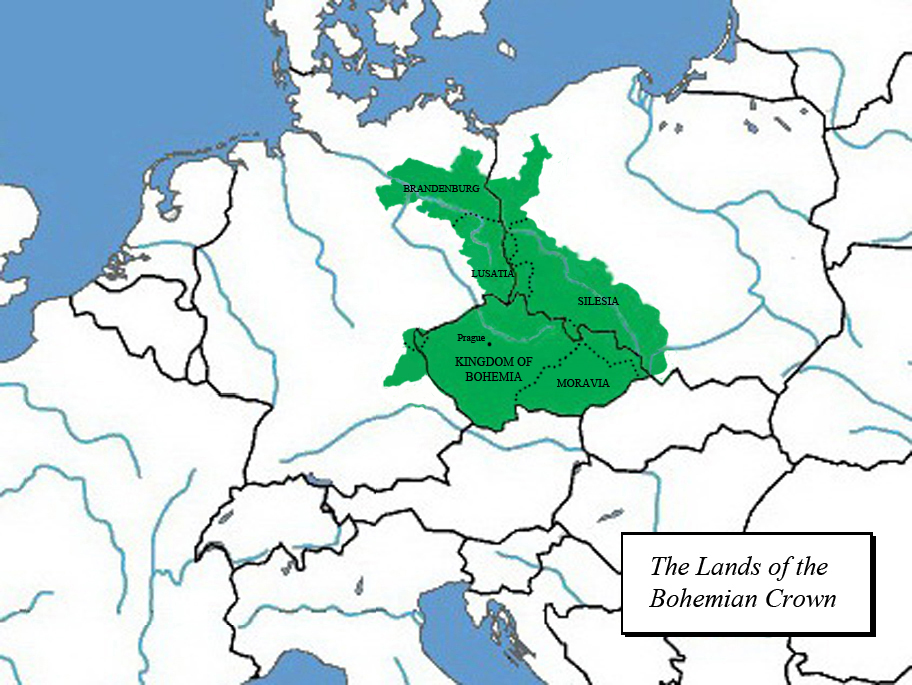
The Luxembourg dynasty held the imperial title for most of the fourteenth and early fifteenth centuries: Henry VII (1308–1313), Charles IV (1346–1378), Wenceslaus (1376–1400, deposed by the electors for incompetence), and Sigismund (1410–1437). Charles IV's reign was the dynasty's high point. He made Prague the imperial capital (founded the Charles University in 1348, built the Charles Bridge from 1357), patronised Bohemian intellectual culture (the seedbed for the Hussite reformation a generation later), and substantially expanded the Bohemian crown's territorial reach. His son Sigismund, by contrast, spent most of his reign managing the Hussite wars (1419–1434) — the religious-and-national revolt of Bohemia following the burning of Jan Hus at the Council of Constance in 1415, the most significant European religious dissident movement before Luther.
The Council of Constance (1414–1418) itself was Sigismund's principal achievement: it ended the Western Schism (which had produced three rival popes), restored the papacy to a single, Roman, occupant (Martin V), and reasserted the theoretical authority of general councils over the papacy in the conciliarist doctrine that would, a century later, give Lutheran reformers some of their legal language. The Council also burned Hus and his colleague Jerome of Prague under safe-conducts issued by Sigismund — a betrayal that produced fifteen years of Bohemian religious-civil war and a substantial Czech literature of grievance that has not entirely subsided in six hundred years.
The Habsburg succession
The death of Sigismund in 1437 brought the imperial title to his son-in-law Albert of Habsburg, who held it briefly before dying in 1439. From 1440 onward — with the single exception of Charles VII of Bavaria (1742–1745) during the War of the Austrian Succession — every Holy Roman Emperor would be a Habsburg. The dynastic accident was, in its consequences, decisive. The Habsburgs were primarily Austrian-Tyrolean territorial rulers whose strategic interests pulled the empire's centre of gravity progressively south-east toward the Danube and into the long Ottoman frontier. The imperial title, increasingly, became one of several Habsburg crowns rather than the principal one. The empire's constitutional weight, by contrast, remained — and was about to be tested, in the early sixteenth century, by the largest religious upheaval in European history. That is the next chapter.
End of Chapter III