Foreword
What was the Empire,
really?
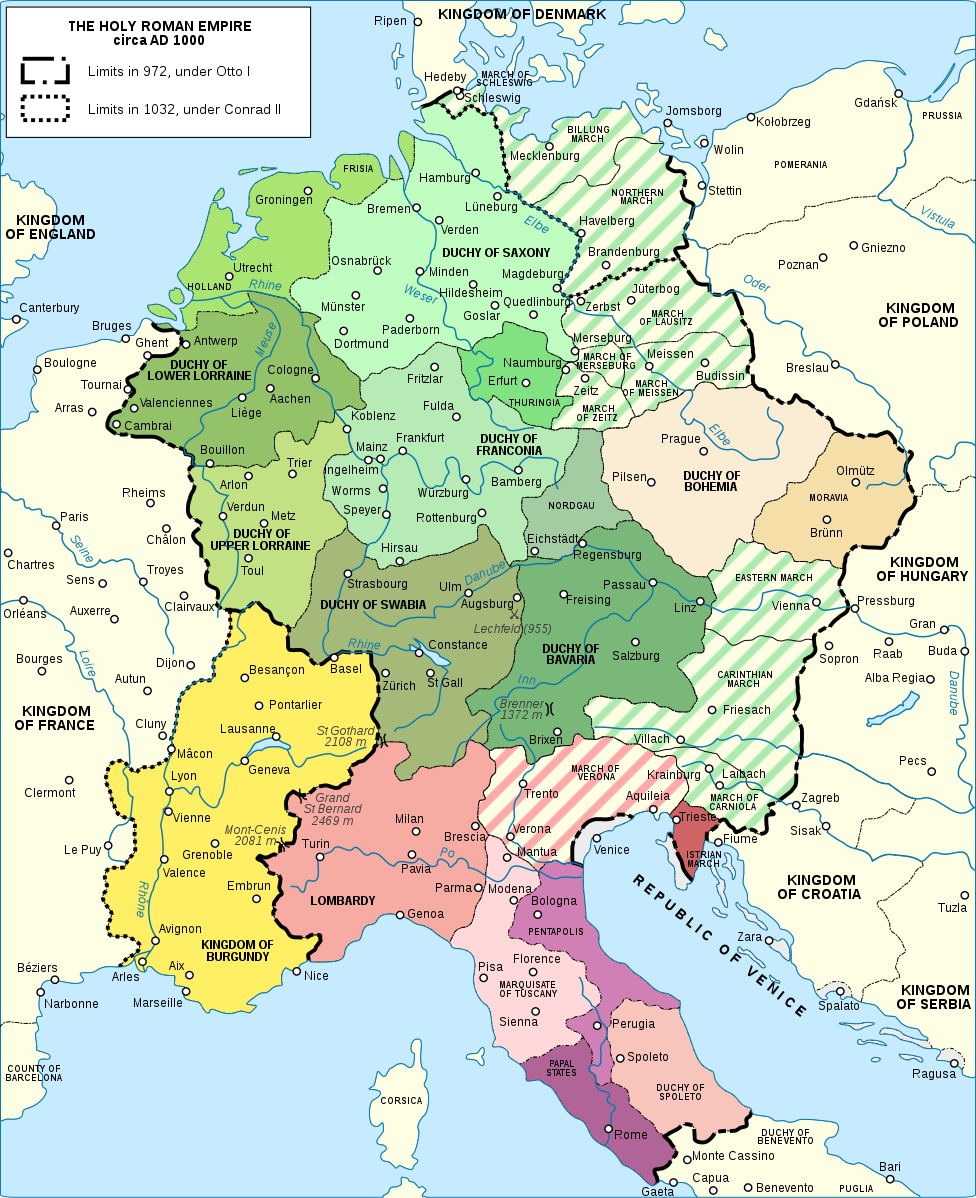
Voltaire's nineteenth-century jibe — that the Holy Roman Empire was neither holy, nor Roman, nor an empire — has stuck because it sounds clever, and because it has the additional advantage of being substantially wrong on all three counts.
The Empire was holy in a specific medieval sense: its emperor was crowned by the Pope, was understood as the temporal sword of Catholic Christendom, and held — in theory — universal authority over the lay political order in the West. It was Roman in a specific medieval sense: it claimed continuous translation of imperial dignity from the Caesars through Charlemagne to its own ruling dynasties, and the imperial chancellery continued to use Latin and to model its diplomatic forms on the late Roman pattern. And it was an empire in a specific federal sense: a multilingual, multi-confessional, multi-jurisdictional polity governed jointly by an elected monarch and the assembled estates of the realm, recognised by its neighbours as the senior secular institution in Europe, and operating a continuous body of constitutional law from the Investiture controversy of 1075 to the dissolution of 1806.
What it was not, by the standards of seventeenth-century French or eighteenth-century English political theorists, was a centralised state with a unified army, a unified currency, a uniform legal code, and a single capital. By those criteria it was a failure for most of its existence — Hobbes derided it as "an irregular body" and Pufendorf called it a "monstro simile" ("similar to a monster"). But those criteria were specific to the political revolutions of the seventeenth and eighteenth centuries, and the Empire's continued survival — by federal rather than centralised means — through the Reformation, the Thirty Years' War, the wars of Louis XIV, and the Seven Years' War, is, in retrospect, more impressive than its critics allowed.
This volume traces the Empire across nine centuries, with particular attention to the constitutional moments that defined it: the Golden Bull of 1356, the Reformation of 1517, the Peace of Westphalia of 1648, the partitions of the eighteenth century, and the dissolution of August 1806. Then we go and walk through its surviving capitals — Aachen, Frankfurt, Vienna, Regensburg — and the smaller imperial cities still recognisable as imperial.