
The fifty-two years between the Peace of Westphalia and the close of the seventeenth century were the empire's period of institutional consolidation. The constitutional architecture of the post-1648 settlement had to be made operational, and the substance of what the empire would now be — a multi-confessional federation rather than a confessional polity, a permanently negotiated political space rather than a hierarchical state, a defensive bloc against external threats rather than an offensive power — had to be tested in practice. The principal external threat of the period was Ottoman, and the principal internal institutional development was the conversion of the imperial diet from an intermittently summoned assembly into the Permanent Diet (Immerwährender Reichstag) at Regensburg, sitting continuously from 1663 onward and surviving until the empire's dissolution.
The Permanent Diet
The Permanent Diet at Regensburg, opened in 1663, was a structural innovation forced on the empire by the difficulty of summoning periodic diets for legislation, taxation, and treaty ratification under the Westphalian constitution. Each imperial estate sent permanent envoys (Reichstagsgesandte) to Regensburg; the envoys were organised in three colleges — the electors, the princes, and the imperial cities — voting in their respective chambers. Joint resolutions of the three colleges, ratified by the emperor, became Reichsgutachten with the force of imperial law. The diet sat in the Regensburg town hall, in chambers (still visible to visitors today) preserved largely unchanged. It was not a legislature in the modern sense — its consents were generally to imperial proposals rather than its own initiatives — but it was the principal mechanism by which the imperial estates kept the emperor's authority under collective check.
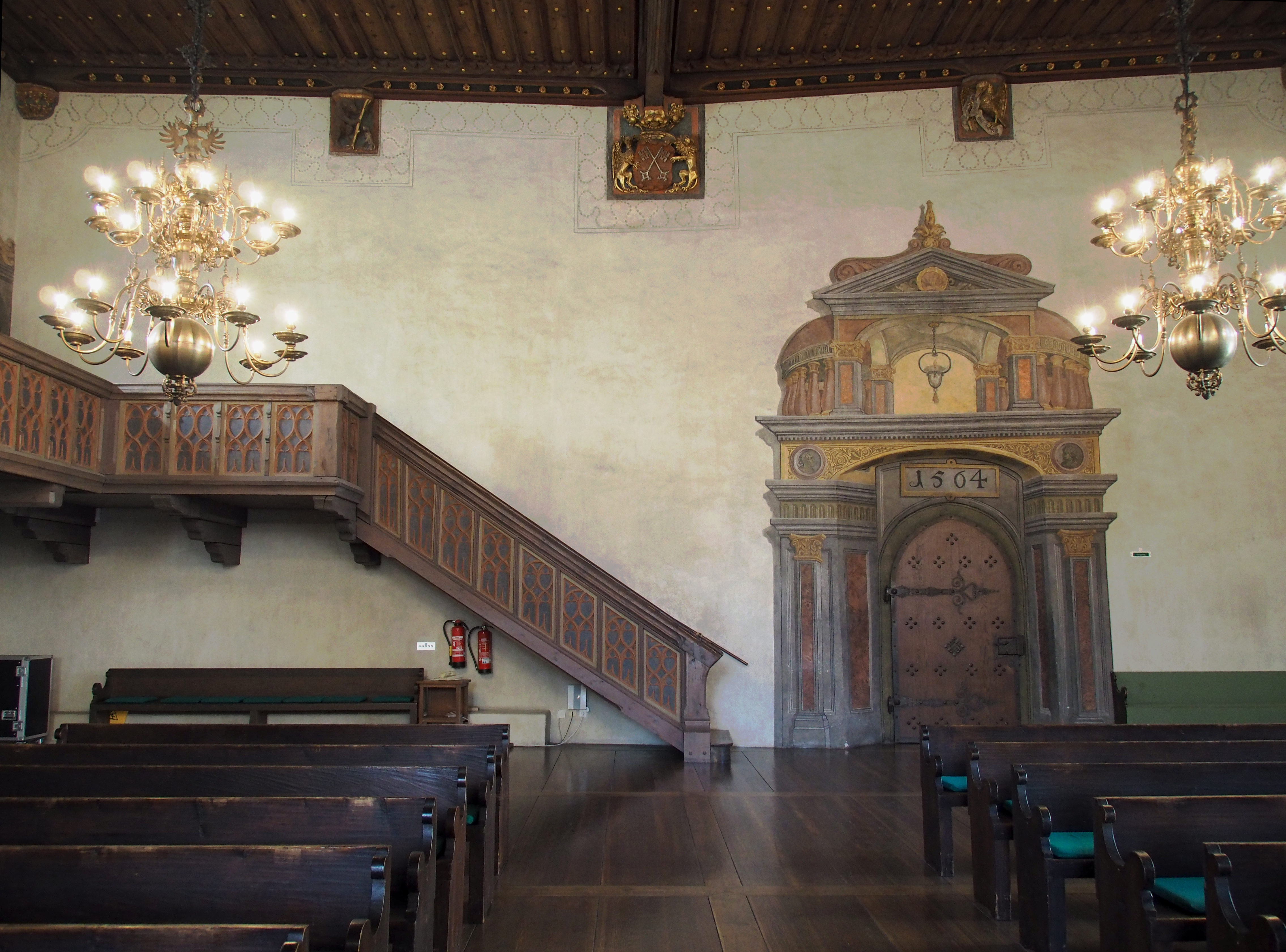
The decisional difficulty was substantial. Many resolutions required unanimity within each college; some required unanimity across colleges; the religious-confessional balance was preserved by the institution of the itio in partes — the right of either confessional party (Catholic or Protestant) to demand that a question be voted in separate confessional chambers rather than by majority of the whole — which gave each confession an absolute veto on religious matters. The combination produced an institutional bias toward stasis: the diet was good at preventing change and weak at producing it. For most of the eighteenth century this was, in fact, what its members preferred.
The Ottoman wars
The external history of the empire in the late seventeenth century was dominated by the renewed Ottoman pressure on the Habsburg eastern frontier. After fifty years of relative quiet (the long Habsburg-Ottoman peace of 1606–1660 broken only by minor frontier skirmishes), the Ottomans under the Köprülü viziers resumed major offensive operations: the Hungarian war of 1663–1664 (defeated by Habsburg-French forces at Saint-Gotthard on the Rába river), the Polish-Ottoman war of the 1670s, and the great offensive of 1683 that brought the Grand Vizier Kara Mustafa to the walls of Vienna in July of that year. The siege of Vienna ran from the 14th of July to the 12th of September 1683. The defence was conducted by Count Rüdiger Starhemberg with a garrison of 11,000 against an Ottoman army of approximately 150,000; relief was delivered by the Polish king Jan III Sobieski, the Lorrainer Charles V, and the Saxon and Bavarian electors at the Battle of Kahlenberg on the 12th of September. The Ottoman army was routed; Kara Mustafa was strangled by the Sultan's order at Belgrade three months later.
The Vienna relief opened a fifteen-year Habsburg counteroffensive — the Great Turkish War of 1683–1699 — which reconquered Hungary, Transylvania, Slavonia and parts of Serbia under the brilliant general Eugene of Savoy, whose victory at Zenta in 1697 broke the Ottoman field army. The Peace of Karlowitz of 1699 transferred the recovered territories to the Habsburg crown, doubling the size of the hereditary lands and converting Vienna from a frontier garrison into the operational capital of a Danubian empire. The empire as such, however, gained no territory; the Habsburg dynastic gains were juridically external to the imperial structure, even though the army that achieved them had been mobilised through the imperial defensive levy.
The Louis XIV wars
The empire's western front in the late seventeenth century was the contest with the France of Louis XIV. The War of Devolution (1667–1668), the Franco-Dutch War (1672–1678), the Reunion policy of 1680–1688 (a programme of legal annexations by French chambres de réunion of imperial territory in the Saar and Alsace), the Nine Years' War (1688–1697), and the War of the Spanish Succession (1701–1714) were a continuous strategic engagement between Louis's France and the empire-plus-allied-coalition (the Dutch, England under William III and Anne, and the maritime powers generally) for control of the Spanish inheritance and for the western imperial frontier. The empire as institution played a defensive role — the imperial military constitution (Reichskriegsverfassung) of 1681 organised imperial contingents from the various Circles for defensive operations — while the principal military weight was carried by the Habsburg hereditary army and its allies. The territorial outcome was the loss of substantial imperial territory in Alsace (formally ceded at Westphalia and progressively extended through the Reunion policy) and the institutional retreat of the imperial frontier to the Rhine.
The princely territorial state
The most consequential internal development of the period was the consolidation of the great territorial principalities — Brandenburg-Prussia under the Great Elector Frederick William (1640–1688), Bavaria under Maximilian II Emanuel, Saxony under the Albertine Wettins, Hanover under Ernest Augustus (whose son George would become George I of Great Britain in 1714) — into substantial regional powers with standing armies, professional bureaucracies, and territorial-economic policies in the cameralist mode. The Brandenburg-Prussian case is particularly important: the Great Elector's military and administrative reforms after 1648 produced, over two generations, the most professionalised army in the empire and the foundations of what would become, in 1701, the Kingdom of Prussia. The kingdom-of-Prussia question is the subject of Volume I in this library; for the present chapter the point is that the empire's federal structure was now containing a major rival to Habsburg authority within itself, the long-term consequence of the Westphalian transfer of substantive sovereignty to the territorial princes.
The eighteenth-century inheritance
By 1700 the institutional outlines of the post-Westphalian empire were settled. The Habsburgs held the imperial title and were consolidating a major Danubian state. The Bourbons in France were the empire's principal external rival. Brandenburg-Prussia was rising. The imperial diet at Regensburg was the empire's permanent constitutional theatre. The imperial courts at Wetzlar (the Reichskammergericht) and Vienna (the Reichshofrat) provided judicial review. The Aulic Council adjudicated feudal-imperial questions. The system functioned, slowly and defensively, for the next hundred years. The eighteenth century is the next chapter.
End of Chapter VI