The fitna ("trial" or "disorder" in classical Arabic, used in Islamic historiography for the major internal political crises of the Muslim community) of the Caliphate of Córdoba was the catastrophic political and military collapse that ended the institutional caliphate. It ran from the proclamation of Sanchuelo as heir in February 1009 to the abolition of the caliphate by the Cordoban municipal council in 1031 — twenty-two years of factional warfare among Umayyad pretenders, Berber confederations, Slavic palace guards, and various regional warlords. The fitna produced, by aggregate effect, the most substantial single demographic and material catastrophe of the medieval Iberian peninsula. Córdoba itself, the principal city of western Europe at 1000 AD, was reduced to perhaps a tenth of its 1000-AD population by 1031.
The opening phase
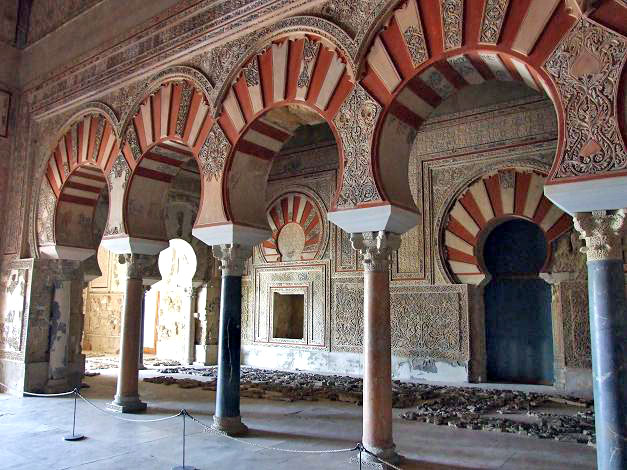
The factional struggle began with the overthrow of Sanchuelo in February 1009 by a coalition led by Muhammad II al-Mahdi, an Umayyad prince of the senior caliphal line. Al-Mahdi was proclaimed caliph at Córdoba in February 1009; the captive Hisham II was deposed; the Amirid dynasty's institutional infrastructure was systematically dismantled. The Berber troops of the Amirid army, finding themselves politically marginalised under the new regime, mutinied. Their commander Sulayman, an Umayyad prince of a junior line, was proclaimed counter-caliph by the Berber army in 1009 with the title al-Musta'in. The Berber forces, supported by Castilian Christian troops who had crossed the frontier as Sulayman's allies, defeated Al-Mahdi's army at the battle of Cantich in November 1009, sacked the suburbs of Córdoba (including the substantial sack of Madinat al-Zahra), and forced Al-Mahdi from the capital.
The next two years (1010-1011) saw repeated changes of regime at Córdoba as the various factions fought for control. Al-Mahdi briefly regained the city; Sulayman recovered it; Al-Mahdi was murdered in 1010 by his own faction's commanders; Sulayman ruled briefly under acknowledgement of the Berber confederations as kingmakers; the Slavic palace guard rose against the Berbers and overthrew Sulayman in 1010; the Berber confederations counter-attacked and besieged Córdoba in 1011; the city fell after a long siege; the Berber forces sacked Córdoba again, this time on a far more substantial scale, with substantial damage to the central buildings.
The destruction of Madinat al-Zahra in 1010 and 1011 was, in retrospect, the most visible single material consequence of this opening phase. The palace-city was burned, looted, and substantially demolished over the two-year period. The great library of Al-Hakam II — the principal cultural inheritance of the caliphal high period — was substantially destroyed, with most of the 400,000 manuscripts burned or scattered. (A small portion of the collection had been moved to other Cordoban libraries before the destruction; some manuscripts survived in private collections; perhaps a thousand original Madinat al-Zahra-period manuscripts can now be identified in modern collections worldwide, principally at the Escorial Library outside Madrid, the Marciana Library in Venice, and the National Library of Tunisia.)
The middle phase
The civil war continued through the 1010s and 1020s in a series of factional changes that progressively weakened the central institution. The seven caliphs of the fitna period were, in summary:
Muhammad II al-Mahdi (1009-1010): Umayyad senior-line pretender; deposed and killed.
Sulayman al-Musta'in (1009 contested, 1013-1016): Berber-supported pretender; deposed and killed.
Hisham II (restored 1010, briefly): the deposed boy caliph of Al-Mansur's regime, briefly restored as figurehead; deposed again, ultimately died c. 1013 of uncertain cause (possibly murdered).
Ali ibn Hammud al-Nasir (1016-1018): a Hammudid (a different family of putative Umayyad descent) pretender; murdered.
Abd ar-Rahman IV al-Murtada (1018, briefly): Umayyad pretender; murdered in his first month.
Al-Qasim al-Ma'mun (1018-1021, contested): Hammudid pretender; deposed.
Yahya al-Mu'tali (1021-1023, contested): Hammudid pretender; killed.
Hisham III al-Mu'tadd (1027-1031): an Umayyad senior-line pretender; the last formal caliph of Córdoba; deposed by the Cordoban municipal council in 1031 and forced into exile, where he died several years later in obscurity.
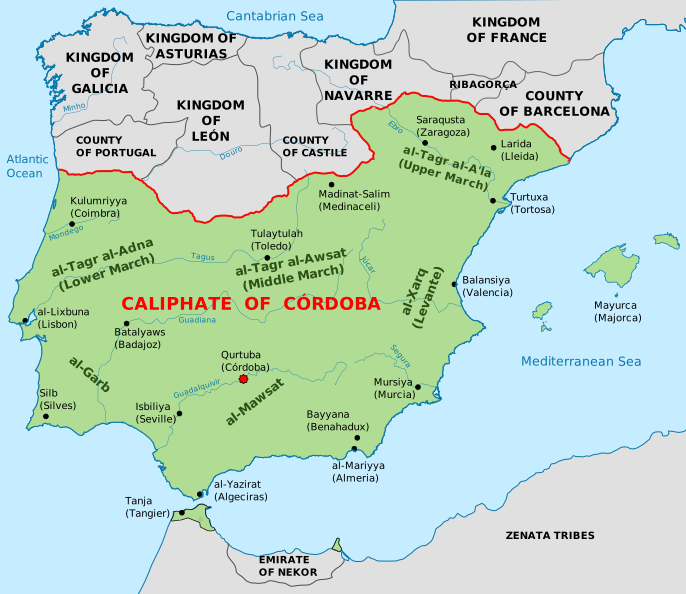
The sequence of seven different families and twelve substantive regime changes in twenty-two years made any sustained governance impossible. The state's administrative apparatus collapsed. The territorial integrity of the caliphate disintegrated as regional governors and local Berber, Slavic, and Andalusian warlords carved out personal principalities. By the mid-1020s, the substantive caliphate consisted only of the immediate Cordoban hinterland.
The abolition
The formal end came on the 30th of November 1031. The municipal council of Córdoba — the assembly of senior citizens, religious officials, and local notables that had operated continuously through the fitna as the de facto local government of the city — met in formal session and voted to abolish the caliphate. The reasoning was substantively practical: the office had become a source of factional conflict rather than a unifying institution, and the city's various interests were better served by direct municipal governance than by continued participation in the dynastic struggle. The deposed caliph Hisham III was permitted to leave the city for exile. The caliphal institution that had been formally proclaimed by Abd ar-Rahman III on the 16th of January 929 was, after 102 years and 10 months of operation, abolished by the city that had been its capital.
The post-caliphal Cordoban state operated for the next several decades as a municipal republic of sorts, governed by the council, under the substantive overlordship of the kingdom of Seville (which under the Abbadid dynasty had emerged as the principal post-caliphal Andalusian polity). The city's substantial decline in population, in commercial activity, and in cultural prestige continued through the second half of the eleventh century. By the time of the Christian reconquest of Córdoba on the 29th of June 1236 by Ferdinand III of Castile, the city's population was perhaps 50,000 — a tenth of its peak under the caliphate.
The taifa successor states — the small Muslim principalities that had emerged from the caliphate's dissolution — are the subject of the next chapter.
"The Caliphate that was the glory of our people has been destroyed by the contention of our own kinsmen." — Cordoban municipal council, abolition resolution, 30 November 1031
End of Chapter VI