Al-Hakam II succeeded his father Abd ar-Rahman III on the 15th of October 961. He was forty-six and had been groomed for the throne for nearly four decades. He had served as principal heir under his father's reign with substantial state responsibilities; he had been a personal patron of the Andalusian scholarly community since his thirties; he was, by any measure, the most learned of the medieval Iberian rulers. His fifteen-year reign produced the cultural high-water mark of the caliphate.
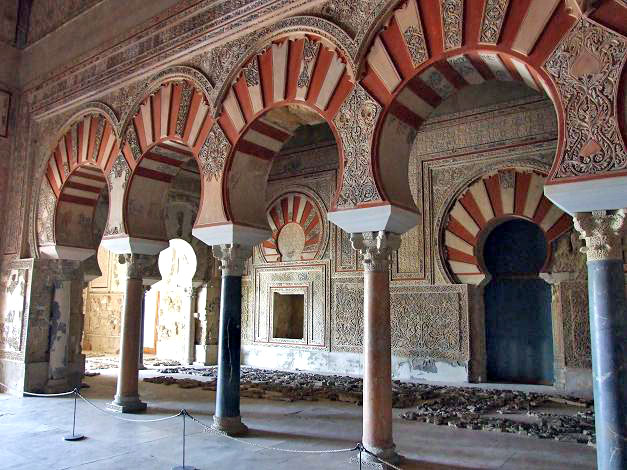
The reign was, in foreign-policy terms, substantially less ambitious than his father's. Al-Hakam was not, by temperament, a military commander; he conducted the necessary frontier campaigns against the northern Christian kingdoms through delegated generals, achieving the principal diplomatic objective of stabilising the frontier at the Duero river line without substantial territorial expansion. The strategic position the caliphate had reached under Abd ar-Rahman III was maintained but not extended. The substantive achievement of the reign was the cultural and intellectual programme conducted at Córdoba and Madinat al-Zahra throughout the fifteen years.
The library
The library of Madinat al-Zahra — and, after the late 960s, the principal caliphal library at Córdoba — was the most ambitious collection of manuscripts assembled in medieval western Europe. The standard estimate is approximately 400,000 manuscripts, though the figure is debated; the lower-end scholarly estimates put it at perhaps 250,000, and the upper-end estimates at perhaps 600,000. Even at the lower estimate, the library was substantially larger than any other collection in the medieval Mediterranean basin (the contemporary Abbasid libraries at Baghdad were perhaps comparable in size; the Byzantine imperial libraries at Constantinople were smaller; the largest medieval Christian monastic libraries — at Cluny, at St Gall, at Monte Cassino — held perhaps several hundred to a few thousand manuscripts in this period).
The library's collection was assembled through several channels. Al-Hakam maintained agents in the principal eastern Islamic cities (Baghdad, Cairo, Damascus, Kairouan) who acquired manuscripts on his behalf — sometimes purchasing them in the open book market, sometimes commissioning fresh copies of standard works, sometimes acquiring private collections from scholarly heirs. The caliphal court also operated its own scriptorium with substantial copying capacity; the standard estimate is that the court could produce perhaps 30,000 to 50,000 manuscripts over Al-Hakam's reign through its own copying programme. The Madinat al-Zahra library employed a substantial staff of librarians and copyists; the principal catalogue (compiled under the library's chief librarian Talid al-Khasi) ran to forty-four volumes itself.
The substantive subject coverage was substantial. The library held the principal Arabic-language literary, theological, and philosophical works of the era; substantial collections in Greek (in Arabic translation) on medicine, philosophy, mathematics, and astronomy; substantial Persian-language material; some Latin-language texts (the Cordoban Christian community continued in operation as a Mozarabic religious tradition under caliphal supervision, with Latin liturgical and scholarly traditions); and a small body of Hebrew-language Jewish religious material.

The translation programme
The principal intellectual achievement of Al-Hakam's reign was a substantial translation programme that brought into Arabic many works of Greek philosophy, mathematics, astronomy, and medicine that the contemporary Christian Latin West knew either incompletely or not at all. The programme was, in scale and ambition, comparable to the earlier ninth-century Abbasid translation programme at Baghdad (the so-called House of Wisdom under Caliph al-Ma'mun, 813-833) and produced, over Al-Hakam's reign, perhaps several hundred substantial translations.
The most consequential single translation project was the Arabic version of Dioscorides' De Materia Medica — the principal ancient Greek pharmacological reference, with descriptions of perhaps a thousand medicinal plants and substances — that the caliphal court had begun under Abd ar-Rahman III after the 949 Byzantine embassy. The project was completed under Al-Hakam in the 960s with the assistance of the Christian monk Nicholas (sent from Constantinople specifically for the translation), the Jewish physician Hasdai ibn Shaprut, and a team of Andalusian Arab scholars. The resulting Arabic text, with substantial Andalusian additions on locally available plants, became the standard medical-botanical reference of the medieval Islamic world for the next four centuries. Several manuscript copies survive, including the substantial Bayerische Staatsbibliothek manuscript in Munich.
The expansion of the Great Mosque
The principal architectural project of Al-Hakam's reign was the third major expansion of the Great Mosque of Córdoba, conducted in 961-965. The mosque had been founded by Abd ar-Rahman I in 786 on the site of the Visigothic cathedral of St Vincent; it had been expanded by Abd ar-Rahman II in the 830s and by Abd ar-Rahman III in the 950s. Al-Hakam's expansion added approximately 6,400 square metres to the prayer hall, including the famous mihrab (prayer niche) decorated with Byzantine-style gold mosaics depicting the Quranic inscriptions. The mosaics were commissioned by Al-Hakam from the contemporary Byzantine emperor Nikephoros II (the result of substantial diplomatic correspondence), who sent both the gold tesserae and a master mosaicist to supervise the installation. The mihrab area of the Great Mosque is, today, one of the best-preserved single pieces of monumental Byzantine-Islamic decorative work anywhere.
The expansion also added the maqsura (the screened-off area for the caliph and his immediate court at Friday prayer), with its three principal domes — the first Islamic ribbed-vault domes anywhere, with substantial mathematical sophistication in their construction. The Cordoban ribbed-vault tradition would, through subsequent Andalusian architectural transmission to Christian Spain and through the Crusader contacts, influence the development of the European Gothic ribbed-vault tradition of the twelfth century.

Al-Hakam's death
Al-Hakam II died on the 1st of October 976 of a stroke, after fifteen years on the throne. He was sixty-two. He left the caliphate at the peak of its institutional strength, in the absence of any obvious external threat, with a substantial treasury, an active scholarly establishment, and an enormous library. The succession, however, was problematic. Al-Hakam's only surviving son, the future Caliph Hisham II, was twelve years old at his father's death. The regency arrangements for a child caliph in this period of Islamic political theory were not clearly settled; the resulting institutional struggle over the regency would produce, within a year of Al-Hakam's death, the political dominance of his chamberlain Al-Mansur — and, within twenty years, the structural conditions of the civil war that destroyed the caliphate.
The next chapter takes up Al-Mansur's twenty-six years of effective rule on behalf of the boy caliph.
"Books are the gardens of the learned." — Al-Hakam II, conversation reported by Ibn al-Faradi in Tarikh ulama al-Andalus, c. 1000
End of Chapter IV