The Muslim conquest of the Iberian peninsula was a rapid operation conducted between 711 and 718 by the armies of the Umayyad Caliphate of Damascus, then ruling an empire stretching from the Atlantic to the Indus. The Visigothic kingdom of Hispania, which had ruled the peninsula since the late Roman period, was destroyed at the battle of Guadalete in July 711; its capital Toledo fell within months; the remaining territory was overrun within seven years. The northern mountain refuges of the Asturias and the eastern Pyrenees were left in Christian hands and would later form the political base of the Reconquista. The bulk of the peninsula — al-Andalus, in the new Arabic naming — became an Umayyad province administered from Damascus through governors based at Córdoba.

The province was, for the first forty years, a peripheral Umayyad territory. Its political relevance to the caliphate's east was modest; its strategic significance was largely that it gave the Umayyads a Mediterranean western flank. The decisive transformation came with the Abbasid revolution of 750.
The Abbasid revolution and the Umayyad escape
The Abbasid revolution of 747-750 was the largest single regime change in early Islamic history. The Umayyad caliphate was overthrown by an alliance led by the Abbasid family (descendants of an uncle of the Prophet, Abu Talib), supported by the Khurasani military and the substantial body of Muslim opinion that considered the Umayyads insufficiently Islamic in their conduct of government. The Umayyad caliph Marwan II was defeated at the Great Zab river in January 750 and killed in flight in Egypt in August. The new Abbasid caliphate proceeded to hunt down and execute the Umayyad family members systematically; perhaps eighty of them were murdered in a single banquet to which they had been invited under safe conduct in mid-750.
One Umayyad prince escaped. Abd ar-Rahman, the twenty-year-old grandson of the caliph Hisham, fled west through Palestine, North Africa, and the Maghreb over the next five years. He arrived on the Iberian peninsula in August 755, with a small body of followers, claiming the political loyalty of the substantial Umayyad-loyalist faction in al-Andalus. The military operations of late 755 and early 756 produced his victory over the existing Abbasid-loyalist governor; the proclamation of Abd ar-Rahman as the new emir of an independent al-Andalus took place at Córdoba on the 14th of May 756. The Umayyad emirate of Córdoba had begun.

The emirate
The Umayyad emirate of Córdoba (756-929) lasted 173 years. It was a substantial Muslim state — population perhaps three to five million by the mid-ninth century, with a substantial urban population at Córdoba, Seville, Toledo, Mérida, Valencia, and Zaragoza — that operated, throughout this period, in formal independence from the Abbasid caliphate of Baghdad but did not claim caliphal status itself. The emirs styled themselves as legitimate Umayyads ruling in continuity with the Damascus caliphate's traditions, while accepting that the caliphal title (which carried universal Islamic religious-political authority) was, in formal terms, vacant from a Sunni perspective after Marwan II's death. The arrangement was an unusual one. Most Sunni Muslim states of the period accepted, at least formally, the suzerainty of the Abbasids; the emirate of Córdoba did not.
The emirs through the first century (Abd ar-Rahman I 756-788; Hisham I 788-796; al-Hakam I 796-822; Abd ar-Rahman II 822-852; Muhammad I 852-886; al-Mundhir 886-888; Abdullah 888-912) governed a state with substantial internal challenges. The principal tensions were ethnic-religious (the Arab military aristocracy descended from the original conquest forces; the Berber troops recruited from North Africa; the substantial population of muwallads — indigenous Iberians converted to Islam — who provided much of the urban professional class; the Mozarabic Christian and Jewish populations who remained in their original religions under dhimmi status; the smaller substantial communities of saqaliba Slavic slaves serving as palace guards and military officers). The emirate's political history is largely the management, by varying degrees of success, of these multiple internal communities. Substantial revolts — the rebellion of the muwallad leader Umar ibn Hafsun at Bobastro (mid-ninth century onward, a 50-year insurgency in the Andalusian highlands), the various Toledan revolts of the mid-ninth century, the recurrent Berber risings — required substantial military effort to suppress.
Abd ar-Rahman II
The most consequential of the emirs before the caliphal period was Abd ar-Rahman II (r. 822-852), whose long reign brought al-Andalus into closer contact with the contemporary Abbasid east. The principal cultural figure of his reign — and one of the great cultural figures of the entire medieval Islamic west — was Ziryab (Abu al-Hasan Ali ibn Nafi, c. 789-857), a Baghdad musician of Persian or Kurdish origin who had been a court musician in Iraq, had been forced out by court intrigue, and arrived at Córdoba in 822. Ziryab established a music conservatory at Córdoba, brought to al-Andalus the Eastern courtly culture of refined cuisine, dress, manners, and personal etiquette (he is credited with introducing the three-course meal as a Western table standard, with deodorant, with toothpaste, with seasonal changes in clothing fashions, with the chess game played for elite entertainment), and trained a generation of Andalusian musicians who carried his musical tradition into the next two centuries. The Andalusian musical tradition that emerged from Ziryab's school — the so-called Nuba tradition — survived through the medieval period and continues in modified form in the contemporary Moroccan and Algerian Andalusian-musical revivals.
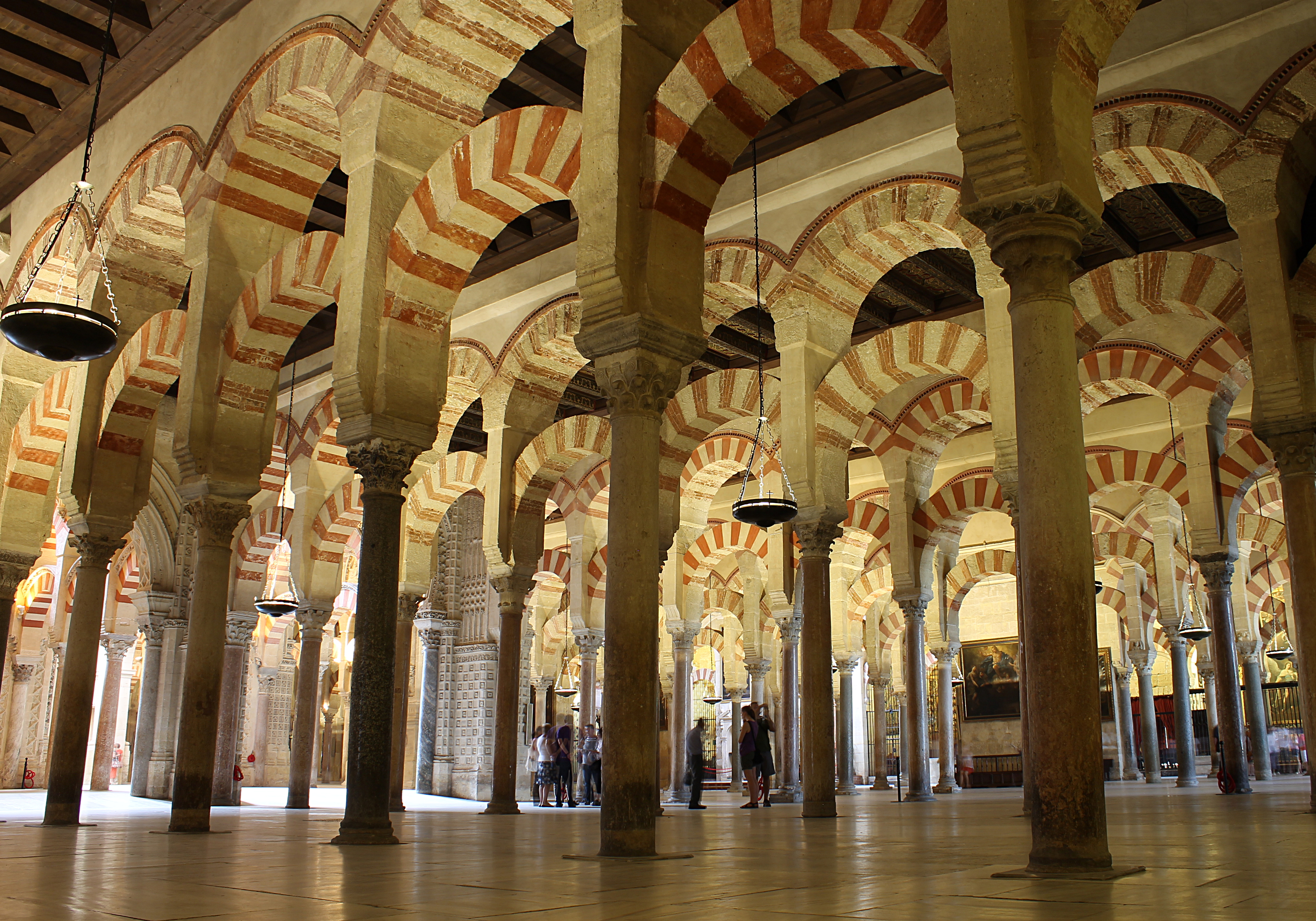
Abd ar-Rahman II also built substantially in Córdoba and Seville, established the first Andalusian state coinage, and conducted diplomatic relations with the Carolingian empire to the north (the embassy of the abbot Reginhard to Córdoba in 845-847 is one of the better-documented early-medieval European-Islamic diplomatic exchanges). The substantive emirate that he left at his death in 852 was substantially better integrated, more administratively sophisticated, and more culturally distinguished than the one he had inherited.
The road to the caliphate
The half-century after Abd ar-Rahman II's death was politically difficult. The reigns of Muhammad I (852-886), al-Mundhir (886-888), and Abdullah (888-912) saw substantial regional rebellions and a slow weakening of central authority. By the accession of Abd ar-Rahman III in October 912, the emirate's authority was limited to about a third of its nominal territory. Abd ar-Rahman III, at twenty-one years of age, inherited a state in serious institutional crisis.
His first eighteen years on the throne were spent reconquering the rebellious territories. The campaigns were systematic and brutal: Bobastro fell in 928; Toledo in 932; the Berber risings were suppressed by mid-decade; the Christian frontier was stabilised on roughly the line of the Duero river. By 929, the emir was the substantive master of the Iberian peninsula's Muslim territories from a position of strength unmatched by any of his predecessors. The political moment was ripe for the constitutional change that he then made.
The next chapter takes up the caliphal proclamation.
End of Chapter I