Córdoba
Córdoba · Spain
The Great Mosque (Mezquita-Catedral)

The single most important Andalusi monument. Founded by Abd ar-Rahman I in 786 on the site of the Visigothic cathedral of St Vincent (which had itself been built on the site of a Roman temple); expanded by Abd ar-Rahman II in the 830s, by Abd ar-Rahman III in the 950s, and by Al-Hakam II in 961-965 (the famous mihrab and the Byzantine-mosaic-decorated maqsura date to this expansion). After the 1236 Christian reconquest, the building was converted to a cathedral; a substantial Renaissance cathedral choir was inserted into the centre of the building in 1523. The result is one of the most architecturally distinctive religious monuments anywhere — a Muslim hypostyle-hall mosque with a Catholic Renaissance cathedral built inside it. UNESCO World Heritage.
Madinat al-Zahra · Spain
The palace-city
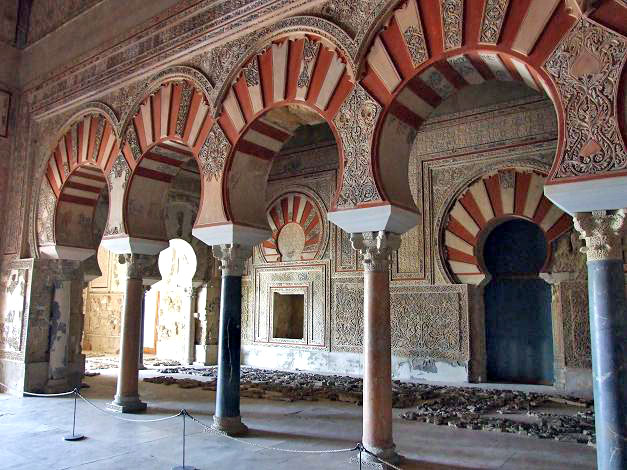
Eight kilometres west of Córdoba, at the foot of the Sierra Morena. The partially-excavated remains of the new palace-city built by Abd ar-Rahman III between 936 and approximately 976, destroyed in the fitna of 1010-1013, and never reoccupied. About ten percent of the 112-hectare site has been excavated. The surviving structures include substantial portions of the Salón Rico (the throne hall, with restored marble decoration), the upper-terrace residential rooms, the principal mosque foundations, and the elaborate hydraulic system. The on-site museum, opened in 2009, holds the excavated material in an architecturally distinguished Pritzker Prize-winning building (by the Spanish architectural firm Nieto Sobejano). UNESCO World Heritage since 2018.
Córdoba · Spain
The Jewish Quarter and the medieval city
The Judería — the medieval Jewish quarter of Córdoba, immediately adjacent to the Mezquita — preserves substantial Andalusi urban fabric. The fourteenth-century Sephardic Synagogue (built 1315, in modified late-Andalusi style) is one of the few surviving pre-1492 Iberian synagogues. The Maimonides statue in the Plaza de Tiberíades commemorates the Cordoban-born Jewish philosopher (1138-1204). The Casa de Sefarad museum on the Calle Judíos preserves substantial Sephardic-tradition material. The old Roman bridge over the Guadalquivir and the Roman gates of the medieval city walls preserve substantial pre-Islamic and Islamic-period fabric.
The other Andalusian cities
Granada · Spain
The Alhambra

The principal surviving Andalusi palace complex. Built principally between 1238 and 1492 by the Nasrid dynasty of the Emirate of Granada. The complex includes the Alcazaba (the original Nasrid citadel), the Comares Palace (with the great Hall of the Ambassadors), the Palace of the Lions (with its central courtyard fountain), and the Generalife (the upper summer-residence gardens). UNESCO World Heritage. The most visited tourist site in Spain; advance ticket booking is essential, often months ahead in peak season. The associated Albaicín quarter — the surviving Muslim residential district below the Alhambra — preserves substantial medieval urban fabric.
Seville · Spain
The Almohad and Mudejar inheritance
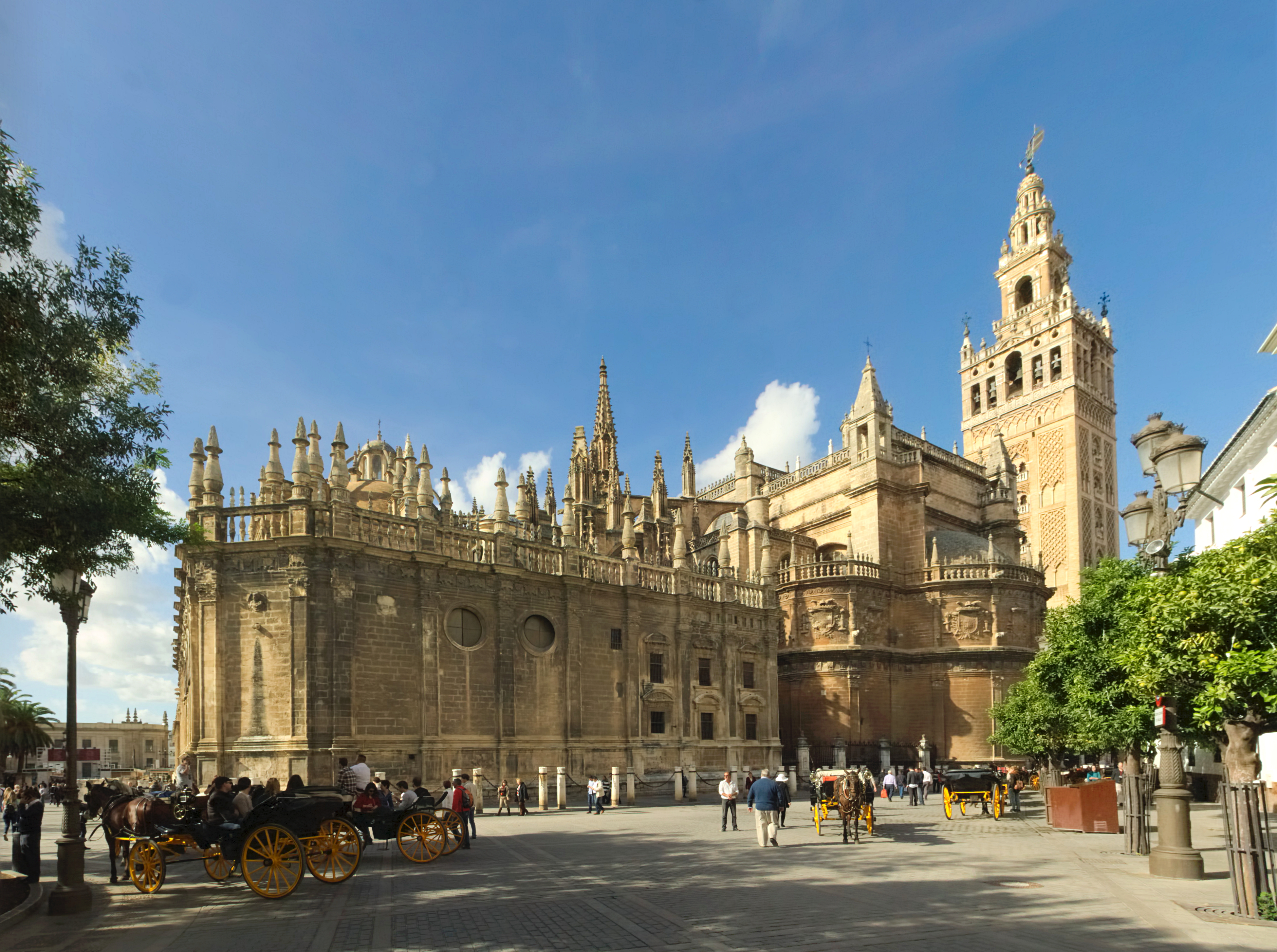
The Reales Alcázares of Seville — the royal palace originally built on Almohad foundations and substantially expanded by the Christian kings of Castile in the fourteenth century — is the principal surviving Mudejar palace complex (the Mudejar style being the Andalusi-Islamic architectural tradition continued by Christian patrons in post-Reconquista Iberia). The Giralda — the bell-tower of Seville Cathedral, built as the minaret of the Almohad principal mosque in the late twelfth century — is the principal surviving Almohad monument anywhere. The cathedral itself is the largest Gothic cathedral in the world by volume and was built on the site of the Almohad mosque after the 1248 Christian reconquest.
Toledo · Spain
The translation school
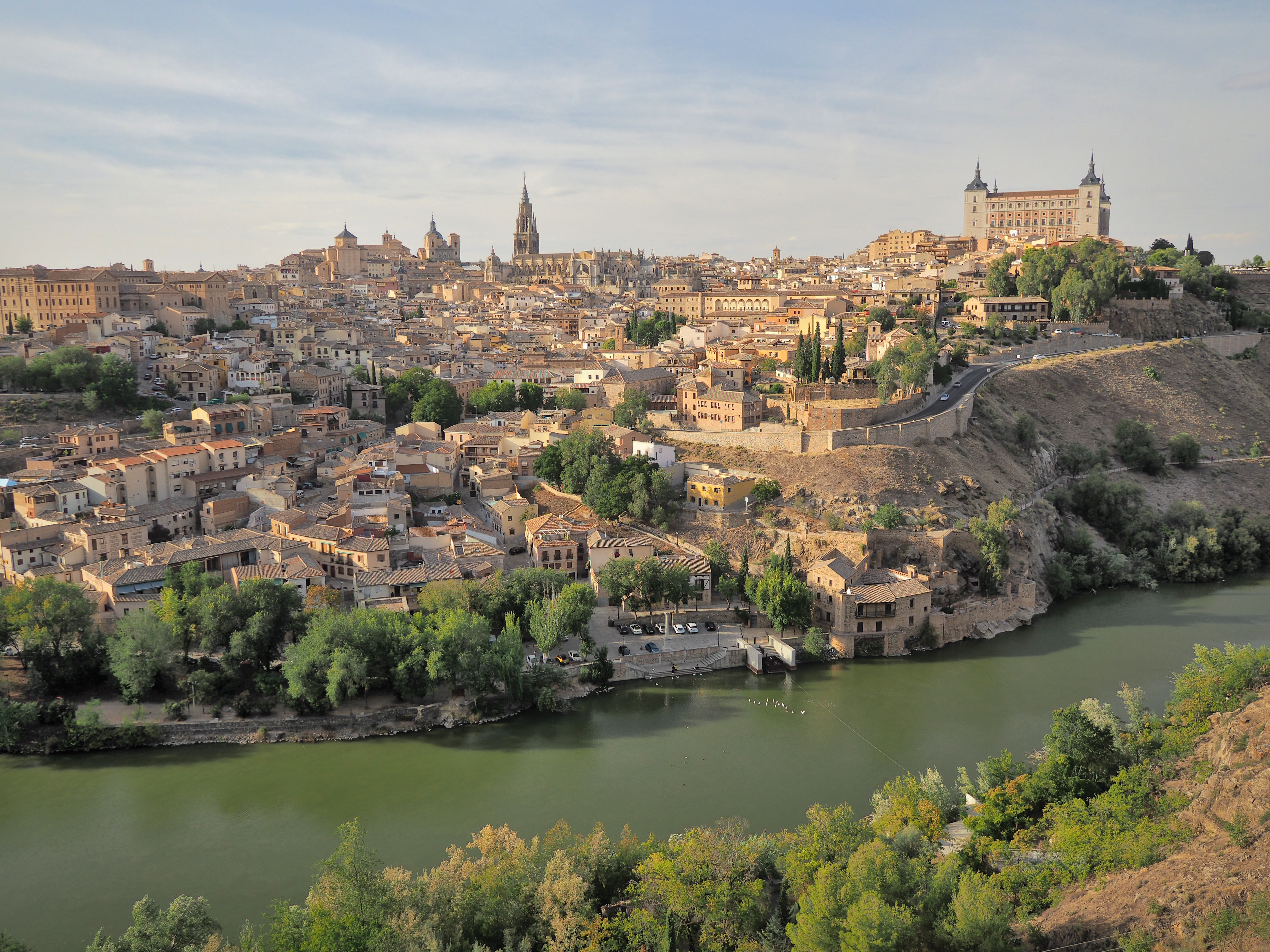
The medieval capital of the Visigothic kingdom (until 711), of the Toledan caliphal-period taifa state, and of post-1085 Christian Castile until the seventeenth century. The principal surviving Andalusi monument is the small Cristo de la Luz Mosque (built 999, one of the oldest surviving Andalusi-period buildings anywhere; converted to a Mudejar Christian chapel after 1085 but preserving its original Islamic structural fabric). The Santa María la Blanca synagogue (twelfth century, the oldest surviving synagogue building in continuous Europe) and the El Tránsito synagogue (fourteenth-century Mudejar) are major Jewish-tradition monuments. The Toledan cathedral — built over the principal mosque after 1085 — is one of the great Gothic cathedrals. UNESCO World Heritage.
Zaragoza · Spain
The Aljafería

The Aljafería palace — the late-taifa-period royal residence of the Hudid rulers of Zaragoza, built principally in the late eleventh century — is one of the most architecturally distinguished surviving taifa monuments. The complex preserves the substantial central pavilion with its arabesque-decorated halls, the small mosque, and the surrounding gardens. The building was used by the Christian kings of Aragón after the 1118 reconquest and substantially expanded; the medieval Christian additions are substantial but the underlying taifa fabric is well-preserved. UNESCO World Heritage.
Almería · Spain
The Alcazaba

The Alcazaba (citadel) of Almería is the second-largest Andalusi fortress complex on the peninsula, after the Alhambra. Founded by Abd ar-Rahman III in 955 as the principal Mediterranean port of the Caliphate, substantially expanded under the eleventh-century taifa kings. The site preserves the three principal terraces of the original fortification, with substantial surviving caliphal-period and taifa-period walling. The associated medieval town below the Alcazaba preserves substantial Mudejar urban fabric.
Morocco
Fez · Morocco
The Andalusian quarter
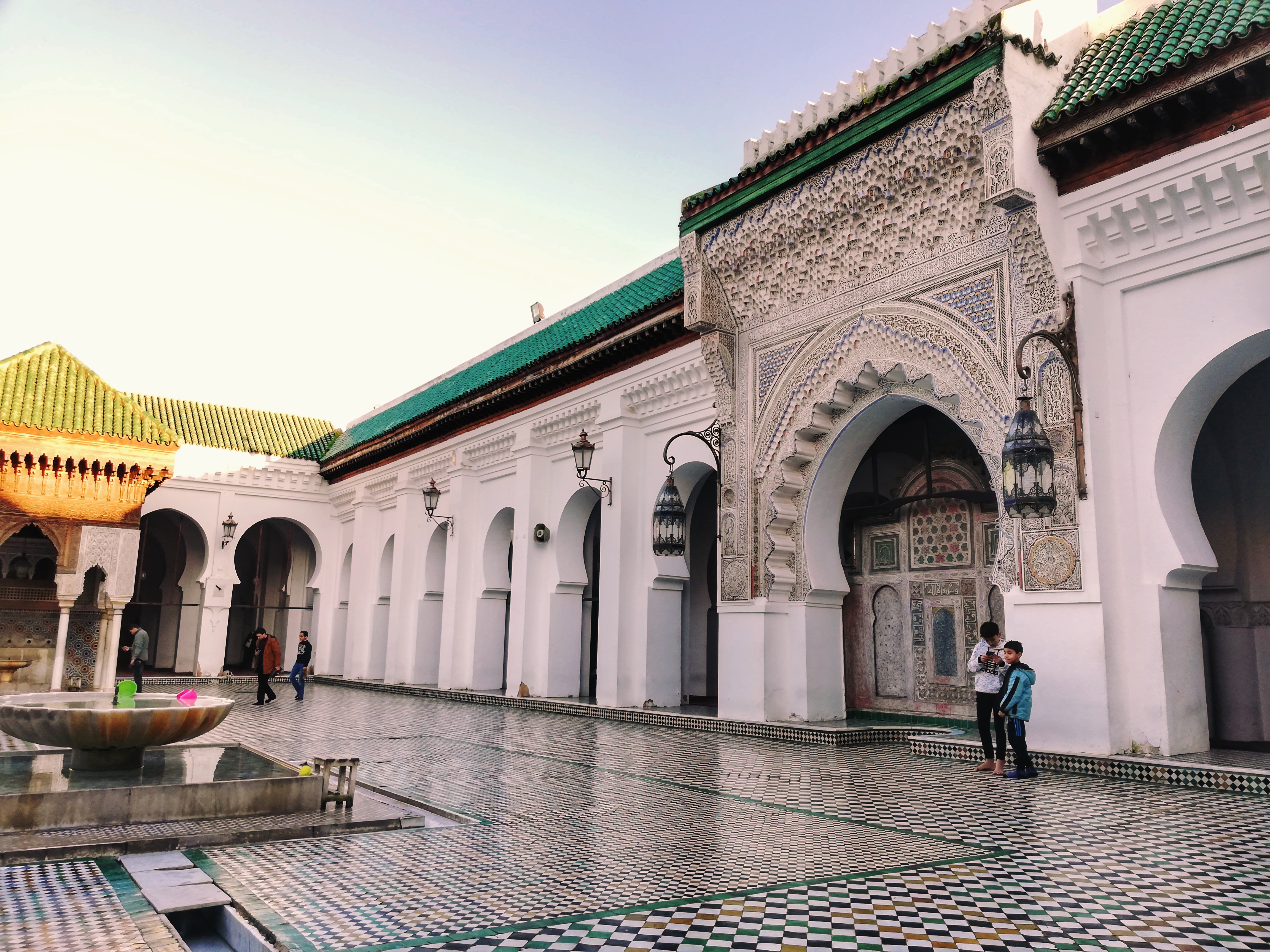
The Fez al-Andalus quarter — the eastern half of the medieval city of Fez — was founded in 859 by Andalusian Muslim refugees from Córdoba (fleeing factional violence under Al-Hakam I), with the parallel Qarawiyyin quarter founded the same year by Tunisian Muslim refugees. The Andalusian Mosque (built 859, expanded substantially in the eleventh and twelfth centuries) is the principal surviving Andalusi-tradition mosque in Morocco. The University of al-Qarawiyyin, founded 859 in the parallel Qarawiyyin quarter, is the oldest continuously operating university in the world by some accountings. The Fez medieval medina is UNESCO World Heritage. The contemporary Andalusian musical conservatory at Fez maintains the principal Moroccan tradition of Andalusian classical music.
Tetouan · Morocco
The Morisco capital

The Moroccan city most directly descended from the post-1609 Morisco expulsion. Tetouan was substantially rebuilt by the Morisco emigrants in the early seventeenth century and preserves, in its medieval medina, substantial Andalusi-tradition urban architecture. The local Andalusian musical tradition (the Tetouan ala nuba) is one of the principal contemporary Moroccan Andalusian-music repertoires. UNESCO World Heritage.
Marrakech · Morocco
The Almohad capital

Founded in 1062 as the Almoravid capital and substantially developed under the Almohads (1147-1269) as the western Maghreb's principal city. The principal Almohad monument is the Koutoubia Mosque (1147-1199), with its 77-metre minaret that served as the model for the Giralda of Seville and the Hassan Tower of Rabat. The associated city walls, the Saadian Tombs (a later Saadi-period addition), and the medieval medina constitute the principal surviving Almohad architectural complex. UNESCO World Heritage.
The Sephardic diaspora
Istanbul · Turkey
The Sephardic settlement

The Ottoman Empire's reception of the Sephardic Jews after 1492 produced one of the major Jewish communities of the early modern period. Sultan Bayezid II reportedly remarked: "How can you call King Ferdinand wise? He has impoverished his country and enriched mine." The principal Sephardic neighbourhoods of medieval and early-modern Istanbul (Hasköy, Balat, the Galata district) preserved Ladino-speaking populations through the early twentieth century; substantial cultural inheritance survives in the contemporary Turkish Jewish community. The Ahrida Synagogue at Balat, the oldest surviving Istanbul synagogue, was founded by the Macedonian Jewish community before the Spanish arrival; the principal Spanish-Sephardic synagogues of the early modern period were elsewhere in Balat and have been variously preserved.
Salonika · Greece
The Mother of Israel

Salonika (Thessaloniki) was, from the late fifteenth century to the German occupation of 1941-1944, the principal Sephardic Jewish city of the eastern Mediterranean. At its early-twentieth-century peak the Jewish community of the city numbered about eighty thousand — the city's substantial majority — with about forty synagogues, a Sephardic religious court, an active Ladino press, and a Sephardic cultural and economic infrastructure. The community was substantially destroyed by the German deportations of 1943; about ninety-five percent of Salonika's Jewish population was murdered in the Auschwitz-Birkenau and other death camps. The remaining community of about a thousand survivors and returnees rebuilt a small post-war Jewish presence. The Jewish Museum of Thessaloniki, the Monastir Synagogue (the principal surviving synagogue of the original Sephardic settlement), and the Holocaust Memorial at the city's eastern Jewish cemetery preserve the substantial inheritance.
The libraries
El Escorial · Spain
The royal library and its Arabic collection

The Royal Monastery of El Escorial, outside Madrid, was built by Philip II of Spain between 1563 and 1584. The royal library on the upper floor of the complex holds approximately 2,000 Arabic manuscripts of Andalusi provenance — substantially the largest surviving collection of medieval Arabic manuscripts in Spain. The collection was substantially built up from the seizure of Morisco libraries during the post-1492 period and from the seizure of the library of the Saadian Sultan of Morocco in 1612 (when a Spanish naval expedition captured the sultan's substantial book collection at sea, transporting it to El Escorial as a state prize). UNESCO World Heritage.
Tunis · Tunisia
The National Library and the Andalusi manuscripts

The National Library of Tunisia holds substantial collections of Andalusi-tradition manuscripts brought to North Africa by the post-1492 and post-1609 Morisco emigrants. The associated medieval medina of Tunis (UNESCO World Heritage) preserves substantial Andalusi-tradition urban fabric in its Sidi Bou Saïd district and elsewhere. The contemporary Tunisian Andalusian-music tradition (the malouf) is one of the principal Maghrebi surviving traditions of caliphal-period Andalusian music.