From the fall of Constantinople in 1453 until the abolition of the republic in 1797, Venetian foreign policy was, at root, a single question: how does a Mediterranean trading republic of one million subjects coexist with an Ottoman Empire of perhaps twenty million inhabitants and a standing army of more than a hundred thousand men, on the borders of which sit the Venetian colonial possessions of greatest value? The answer the republic worked out — by trial and considerable error — was simultaneously to trade with the Ottomans, to fight them when forced, to lose to them slowly, and never to pretend that any single defeat was decisive. Across three hundred and forty-four years, this strategy preserved the republic. It also lost the empire.
Six Ottoman-Venetian wars
Historians conventionally count six full-scale wars between the Most Serene Republic and the Ottoman Empire, plus a number of smaller conflicts and a near-permanent corsair war at sea. The first (1463–1479) cost Venice Negroponte, Lemnos and Scutari, and produced the indemnity payment that left the republic financially weakened for a generation. The second (1499–1503) cost it the ports of Modon and Coron in the Peloponnese — a serious strategic loss, because Modon and Coron were the principal Venetian way-stations for the muda voyages to the Levant. The third (1537–1540) was fought as part of the so-called Holy League with Spain and the Papacy, and ended with the loss of Nauplion, Monemvasia, and most of the remaining Aegean possessions. The fourth (1570–1573) was the Cyprus War, ending with the loss of that island. The fifth (1645–1669) was the Cretan War, ending with the loss of Crete after a twenty-one-year siege. The sixth (1684–1699), the Morean War, was the one war Venice unambiguously won, recovering most of the Peloponnese — only to lose it again in 1718.
Cyprus and Famagusta
Cyprus had come into the Venetian Stato da Mar in 1489, after a complicated diplomatic episode in which the widowed queen of Cyprus, the Venetian noblewoman Caterina Cornaro, was persuaded to abdicate in favour of the republic. The island was strategically valuable: a major sugar producer, a stopover for Levant trade, a forward base for fleet operations. In 1570 it was attacked by an Ottoman expeditionary force under Lala Mustafa Pasha. Nicosia fell in September. The second city, Famagusta, held out for eleven months under the command of Marcantonio Bragadin. When it surrendered in August 1571, Bragadin was promised safe-conduct. The promise was reneged upon: he was tortured, his nose and ears cut off, then flayed alive in the public square of Famagusta on the 17th of August. His skin was stuffed with straw and sent to the sultan in Istanbul.
Lepanto
The same year, on the 7th of October 1571, a combined Christian fleet — Spain, Venice, the Papacy and the Knights of Malta, totalling some two hundred and seven galleys and six oared galleasses — met the main Ottoman fleet under Ali Pasha at the entrance to the Gulf of Patras in western Greece. The battle of Lepanto lasted about four hours. The Ottoman fleet was, by the standards of the period, annihilated: roughly two hundred and ten Ottoman vessels were sunk, captured or destroyed; perhaps thirty thousand Ottoman seamen and marines were killed; Ali Pasha himself was killed. Christian losses were heavy too — about twelve galleys sunk, nine thousand dead — but the strategic outcome was clear. It was the first major Ottoman naval defeat in over a century.
It was also strategically inconclusive. The Ottomans rebuilt their fleet within a single year. Cyprus, the casus belli, remained Ottoman. The Christian alliance fractured within months. Venice, abandoned by its allies and unable to continue the war alone, signed a separate peace with the sultan in 1573 that formally ceded Cyprus, paid an indemnity of three hundred thousand ducats, and resumed trading relations on Ottoman terms.

Lepanto thus illustrates a paradox of Venetian-Ottoman warfare: the republic could win battles but not wars, because it could not match Ottoman demographic and fiscal depth over a long campaign. The Venetian Senate understood this very clearly. The standard Venetian war-aim in any Ottoman conflict was not to defeat the empire but to fight long enough to extract a settlement that lost as little as possible. The diplomatic apparatus that achieved these settlements — Venetian ambassadors at the Sublime Porte, the baili, were the most experienced corps of professional diplomats in early modern Europe — was, in some respects, the republic's most important strategic asset.
Candia
The fifth and most attritional of the wars was the Cretan War of 1645–1669, fought entirely over the island of Crete and especially its capital, Candia (modern Heraklion). The siege of Candia lasted twenty-one years, four months, and twenty-seven days. It is conventionally counted as the longest single siege in recorded military history. The Venetian garrison, never more than a few thousand strong at any one time and supplied by sea, repelled assault after assault. The Ottomans rotated armies in and out, sometimes thirty thousand men at a time. Engineers on both sides invented and counter-invented forms of siege warfare that anticipated the trench warfare of the twentieth century by two hundred and fifty years. The total casualty count was, on the most conservative estimates, in excess of a hundred and twenty thousand dead from combat, disease and starvation. The city finally surrendered on terms in September 1669, after the new Venetian commander Francesco Morosini was forced by exhaustion of supplies and reinforcements to negotiate. The Ottoman commander, Köprülü Fazıl Ahmet Pasha, granted unusually generous terms: the garrison was allowed to leave under arms, with all archives, weapons, and as many civilians as wished to accompany them.
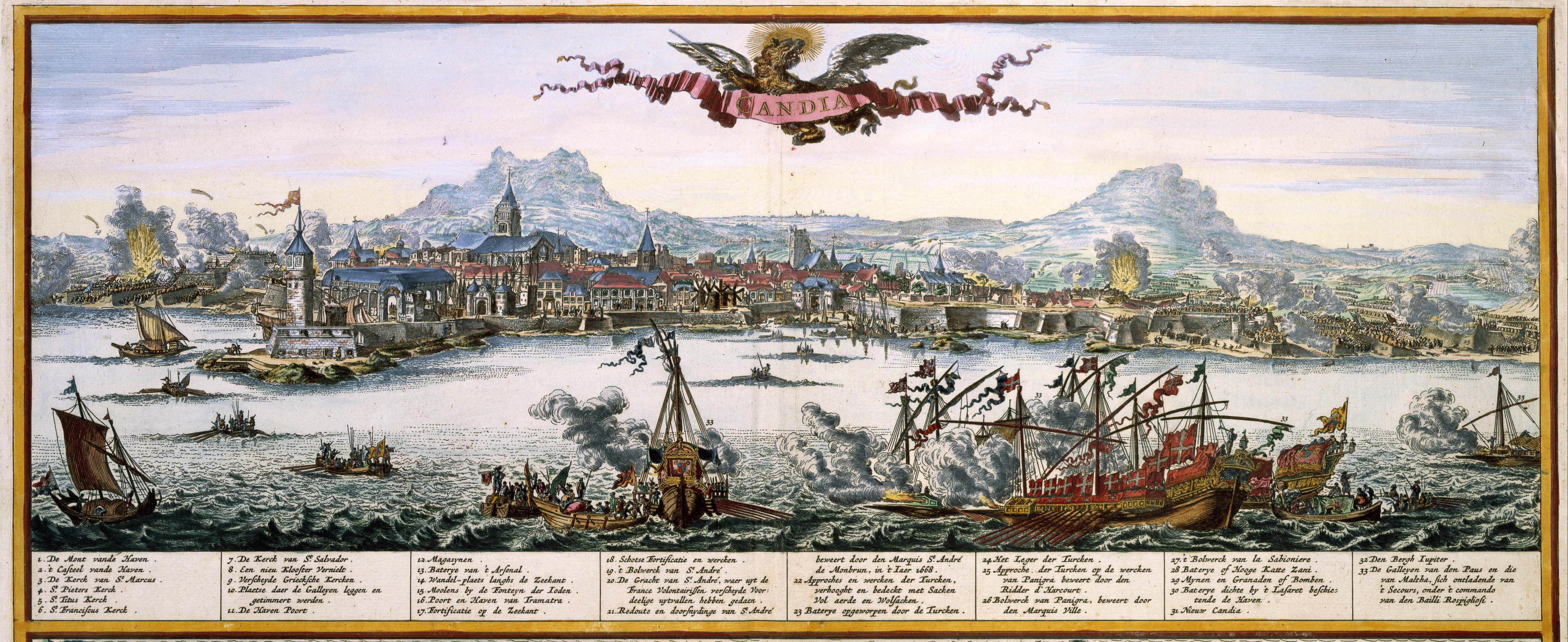
The fall of Candia ended Venetian rule in Crete after four hundred and sixty-five years, and removed the last major Venetian commercial-strategic asset in the eastern Mediterranean. The smaller islands and ports — Tinos, Cythera, the Ionian islands — remained, but the Stato da Mar as a productive economic empire had effectively ended.

The Morean revival, brief
In 1684, with the Ottomans absorbed in their second siege of Vienna and its aftermath, Venice joined the Holy League and reopened the war. Francesco Morosini, the same Morosini who had surrendered Candia fifteen years earlier, led a Venetian army into the Peloponnese (the Morea), captured almost all of its fortified cities, and in 1687 occupied Athens. It was during the siege of Athens that a Venetian mortar shell, fired from a battery on the Philopappos hill, hit a powder magazine the Ottomans had stored inside the Parthenon. The resulting explosion blew the centre of the temple out, destroying the cella, the colonnade on three sides, and most of the sculptural programme of the inner frieze. It is the single most consequential act of architectural destruction in the early modern Mediterranean.
The Morean conquest was confirmed at the Treaty of Karlowitz in 1699, the first time in the long Venetian-Ottoman relationship that Venice had been on the winning side. The conquest did not last. In 1715 the Ottomans recovered the Morea in a single summer campaign, against a Venetian provincial administration that had alienated the Greek population through fiscal pressure and a Catholic ecclesiastical policy that they neither needed nor wanted. By 1718 the war was over. Venice held the Ionian islands, a tiny handful of Adriatic outposts, and the metropolitan republic itself. The Stato da Mar, as a coherent territorial structure, had ceased to exist.
The next chapter is the long, prosperous, and increasingly anachronistic eighteenth century, during which Venice abandoned strategic ambition entirely and reinvented itself as the carnival capital of Europe.
End of Chapter VII