By 1450 the Republic of Venice was a country of about 180,000 metropolitan inhabitants and perhaps a million subjects across the Stato da Mar and a recently expanded mainland province, the Stato da Terra. It deployed a fleet of more than three thousand vessels of all sizes, of which between eighty and a hundred were state-owned war galleys. It traded in everything that moved in the Mediterranean economy: silk and damask from the Levant, pepper and spices from Alexandria, wheat from the Black Sea, sugar from Cyprus, wine from Crete, slaves from the Tartar steppe, salt from its own lagoon. It minted a gold ducat — the zecchino — that for two centuries was the most trusted unit of account in the Mediterranean. And it built all of this with a single industrial-scale shipyard.
The Arsenal
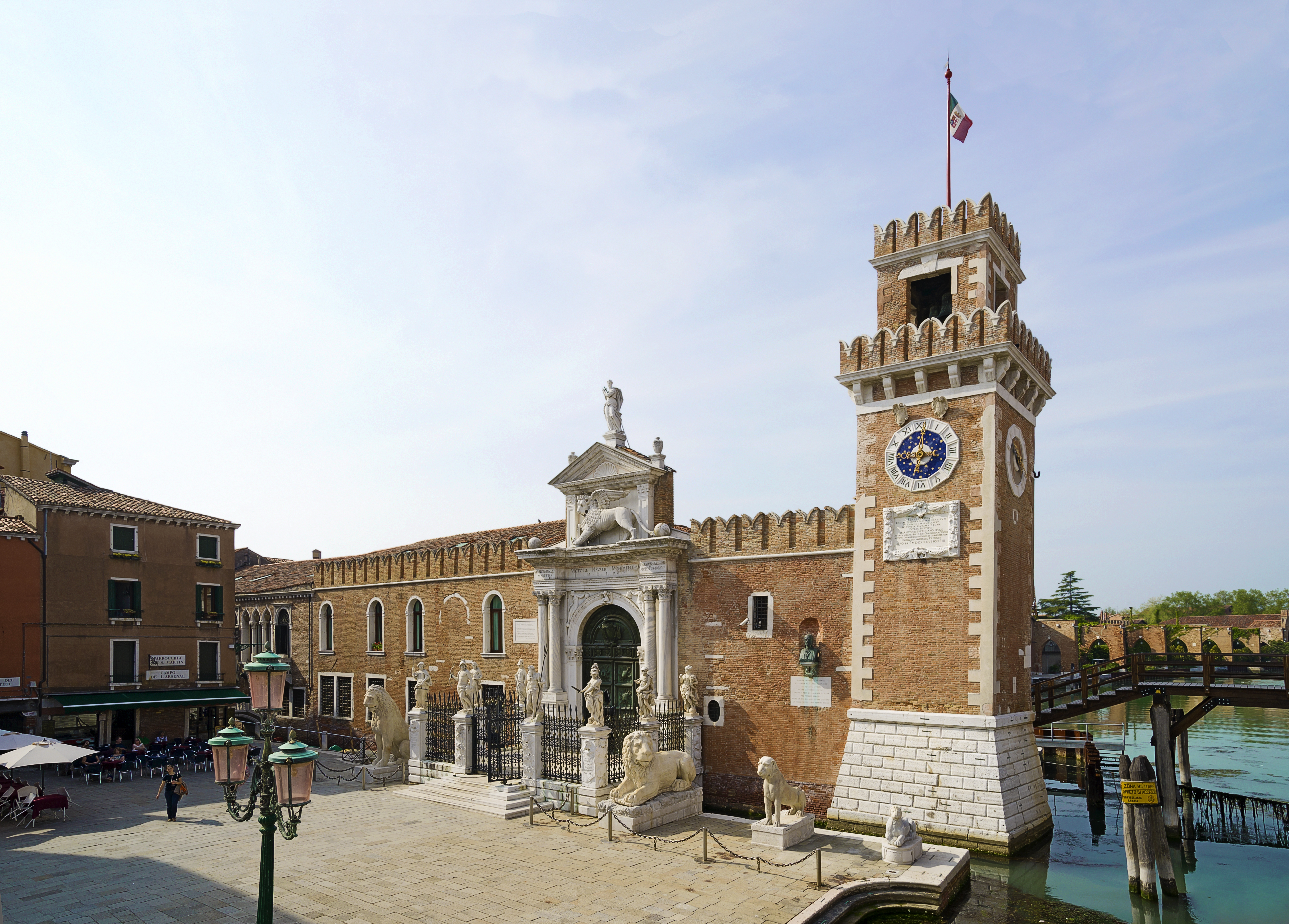
The Arsenale di Venezia, in the eastern part of the city, was the largest single industrial complex in pre-industrial Europe. At its peak in the early sixteenth century it employed roughly sixteen thousand workers — called arsenalotti — across some fifty hectares of enclosed shipyards, warehouses, foundries, rope-walks, gunpowder works, sail lofts and biscuit ovens. It produced, in its standard pattern, a state-owned war galley every twelve to fifteen days when running at full capacity. In a crisis, as in 1570 when Venice was preparing for the war that would end at Lepanto, it produced one a day for several weeks.
The Arsenal was, in everything but name, an assembly line. The hull was laid down in one shed, then towed by water to the next, where the deck was fitted; thence to the next, where the masts were stepped; and so on, with the half-finished galley moving through a sequence of stations at each of which a specialised team did its work. The Spanish ambassador Pero Tafur, visiting in 1436, describes a galley moving down a long water-channel and being fully fitted out with rigging, weapons, sail and oars from depots on either bank, "as a person passing a counter at which they are given everything they need". This is, to the best of any historian's knowledge, the earliest documented example of factory-style production in European history. It was managed by a board of three patricians called the Provveditori dell'Arsenale, audited annually, and operated continuously from 1104 to 1797 — almost seven hundred years of unbroken industrial activity.
The galley
The Venetian war galley of the late fifteenth century was a long, low-built oared vessel, typically forty metres long and five metres in beam, with a single bank of oars worked by free professional rowers — not, as is often supposed, by slaves; Venetian war galleys used buonavoglie, paid volunteers, and condemned criminals only as a supplement. A typical war galley carried about a hundred and seventy-five oarsmen, a sailing master and crew of about thirty, twenty marines, a few gunners after the late fifteenth century, and an officer corps drawn from the patrician class. The galley was fast over short distances, manoeuvrable in coastal waters, and devastating in head-on combat because of the heavy ram and forward-mounted artillery on its prow. It was useless in winter — galleys did not put to sea between November and February — and limited in range, which is why Venetian naval strategy depended on a chain of friendly harbours from the lagoon to Cyprus.
Alongside the war galley, the Arsenal also built the galera grossa, the great merchant galley, a larger and more rounded vessel intended for the high-value muda voyages — the convoyed trade fleets that left Venice each spring for Alexandria, Beirut, Constantinople, Flanders, and the Black Sea. The mude were state-organised, state-protected, and bid for by private merchants in annual auctions at the Senate. They were one of the most successful pieces of commercial infrastructure in medieval Europe. A merchant who bid successfully on a place aboard a muda galley could send a few crates of spices or silk to Bruges, knowing that a state warship would convoy his investment, that the prices at the far end were known and posted, and that the galley would return on schedule with the receipts. Over two centuries of operation, the muda system enabled a level of commercial predictability that no other Mediterranean republic offered.

What was traded
The composition of Venetian trade in this period was almost entirely east-to-west, with manufactured goods (textiles, especially) flowing east in modest quantities and high-value oriental commodities flowing west in much larger quantities. Pepper was the dominant single commodity by value — perhaps a third of all Venetian commercial revenue in the fifteenth century. Other spices (ginger, cinnamon, mace, cloves), silk in various forms (raw, woven, embroidered), cotton, sugar (especially from Cyprus), wine (from Crete and Naxos), wheat (from the Black Sea), alum (from Phocaea in Asia Minor), slaves (from the Crimea, on a much smaller scale than the Genoese, but real), and luxury manufactured goods (Venetian glass, Murano mirrors, Venetian printing — Aldus Manutius was setting up his press at this period — and Venetian books) made up the bulk of the rest.
The Stato da Terra
Almost as an afterthought, in the period 1404 to 1454, the republic acquired a substantial mainland empire. The cities of Padua, Vicenza, Verona, Belluno, Feltre, Brescia, Bergamo and Crema all came under Venetian sovereignty, mostly by treaty or by deferred surrender, occasionally by force. The motive was strategic: the Visconti dukes of Milan were expanding aggressively, and a continental land buffer was a hedge against Milanese pressure on the lagoon's salt and grain supplies. The mainland conquest produced, by 1454, a Venetian state whose population centre of gravity had shifted from the lagoon to the terraferma. Padua alone had a population of roughly forty thousand; Verona another forty thousand. The mainland brought new income (taxes, agricultural rents), new strategic depth, and new vulnerabilities — the cities of Brescia and Bergamo lay close to Milan and were repeatedly the front line in the long Venetian-Milanese wars.

By 1500 the republic was at its territorial maximum. Its government was, by the standards of its century, exceptionally well-organised; its navy was the largest in the Mediterranean; its commercial network spanned from London to Trebizond; and its political class numbered about twenty-five hundred families inscribed in the Golden Book. The next two centuries — the long Ottoman wars, the loss of Cyprus, the loss of Crete, the gradual relocation of world trade away from the Mediterranean to the Atlantic — would chip at all of this. But for one century, between roughly 1450 and 1550, Venice was richer, better-governed, and more powerful than at any other point in its eleven-hundred-year history. The fall of Constantinople in 1453 had transferred the Levantine trade entirely into Ottoman hands, but the Ottomans had also concluded — within a year — that they needed a Venetian commercial counter-party more than they needed an enemy. The trade continued, on Ottoman terms. The next chapter is the story of what eventually went wrong.
End of Chapter VI