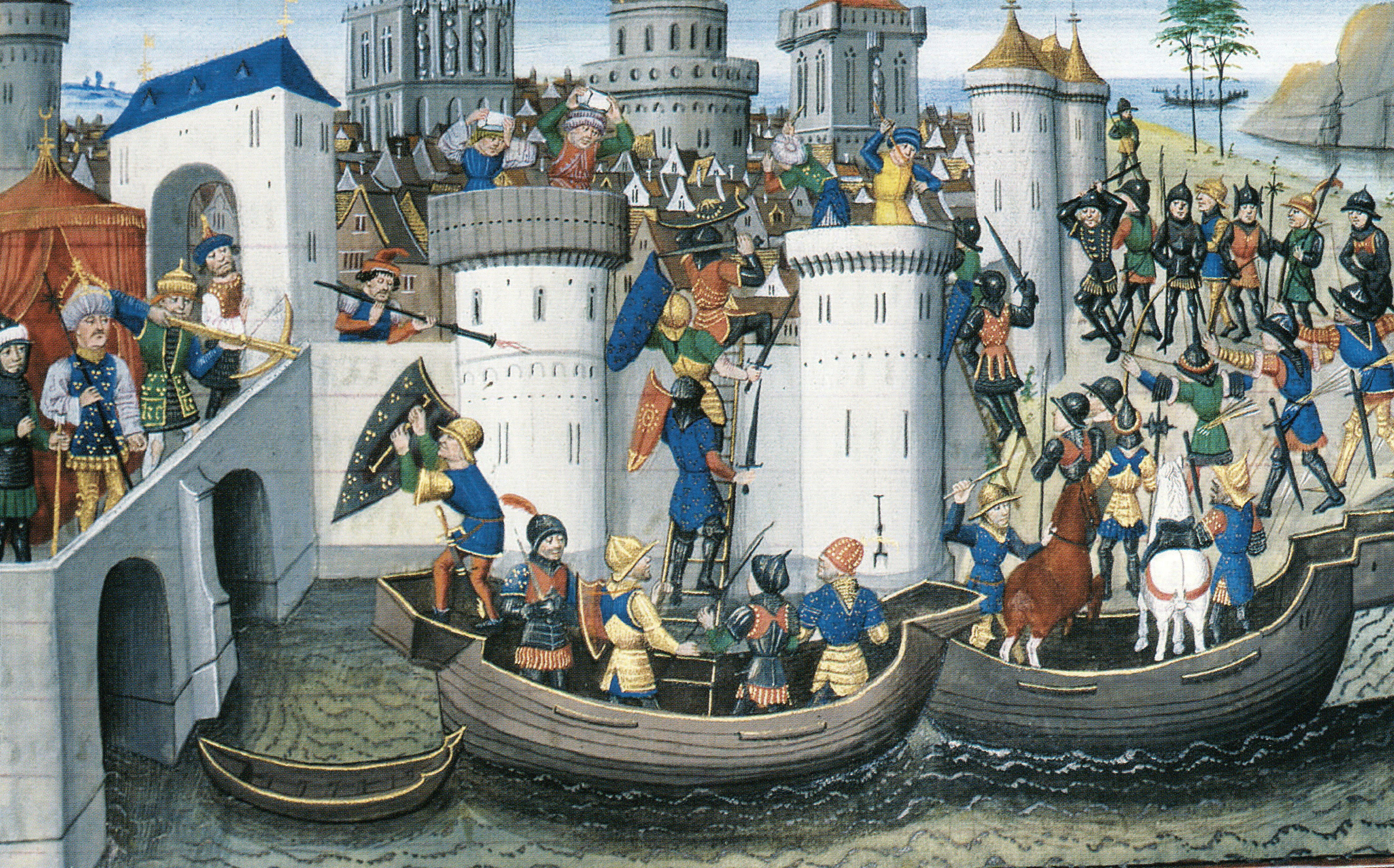
There is a particular morning in April of the year 1204 that the Venetian state, at the height of its power, preferred not to discuss in detail. On the 12th of April, after a siege of three months by the combined armies of the Fourth Crusade, the city of Constantinople fell. The Crusaders sacked it for three days. Constantine the Great's mausoleum was broken open. The Hagia Sophia was looted of its silver fittings, its altar reportedly chopped into souvenirs. The bronze horses that had stood above the Hippodrome since the reign of Septimius Severus were taken down by the Venetians and shipped to Venice. Forty thousand civilians, by the contemporary Greek estimate of Nicetas Choniates, were murdered. Many tens of thousands more fled. The single largest concentration of classical, Hellenistic and early Christian art in the world was, in three days, broken up and distributed across Latin Europe. Venice's share was one-quarter of the empire — a literal one-quarter, written down in the partition treaty as the quarta pars et dimidia totius Imperii Romaniae. From this morning Venice became, formally and overnight, a colonial empire.
How it began — the doge and the camp at Zara
The Fourth Crusade had been called by Pope Innocent III in 1198. Its target was Egypt, the soft underbelly of the Ayyubid sultanate, with the strategic intention of recovering Jerusalem by a flanking manoeuvre. The Crusaders — mostly French and Flemish, under the nominal leadership of Boniface of Montferrat — needed ships. They contracted with Venice for the transport: thirty-three thousand five hundred men and four thousand five hundred horses, in a fleet of fifty galleys and four hundred and fifty transports, at a price of eighty-five thousand marks. The contract was negotiated by Enrico Dandolo, the doge of Venice, who was at this point ninety-one years old, blind from cataracts or perhaps from a head injury sustained decades earlier in Constantinople, and one of the most formidable strategists of his century.
The Crusaders arrived at the Lido in the summer of 1202. They were short — by about a third — of the eighty-five thousand marks. Dandolo proposed a deal: the Crusaders would pay what they could, and the balance of the debt would be retired by capturing, on Venice's behalf, the rebellious Dalmatian city of Zara, which had renounced Venetian rule in favour of the king of Hungary. The Crusaders, after considerable internal dissent — Zara was a Christian city, and the king of Hungary was a Crusader — agreed. Zara was taken in November 1202. The pope excommunicated the entire Crusade.
While the Crusade was wintering at Zara, the deposed Byzantine prince Alexios Angelos — son of the blinded emperor Isaac II — arrived in camp with a proposal. If the Crusaders would help him recover his father's throne in Constantinople, he would: pay the entire balance of the Venetian debt, give the Crusade two hundred thousand marks in addition, supply ten thousand men and food for a year, and unite the Greek and Latin churches under papal supremacy. After more dissent — and considerable preaching by both bishops and dissenting knights who refused on principle — the offer was accepted.
The first sack and the second
The Crusader fleet appeared off Constantinople in June 1203. The city had walls fifteen kilometres long, defended by garrisons that had repelled Avars, Persians, Arabs, Bulgars and Russians for eight centuries. They had never been forced. They were forced — partially — in July 1203, when the Venetians under Dandolo took the harbour wall by a combined ladder-and-ship assault, and the Crusaders, simultaneously assaulting the land wall, broke into the Blachernae district. The reigning emperor Alexios III fled. Isaac II was restored, his son crowned co-emperor as Alexios IV.
The promised payments did not materialise. The Greek populace, now openly hostile to the new emperor, revolted in late January 1204 and murdered Alexios IV. His replacement, the anti-Latin nobleman Alexios V Doukas (called Murtzouphlos), refused to honour the agreement at all. The Crusaders, now stranded outside an unsympathetic capital with no money and a winter behind them, agreed at Dandolo's urging to take the city for themselves. The second assault came on the 9th of April 1204. The walls held. They tried again on the 12th. The walls did not hold. The sack lasted three days.

The partition
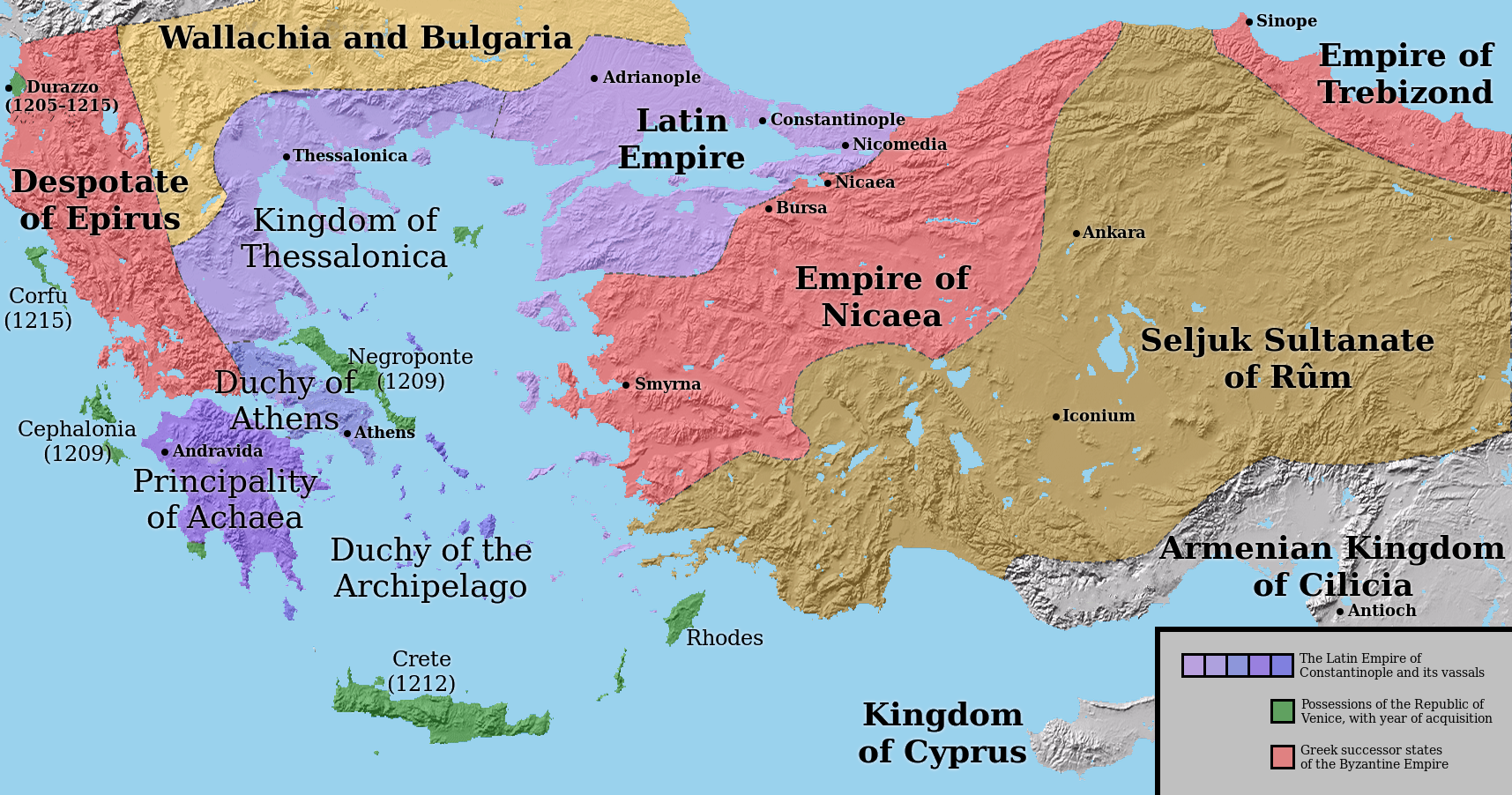
The Crusade leadership immediately drew up a treaty — the Partitio Romaniae — dividing the Byzantine Empire among themselves. A Latin emperor, Baldwin of Flanders, was crowned in Hagia Sophia. A new Latin Patriarch was installed. And the Venetian portion was carved out: three-eighths of the city of Constantinople; the islands of Crete (which was sold to Venice by Boniface of Montferrat for a thousand silver marks, with possession actually taken by force from a rival Genoese landing only in 1212); the Cyclades; the southern Peloponnese; the Ionian islands of Corfu, Lefkada, Cephalonia and Zante (held by various Venetian noble houses as private fiefs); and an extensive list of trading posts along the Black Sea, the Sea of Marmara and the Aegean. The doge of Venice acquired, in addition to his existing title, the formula Dominator Quartae Partis et Dimidiae Totius Imperii Romaniae — "Lord of one-quarter and one-half of the entire Roman Empire" — which would be on the ducal seal until 1356.
Stato da Mar
This collection of territories — heterogeneous, scattered, mostly islands, all of it acquired by an act of violent betrayal — became known to the Venetian state as the Stato da Mar, the "State of the Sea". For the next three hundred years it would be the main commercial asset of the republic. Crete provided wine, oil, hides, sugar and a strategic anchor for the eastern Mediterranean trade. The Cyclades and Aegean islands provided silk, mastic and a network of safe-harbours for the trade galleys. The Adriatic and Ionian holdings secured the route from Venice to the eastern Mediterranean. Each territory was administered by a Venetian governor — a provveditore, baylo or rettore, depending on its rank — appointed for a fixed term of two or three years, audited at the end, and forbidden from acquiring local property or marrying locally. The administrative apparatus that made all this work was created, more or less from scratch, in the two decades after 1204.
Of the Stato da Mar, almost nothing now remains as Venice possessed it. Constantinople was recovered by the Byzantines under Michael Palaiologos in 1261, leaving Venice with only the islands and the Aegean trading posts. Negroponte (Euboea) was lost to the Ottomans in 1470. Cyprus, acquired by inheritance in 1489, was lost in 1571. Crete fell in 1669 after a twenty-one-year siege of Candia. The Ionian islands, the last surviving Venetian colonial holdings, passed to Bonaparte in 1797 along with the metropolitan republic itself. A few stone lions of St Mark, carved over the gates of harbour fortresses from Heraklion to Kotor, remain to mark where the Stato da Mar used to be. They are, mostly, all that remains.
The republic that had committed the crime of 1204 returned home with both the moral weight and the territorial profit. It would spend the next century reorganising its government to administer the empire it had not, until 1204, imagined possessing.
End of Chapter IV