01
Venice — Piazza San Marco
The ducal square

The political and ceremonial heart of the republic for nine hundred years. Visit the Doge's Palace early — the apartments of the doge, the chamber of the Maggior Consiglio with Tintoretto's Paradiso on its rear wall, the Council of Ten's chamber, the Bridge of Sighs to the prisons. Then San Marco, with the four bronze horses (replicas now; the originals are in the basilica museum) and the Pala d'Oro behind the altar. The Campanile gives the only good aerial view of the lagoon's geometry.
The line for the basilica is shorter at 9.45 a.m. than it is at 10.30. The line for the palace is shorter at 4 p.m. than at 11 a.m. Neither line ever fully disappears in summer.
02
Venice — Arsenale
The shipyard republic
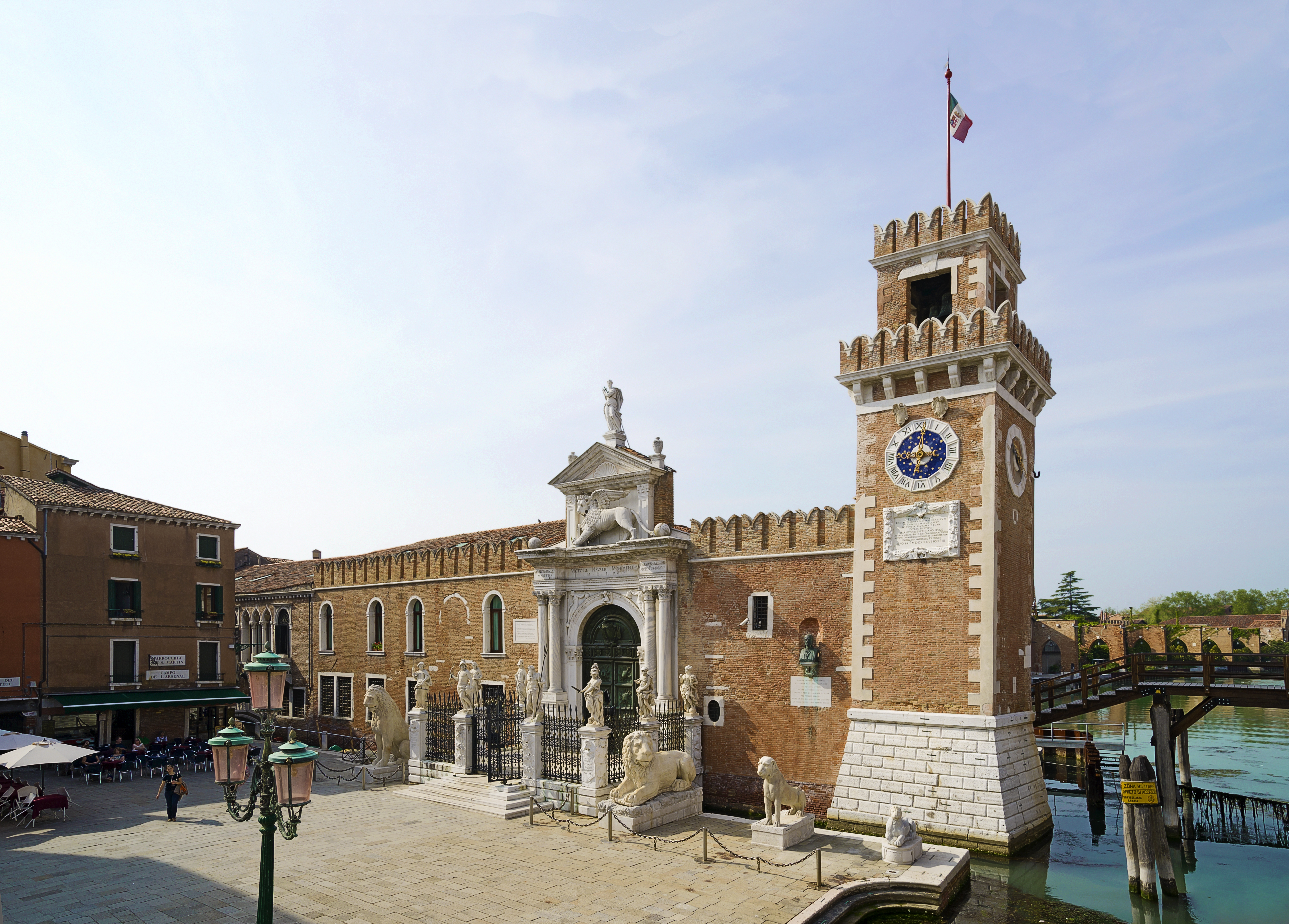
The largest industrial complex in pre-industrial Europe, walled off in 1104 and operated continuously until 1797. Most of the site is still controlled by the Italian Navy and inaccessible, but the Renaissance ceremonial gateway — the Porta Magna of 1460, with its flanking marble lions brought from Athens by Morosini in 1687 — can be photographed at any hour, and the Biennale opens substantial sections to the public during exhibition years.
Walk the perimeter wall along the Rio dell'Arsenal: it is about a kilometre long and gives a sense of just how big a fifty-hectare enclosed shipyard had to be in the age of oars and sail.
03
Torcello
The older Venice

For three centuries between 600 and 900 this was the largest and richest settlement in the lagoon — and you can still feel it. The cathedral of Santa Maria Assunta, founded in 639, contains in its apse one of the masterworks of Byzantine mosaic art on Italian soil: a Theotokos in gold leaf that was old when Marco Polo was a child. The neighbouring church of Santa Fosca, the small bishop's throne, and the half-buried Roman bridge make this the place to come if you want to understand what the lagoon looked like before Rialto became its capital.
04
Murano
The glass island
The glassmakers were ordered out of the city centre in 1291 — partly for fire safety, mostly to keep their trade secrets on a single guarded island. Their descendants are still here. The Museo del Vetro covers the history of Venetian glassmaking from Roman times to the present; the working furnaces along the main canal offer demonstrations to passers-by (the better ones charge for admission, which is a reasonable filter). The fifteenth-century church of Santi Maria e Donato has a mosaic floor of similar quality to San Marco's, with rather fewer cruise-ship visitors looking at it.
05
Padua (Padova)
The mainland capital
The most important city of the Stato da Terra, Venetian from 1405 to 1797. The Basilica of Saint Anthony of Padua and Donatello's equestrian statue of Gattamelata outside it are the most-visited landmarks; the Scrovegni Chapel of Giotto (a fifteen-minute visit booked in advance) is the most artistically important. But the unmissable Venetian-period building is the Palazzo della Ragione — the medieval law court — with its astonishing single-room interior and the wooden horse said to have been carved for a Venetian fifteenth-century court pageant.
06
Verona
The western frontier
Venetian from 1405 to 1797, with the exception of the period 1509–17 when it was held by Maximilian I. The Roman amphitheatre is the conspicuous tourist site; the Venetian heritage is more diffuse — the great winged lion of San Marco still presides over Piazza delle Erbe, the city walls were rebuilt twice on Venetian commission, and the Castelvecchio museum holds a substantial collection of paintings commissioned by the Venetian administration. The site of the Veronese Easter rising of 1797 (the trigger event for Napoleon's war) is marked on the Piazza Bra.
07
Zadar (Zara)
The Dalmatian capital
The principal city of the Venetian Stato da Mar in the eastern Adriatic, Venetian from 1409 to 1797 with brief Hungarian and Ottoman interludes. The Roman forum, the ninth-century church of St Donatus, and the Venetian-period sea walls remain. The single most striking Venetian survival is the gateway in the city walls — the Porta Terraferma of 1543, with a winged lion of St Mark that is one of the finest still in situ outside the lagoon. Sea-organ on the harbour edge is twenty-first century but worth the detour.
08
Kotor (Cattaro)
The fjord city
The southernmost major possession of the Stato da Mar, Venetian from 1420 to 1797. The walled town at the head of the Bay of Kotor is one of the most intact medieval Venetian colonial enclaves anywhere in the Adriatic; the climb up the fortifications to the church of San Giovanni gives a view of the bay that explains, instantly, why Venice wanted this harbour. Walk the old town in the early morning before the cruise ships arrive.
09
Corfu (Kérkyra)
The last colony
One of the Ionian islands, Venetian from 1386 to 1797 — the longest-held of all the Venetian Stato da Mar possessions, and the only one not at some point recovered by the Ottomans. Two great fortresses defend the harbour; the Venetian-built old town, with its narrow Venetian-stuccoed streets and shuttered houses, looks more like an annex of the lagoon than like anywhere else in the Greek world. The Old Fortress (the Palaio Frourio) was Venetian; the New Fortress (the Néo Frourio) was rebuilt by them in 1572.
10
Heraklion (Candia), Crete
The lost capital of the empire
Venetian from 1212 to 1669 — four and a half centuries of unbroken rule, the longest of any major Stato da Mar territory. The harbour entrance is guarded by the Venetian Koules fortress, still inscribed with the lion of St Mark; the old town's massive triple bastion walls are the most complete piece of Venetian military architecture in the eastern Mediterranean. The Archaeological Museum, world-famous for Minoan antiquities, is a less obvious draw on a Venetian itinerary, but the city's identity as a Venetian capital is everywhere, in the names of its squares (Eleftherias was the Piazza San Marco) and in the layout of the old port.