The Tet Offensive, opening on the early morning of the 31st of January 1968, was the most consequential single military operation of the war. The People's Army of Vietnam and the National Liberation Front, in a coordinated offensive across substantially the entire South Vietnamese territory, simultaneously attacked 39 of the 44 provincial capitals, 71 of 245 district capitals, all five autonomous cities (including Saigon), and a large number of American and ARVN military installations. The operation was a tactical defeat for the attacking forces — they failed to seize and hold any major urban centre except Huế, suffered substantial casualties (PAVN/NLF combat losses approximately 30,000 killed within the first month), and conducted the offensive at a substantial cost to the NLF's southern political-military infrastructure. The operation was also a substantial strategic-political victory: it definitively undermined the Westmoreland command's public position that the war was being won, it transformed American public opinion against continued escalation, and it produced the strategic reassessment that initiated the substantive American military disengagement of the next five years.
The planning
The Tet operation had been planned by the North Vietnamese politburo and the PAVN general staff across mid-1967, with the operational concept of a "general offensive and general uprising" — coordinated military attacks that would, the planners hoped, produce a spontaneous popular uprising in the urban areas and the collapse of the ARVN. The substantive military-political objectives were graded: at minimum, demonstrate that the war was not being won and force the Americans to a serious negotiation; at maximum, produce the collapse of the southern government. The expectation of urban uprising was substantially optimistic; the urban population, including the substantial Buddhist and student opposition to the Thieu regime, did not generally rise. The military objectives at the lower end of the gradient were comfortably achieved.
The American command had received substantial advance intelligence of the operation. The Khe Sanh siege opening on the 21st of January 1968 — a PAVN concentration around the American Marine combat base in the northern I Corps area — drew substantial American attention and was, in retrospect, partly intended as a strategic diversion that distracted the American command from the principal urban offensive nine days later. (The continuing scholarly debate over whether Khe Sanh was a principal Tet objective or principally a diversion is unresolved; the contemporary assessment is that the PAVN command intended it as a substantial commitment in its own right but accepted its utility as a diversion when the principal urban operations developed.) The cease-fire that traditionally accompanied the Tet lunar new year holiday, an officially recognised pause for family observance, contributed to lower ARVN garrison alertness on the night of the 30th-31st of January. The first PAVN/NLF attacks opened approximately 12 hours earlier than coordinated in some districts (the result of a timezone calculation error in the operational orders) and produced the first warning to the American command at approximately 3.00 a.m. on the 30th of January; the principal countrywide attacks came at approximately 3.00 a.m. on the 31st.
Saigon and the embassy
The most televised single episode of the Tet offensive was the attack on the American Embassy in Saigon by a nineteen-man NLF sapper team on the morning of the 31st of January. The sappers blew a hole in the perimeter wall, entered the embassy compound, killed five Marines and Vietnamese guards in the initial assault, and held positions in the compound for approximately six hours until killed or captured by American military police and Marines. The embassy chancery building itself was not entered; the operation was a tactical failure but a political success of substantial proportions, since the American television networks broadcast — within hours — footage of American forces fighting to recapture their own embassy compound in the capital of an allied country. The image was substantially incompatible with the Westmoreland command's December 1967 assurances of approaching victory.

The urban fighting in Saigon ran for approximately three weeks across February. The Cholon district — the principal NLF urban foothold — was reduced through substantial American and ARVN combat operations including the use of air strikes and artillery against urban targets. The Cholon operations produced the famous Eddie Adams Pulitzer Prize photograph of South Vietnamese General Nguyen Ngoc Loan executing the captured NLF officer Nguyen Van Lem at point-blank range with a snubnosed revolver — an image that, alongside the embassy attack footage and the Huế civilian casualties, became one of the iconic visual representations of the war in American public memory.
Huế
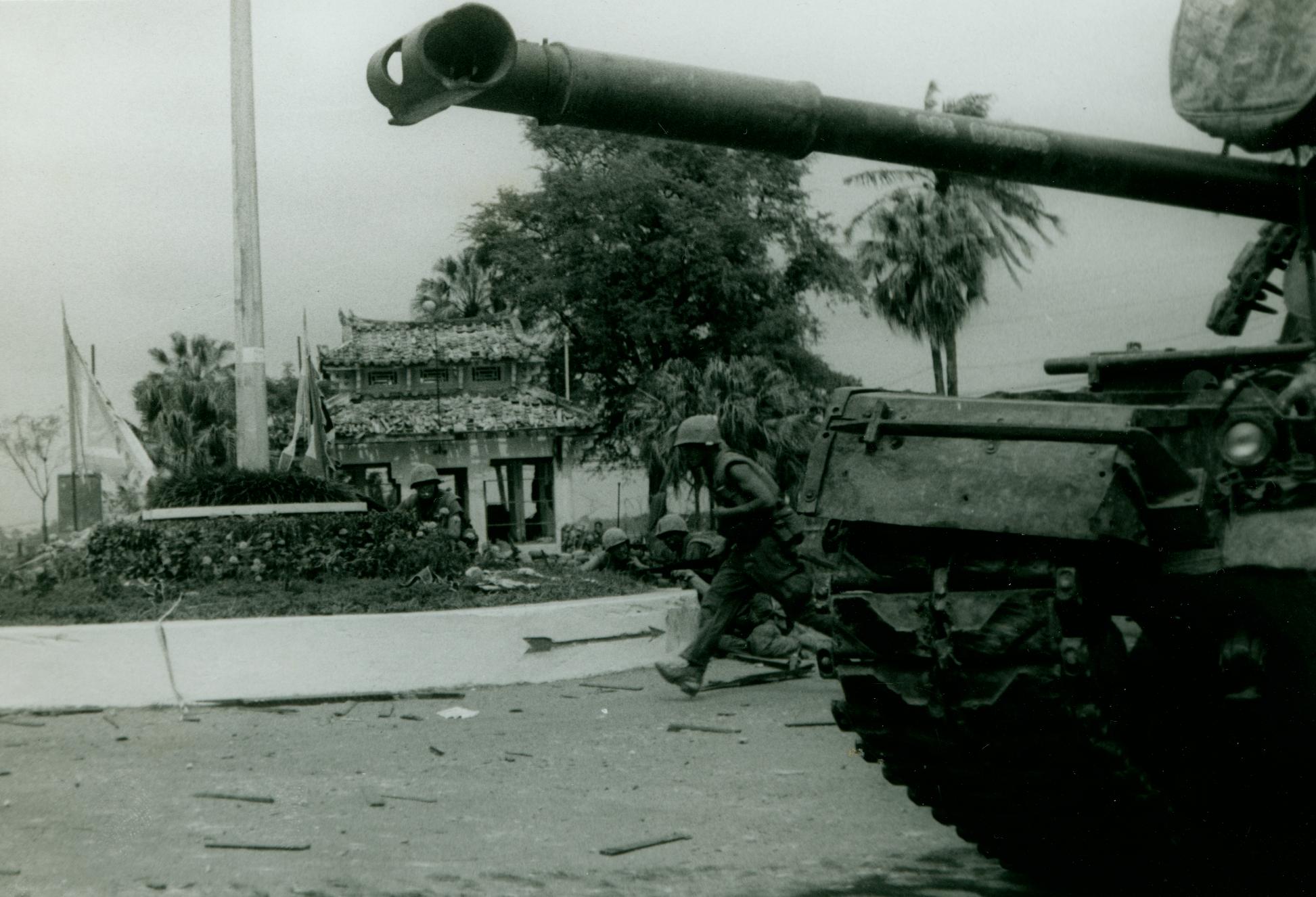
The most substantial urban engagement of the offensive was at Huế, the central Vietnamese former imperial capital, where PAVN and NLF forces of approximately 7,500 captured the city on the 31st of January and held it against substantial American Marine and ARVN counter-attacks for 26 days. The Battle of Huế ran from the 31st of January to the 25th of February 1968. The combat was urban, house-to-house, with substantial use of artillery, air strikes and tanks; the historic Imperial Citadel — the Nguyen-dynasty imperial palace complex — was the principal final defensive position and was substantially damaged in its retaking. Casualties: approximately 500 American and ARVN, 5,000 PAVN/NLF; the principal humanitarian dimension was the discovery, in the weeks after the city's recapture, of mass graves containing approximately 2,800 Hue civilian bodies, predominantly Catholic civil servants, intellectuals, and members of the regime's local administrative apparatus, killed by NLF political-execution squads during the 26-day occupation. The Huế massacres were the largest single atrocity attributable to NLF forces in the war; the substantive scholarly assessment of the events is that the executions were politically deliberate and centrally directed rather than ad hoc.
The strategic reassessment
The American political response to the Tet offensive ran across February and March 1968. President Johnson, who had been considering Westmoreland's request for an additional 206,000 troops, convened a "Wise Men" group of senior former officials on the 25th-26th of March; the group's substantive consensus was that the war's costs had exceeded its political value and that a strategic disengagement was now necessary. Johnson's address to the nation on the 31st of March announced a partial bombing halt north of the twentieth parallel, an opening to peace negotiations, the rejection of Westmoreland's troop request, and — at the end of the address, in the famous and unexpected concluding paragraphs — his own decision not to seek re-election. The political war was over; the formal negotiations would not produce a settlement for five more years, but the strategic trajectory of American disengagement had been set. The disengagement, conducted through Vietnamisation under Nixon, is the next chapter.
End of Chapter V