The Republic of Vietnam was constituted by the political consequences of two events of 1954: the French military defeat at Dien Bien Phu on the 7th of May, which broke the French political will to continue the eight-year colonial reconquest war against the Viet Minh; and the Geneva Conference of April-July 1954, which negotiated the French withdrawal and partitioned the former Indochinese territories along the seventeenth parallel pending a unifying election to be held in July 1956. The election was never held. The partition became permanent. The country south of it took its own name, drafted its own constitution, and was a country.
The French Indochinese war
French Indochina — the colonial federation of Cochinchina, Annam, Tonkin, Laos and Cambodia, administered from Hanoi from 1902 — had been substantially destabilised by the Japanese occupation of 1940-45, the French collaboration with the Japanese authorities under the Vichy administration, the Japanese coup of March 1945 against the French apparatus, the Viet Minh's successful guerrilla operations across the war, and Ho Chi Minh's declaration of Vietnamese independence at Hanoi on the 2nd of September 1945. The post-war French effort to reimpose colonial sovereignty produced the First Indochinese War of December 1946 to August 1954 — an eight-year counterinsurgency campaign against the Viet Minh's increasingly capable conventional forces under Vo Nguyen Giap.
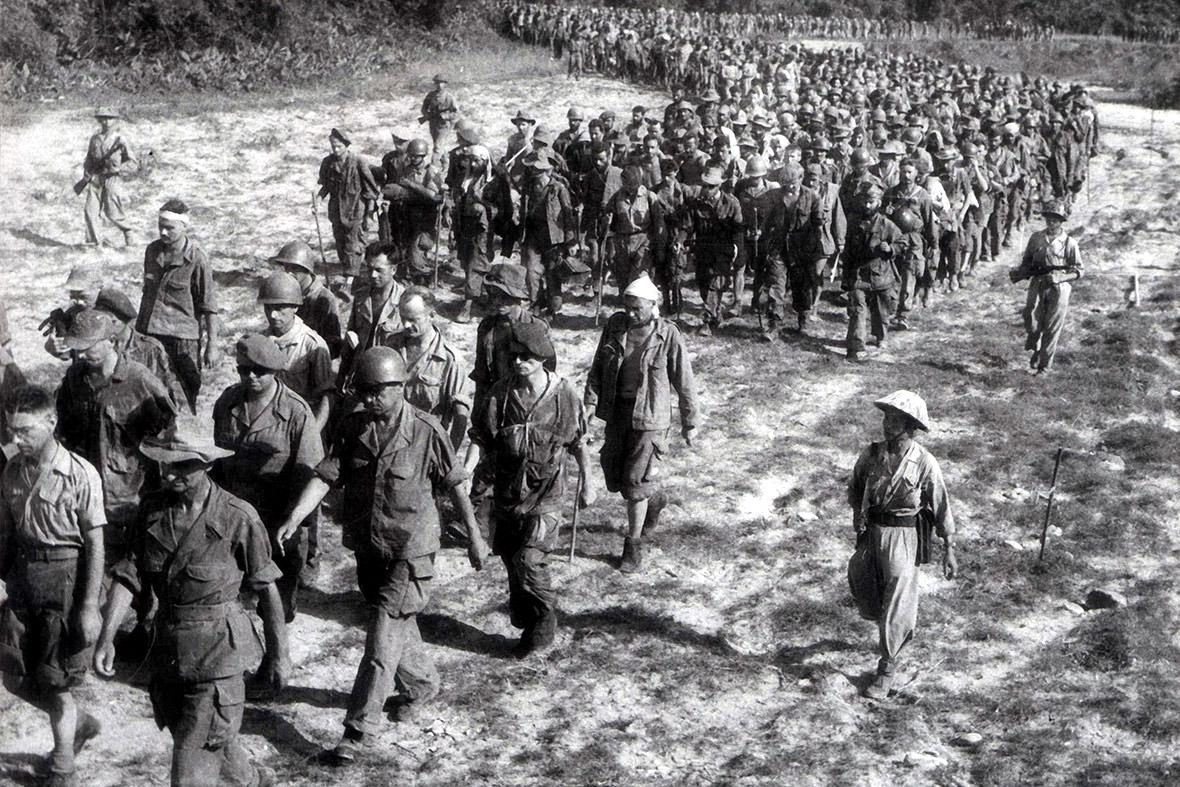
The Viet Minh's strategic position improved substantially after the Communist victory in China in 1949 produced an adjacent supplier of weapons, training and political support. By 1953 the French Expeditionary Corps in Indochina was conducting a manpower-and-budget war that France's post-war political economy could not sustain: approximately 90,000 French and colonial casualties, an annual budget commitment exceeding France's Marshall Plan receipts, and substantial public opposition at home. The Navarre Plan of mid-1953 — an attempt to force a decisive set-piece engagement that French superior firepower could win — produced the Dien Bien Phu confrontation. The French airborne-supplied fortified position in the Dien Bien Phu basin, fifty miles from the Laotian border, was intended as the bait for a Viet Minh assault on a position the French believed Giap could not adequately supply with heavy artillery. Giap, who had recruited approximately 30,000 porters to carry disassembled 105mm howitzers across the Annamese cordillera in 1953-54, defeated this calculation completely. The Viet Minh siege ran from the 13th of March to the 7th of May 1954; the French garrison of approximately 14,000 was surrounded, denied resupply by Viet Minh anti-aircraft fire, and progressively reduced. The position fell on the evening of the 7th of May 1954 — the day before the Geneva Conference's Indochina session opened.
The Geneva Conference
The Geneva Conference of April-July 1954 was convened jointly by the four Geneva-Convention powers (the United States, the Soviet Union, the United Kingdom, France) plus the People's Republic of China (the only multilateral conference China attended at this date) to negotiate the Korean and Indochinese situations. The Korean portion concluded inconclusively in late June. The Indochinese portion opened on the 8th of May 1954, the day after Dien Bien Phu, with the French negotiating from a substantially weakened position. The principal delegations were the French, the Viet Minh under Ho Chi Minh and Pham Van Dong, the State of Vietnam (the French-sponsored Bao Dai government, increasingly displaced in influence by Ngo Dinh Diem), the Cambodian and Laotian royal governments, the Chinese under Zhou Enlai, the Soviets under Molotov, and observer-level delegations from the United States (Walter Bedell Smith) and the United Kingdom (Anthony Eden).
The Geneva Accords of the 21st of July 1954 produced a complex multilateral settlement. The military provisions: a ceasefire effective immediately, a partition of Vietnam at the seventeenth parallel into two regroupment zones (Viet Minh forces north, French Union forces south), a 300-day population-transfer period during which civilians could cross the partition line, demilitarised zones along the seventeenth parallel, and prohibition of foreign military bases in either zone. The political provisions: an internationally supervised election to unify Vietnam to be held by July 1956, with the form and supervision of the election to be negotiated by the two regroupment zones in advance. The settlement was signed by France and the Viet Minh; the State of Vietnam refused to sign, on the grounds that the partition was a betrayal of national unity; the United States declined to sign on similar grounds but issued a unilateral declaration stating it would not "use force or the threat of force to disturb" the settlement.
The population transfer
The 300-day population-transfer period running from August 1954 to May 1955 produced one of the largest forced migrations of the twentieth century. Approximately 900,000 northern Vietnamese — predominantly Catholic, predominantly from the Red River delta, plus substantial professional, military and administrative populations from Hanoi and Haiphong — moved south. Approximately 130,000 southern Vietnamese — predominantly Viet Minh cadres and their families — moved north. The southern Catholic migrants would form the political base of the Diem regime; the northern Viet Minh cadres withdrawn south would form the political-military nucleus of the southern insurgency that re-emerged after 1959.
The election that did not happen
The unifying election scheduled for July 1956 was not held. The political reasoning, in the south, was that Ho Chi Minh's Viet Minh would substantially win a free election in either zone — the Pentagon Papers internal assessment was that Ho would receive approximately 80 per cent of the all-Vietnam vote, including a majority south of the seventeenth parallel. The new southern government under Ngo Dinh Diem, formally installed by Bao Dai in June 1954 and consolidated by the rigged 1955 referendum in which Diem replaced Bao Dai as head of state, refused to participate in the 1956 election. The United States supported the refusal on the grounds that the State of Vietnam had not been a Geneva signatory and was not bound by it. The partition that had been intended as a 24-month transitional arrangement became, in 1956, a 21-year political reality.

The new state south of the seventeenth parallel, formally proclaimed the Republic of Vietnam on the 26th of October 1955 — three days after Diem's 98.2 per cent victory in the referendum (the rigging was substantial: the contemporary scholarly estimate is that an honest vote would have given Diem about 60-70 per cent) — was a country. Its constitution was drafted in 1956. Its army was being formed. Its diplomatic relations with seventy states were being established. Its economy was being reorganised away from the colonial extraction model. Whether it was legitimate — a question that would be argued for the next twenty years and for sixty years after that — was less consequential, in 1955, than whether it would survive. It survived for twenty years. The first nine of those years are the next two chapters.
End of Chapter I