Saigon
Officially Ho Chi Minh City since 1976, and universally Saigon in speech. The capital of the Republic for twenty years, and the one place where its institutions still stand as buildings.
Ho Chi Minh City · Vietnam
The Reunification Palace

The presidential palace of the Republic of Vietnam, rebuilt in the 1960s after the previous one was bombed by two of its own air force pilots, and preserved exactly as it was on the morning it fell.
The building is a period piece of tropical modernism by Ngô Viết Thụ, the first Vietnamese architect to win the Prix de Rome: cabinet room, banqueting hall, presidential library, a cinema, a helipad, and beneath it a warren of command bunkers with 1960s radio sets and situation maps still on the walls.
At 10.45 on the 30th of April 1975 a North Vietnamese T-54 crashed through the perimeter railings. President Dương Văn Minh, in office for two days, offered to hand over power and was told there was nothing left to hand over. The gates are the ones in the photograph.
Ho Chi Minh City · Vietnam
The War Remnants Museum

The most visited museum in the country and the most argued about. It is a state museum with a case to make, and it makes it: captured American aircraft and armour in the courtyard, a reconstruction of the Côn Đảo tiger cages, rooms on massacres, on Agent Orange, and a fine gallery of war photography including the work of photographers from both sides who were killed.
Its framing is one-sided — there is little on the North's own conduct, on the 1968 executions at Huế, or on the post-war camps — and the deformities exhibited in the Agent Orange section are presented without much scientific qualification.
None of that makes the substance false. Go, and read it knowing what it is; then read something else.
Ho Chi Minh City · Vietnam
Notre-Dame and the Post Office

Cochinchina was a French colony from 1862, and central Saigon was laid out as a French provincial capital with boulevards, a cathedral, an opera house and a post office. The Republic inherited that city and governed from its buildings.
The cathedral's bricks came from Marseille and have kept their colour for a hundred and forty years. The post office opposite, of 1891, has a barrel-vaulted iron roof usually attributed to Gustave Eiffel — the attribution is doubtful, and the building is by Marie-Alfred Foulhoux — with a painted map of Saigon's telegraph lines from 1892 still on the wall.
The two of them together are why Saigon was called the Pearl of the Far East, a phrase which the Republic's tourist ministry used relentlessly.
Ho Chi Minh City · Vietnam
The Rex rooftop

From 1965 the American mission held a daily press briefing in Saigon at five in the afternoon. The correspondents called it the Five O'Clock Follies, and the name stuck because the briefings so consistently described a war that the reporters could not find when they went out to look at it.
The gap between the official account and the filed copy is one of the reasons the war was lost politically in the United States, and it is the origin of the modern adversarial relationship between war correspondents and military spokesmen.
The Rex rooftop, where many of the correspondents drank afterwards, is still a bar with wicker furniture and topiary elephants. The Continental across the square, and the Caravelle, complete the set.
Ho Chi Minh City · Vietnam
Tân Sơn Nhứt

At the height of the American build-up this was, by movements, among the busiest airfields on earth — a civil terminal, a vast military airbase, and the headquarters of MACV, the American command, in a compound the troops called Pentagon East.
It is also where the evacuation ended. Fixed-wing flights stopped on the 29th of April 1975 after the runways were shelled, and Operation Frequent Wind — the helicopter evacuation of some 7,000 people from the embassy and the DAO compound — ran through that night and into the morning of the 30th.
The famous photograph of people climbing a ladder to a helicopter is not the embassy roof, as almost everyone believes, but the roof of an apartment building at 22 Gia Long Street that housed CIA staff.
Tây Ninh · Vietnam
The Cao Đài temple
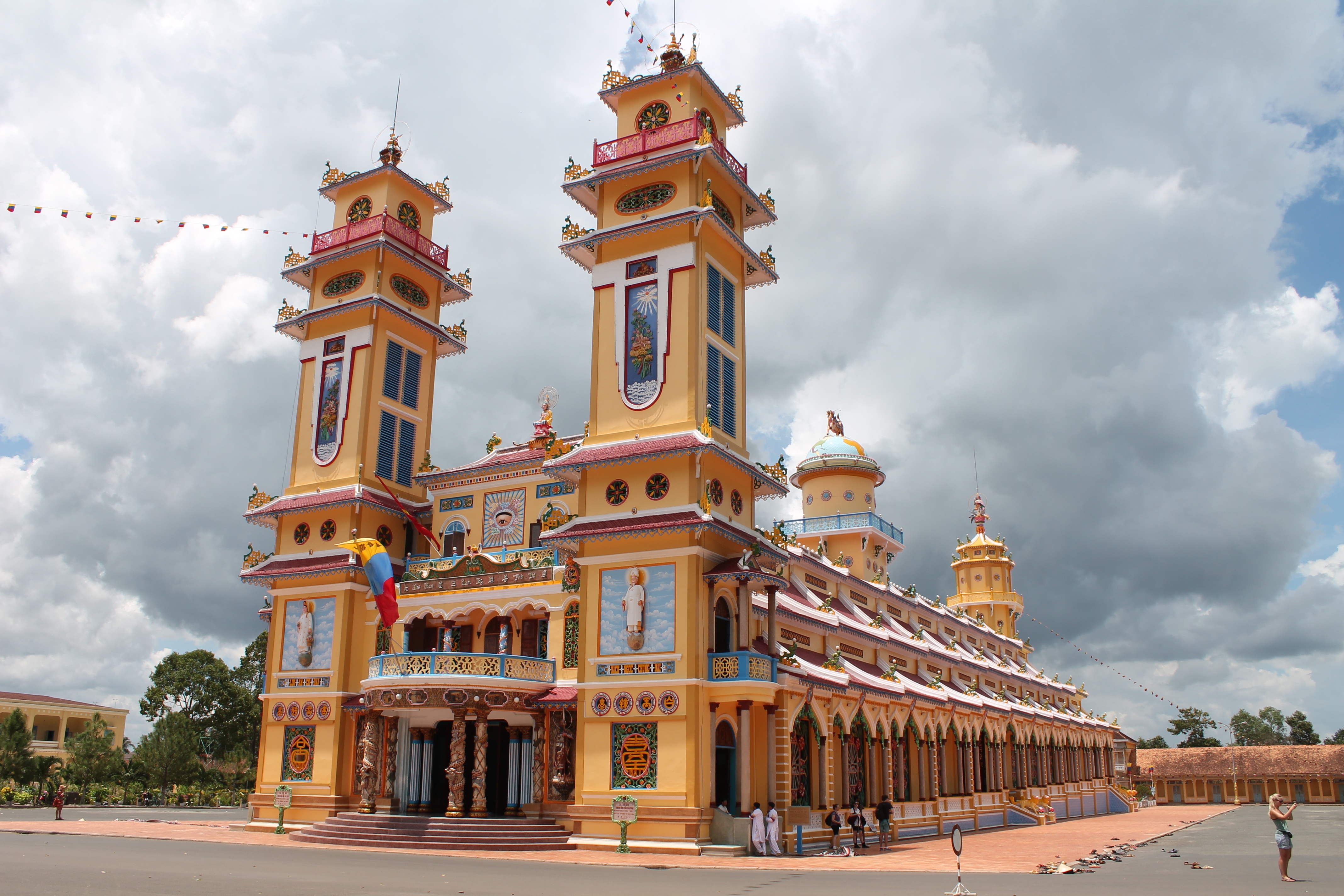
Caodaism was founded in 1926, syncretises Buddhism, Taoism, Confucianism and Catholicism, and counts among its saints Sun Yat-sen, the Chinese poet Nguyễn Bỉnh Khiêm and Victor Hugo. Its cathedral at Tây Ninh is painted in colours that photographs do not exaggerate.
It matters politically because the Cao Đài, like the Hòa Hảo sect and the Bình Xuyên criminal syndicate, maintained a private army of tens of thousands and controlled territory. Ngô Đình Diệm's first achievement as prime minister, in 1955, was to break all three — buying off some commanders and destroying the rest in street fighting in Saigon.
That victory made his reputation and convinced the Americans he could govern. It also removed the only organised non-communist forces outside his own control.
The tunnels, the delta and the highlands
The war in the south was fought among the population rather than along a front, which is why so much of what survives is underground or in the countryside.
Củ Chi · Vietnam
The tunnels

A network of perhaps 250 kilometres of hand-dug tunnel in laterite clay, on three levels, with kitchens vented through chimneys hundreds of metres away, hospitals, sleeping quarters, wells and workshops — and it ran to within forty kilometres of the presidential palace.
The Americans put an entire base on top of it in 1966 without realising, and then spent years trying to clear it with tunnel rats, gas, dogs and eventually B-52s.
The tunnels open to visitors have been widened for Western bodies, which is worth knowing before you decide the experience was manageable. Bến Dược, the further site, is less commercialised and has a genuinely affecting memorial temple listing the local dead.
Cần Thơ · Vietnam
The Mekong Delta

The delta held the rice, the population and the war's real centre of gravity. It was also where the Republic's authority was thinnest: a landscape of canals, paddy and villages in which a government presence meant a district town and an outpost, and everything between them belonged to whoever was there after dark.
The strategic hamlet programme of 1962 tried to fix that by moving peasants into fortified settlements. It moved millions of people off ancestral land and graves, was administered corruptly, and did more to recruit for the other side than any propaganda.
Today it is prosperous, intensively farmed and sinking — groundwater extraction and upstream dams are causing subsidence and salt intrusion that threaten the whole delta within decades.
Sơn Mỹ · Vietnam
Mỹ Lai

Charlie Company, 1st Battalion, 20th Infantry entered the hamlet of Mỹ Lai on the morning of the 16th of March 1968 expecting a Viet Cong battalion and found women, children and old men. Over about four hours they killed between 347 and 504 of them.
The massacre was stopped by Hugh Thompson, a helicopter pilot who landed between the troops and a group of civilians and ordered his crew to fire on the Americans if they continued. It was then concealed for a year, and became public through the persistence of a soldier who had not been present, Ronald Ridenhour, and the reporting of Seymour Hersh.
Twenty-six men were charged. One, Lieutenant William Calley, was convicted; he served three and a half years under house arrest. The memorial preserves the foundations of the houses, the irrigation ditch, and the names.
Đà Lạt · Vietnam
The hill station

The French built Đà Lạt in the highlands as a sanatorium and hill station, and the Republic inherited it as its resort: villas, a golf course, a lycée, a military academy, and Bảo Đại's Art Deco summer palace with its bakelite telephones and its map room.
Bảo Đại himself is one of the more melancholy figures in this book — the last Nguyễn emperor, made head of state by the French in 1949, deposed by Diệm in a referendum of 1955 that returned 98.2 per cent against him, and thereafter an exile in France until 1997.
The city is now a honeymoon destination full of strawberry farms and pastel hotels, and the palace is a museum you can walk round in slippers.
Côn Đảo · Vietnam
The tiger cages

An island prison in the South China Sea, built by the French in 1862 for Vietnamese political prisoners and continued in use by the Republic. Many of the North's leadership had served time here.
In July 1970 two American congressional aides, taken to the island on a controlled tour, slipped away and found the tiger cages: stone pits roofed with bars, prisoners shackled below, lime kept above to be thrown down. The photographs, published in Life, did enormous damage to the Republic's case in the United States.
The islands are now a national park with white beaches and a war cemetery, and the contrast between the two is not easy to hold in the head at once.
Huế, the DMZ and the seventeenth parallel
The Geneva partition line ran along the Bến Hải river, with a demilitarised zone five kilometres either side. It was intended to last two years pending elections that never happened, and it lasted twenty-one.
Huế · Vietnam
The Citadel

The Nguyễn imperial capital from 1802: a walled citadel on the Vauban model enclosing a Forbidden Purple City modelled on Peking's.
North Vietnamese and Viet Cong units took the city in the opening hours of the Tet offensive on the 31st of January 1968 and held it for twenty-six days. Retaking it required house-to-house fighting of a kind American forces had not conducted since Korea, with artillery and naval gunfire used inside the walls. Most of the Forbidden Purple City was destroyed.
During the occupation, between 2,800 and 6,000 civilians — officials, teachers, priests, foreign residents — were executed and buried in mass graves. The Huế massacre is the single strongest counter to accounts of the war that treat one side's conduct as the only conduct.
Huế · Vietnam
Thiên Mụ
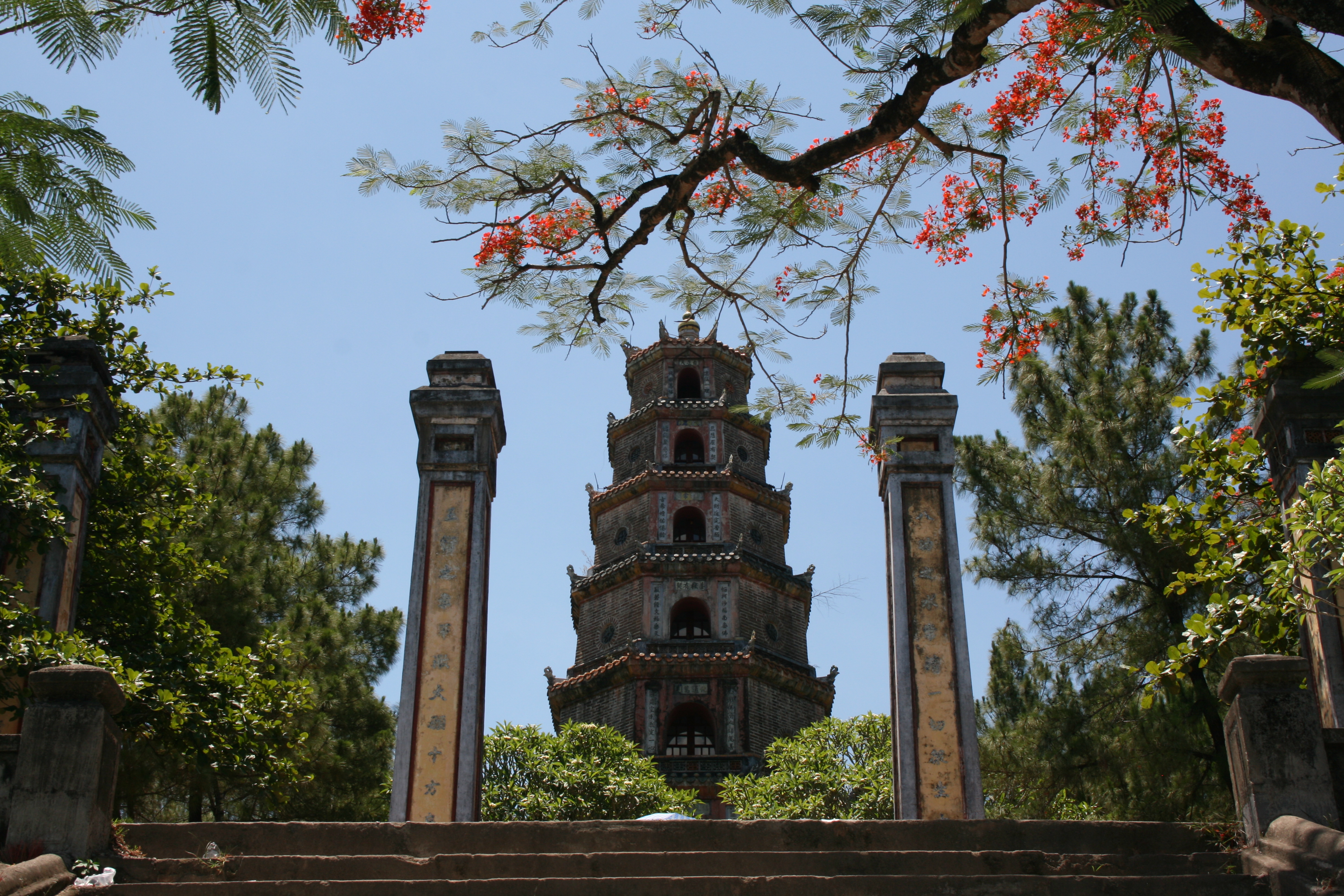
A seven-storey pagoda of 1601 on a bluff above the Perfume River, and the centre of the Buddhist opposition to Diệm's government in 1963.
The crisis began in Huế in May 1963 when the government banned the flying of Buddhist flags on Vesak, days after Catholic flags had flown freely for the archbishop — who was Diệm's brother. Troops fired on the protest and killed nine people.
On the 11th of June the monk Thích Quảng Đức sat down at a Saigon crossroads and burned to death without moving. Malcolm Browne's photograph went round the world; Kennedy said no news picture in history had generated so much emotion. Madame Nhu, the president's sister-in-law, called it a barbecue and offered to supply the matches. Diệm was dead within five months.
The Austin sedan that drove Quảng Đức to Saigon is kept behind the pagoda.
Vĩnh Linh · Vietnam
The Bến Hải bridge

The Geneva accords of July 1954 drew a provisional military demarcation line at the seventeenth parallel, along the Bến Hải river, with a demilitarised zone five kilometres either side, pending nationwide elections in July 1956. The elections were never held: Diệm refused to take part, on the reasonable ground that no free vote was possible in the North and the unreasonable one that he did not want to lose.
The bridge became the border. Each side painted its half a different colour and repainted it whenever the other changed, and both built loudspeaker towers and flagpoles, each taller than the last.
A reconstructed bridge, the towers and a museum stand there now. It is a strange, quiet place for a line that defined twenty-one years.
Vĩnh Mốc · Vietnam
The village underground

North of the line, and included because the two halves of the story are not separable. Vĩnh Linh district was bombed continuously from 1966 as the northern shoulder of the DMZ. The village of Vĩnh Mốc went underground: 1.7 kilometres of tunnel on three levels, with family alcoves, a well, a school, a clinic and exits onto the beach.
About six hundred people lived in them for six years. Seventeen children were born there. Nobody in the village was killed by the bombing.
These tunnels have not been enlarged for tourists, which makes them a harder and more honest experience than Củ Chi. The lowest level is twenty-three metres down.
Khe Sanh · Vietnam
The combat base

A marine firebase near the Laotian border, besieged by two North Vietnamese divisions from January to April 1968. Westmoreland was convinced it was to be a second Điện Biên Phủ and committed enormous air support — some 100,000 tonnes of bombs, the heaviest concentration in history to that date. The base held.
The argument since has been about whether the siege was ever meant to succeed, or was a feint to draw American strength away from the cities before Tet. Both readings have serious support and the North Vietnamese archives have not settled it.
The base was abandoned in July 1968, its position judged not worth holding, which many marines found difficult to accept. The site is a plateau with a small museum, some restored bunkers and a runway you can walk.
Điện Biên Phủ · Vietnam
Where the French lost

In the far north-west, and the reason this volume exists. A French garrison of some 13,000 was placed in a valley in November 1953 to draw the Viet Minh into a set-piece battle. Giáp brought artillery over the mountains by hand, dug it into the reverse slopes where French counter-battery fire could not reach, and closed the airstrip within days.
The garrison surrendered on the 7th of May 1954 after fifty-six days. The Geneva conference opened the following day.
France left Indochina; Vietnam was partitioned at the seventeenth parallel pending elections; the elections did not happen; and the Republic of Vietnam was proclaimed in October 1955. Everything in this book follows from a French decision to fight a battle in a valley surrounded by hills.
Bà Rịa–Vũng Tàu · Vietnam
Long Tan
Some 60,000 Australians and 3,500 New Zealanders served in Vietnam; South Korea sent over 300,000 men, and Thailand and the Philippines contributed as well. The Republic's war was not solely an American one, and the third-country contributions are usually left out of the telling.
At Long Tan on the 18th of August 1966, 108 men of D Company, 6 RAR were caught in a rubber plantation by a force many times their size and held for three and a half hours in monsoon rain, supported by artillery firing almost continuously. Eighteen Australians were killed.
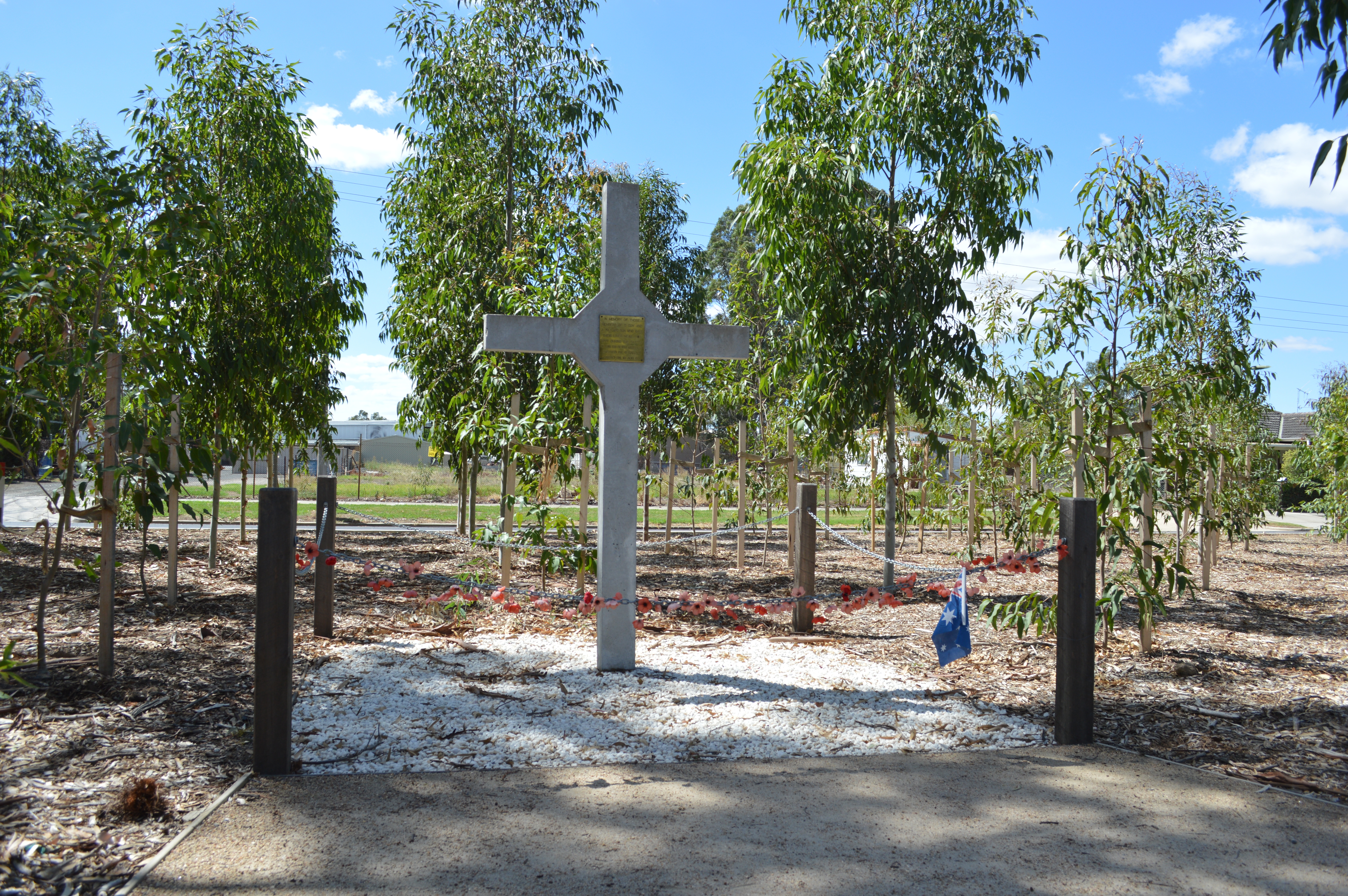
A cross was raised on the site in 1969. The original is in a museum in Australia; a replica stands in the plantation, and access is negotiated and sometimes refused.
The wider country, and the aftermath
Eight more stops: the Republic's parliament, the town the war missed, the place the collapse began, the delta, the Cambodian border, and the North's own memorials.
Ho Chi Minh City · Vietnam
The Opera House

A French colonial opera house of 1900 on Lam Sơn Square, requisitioned by the Republic in 1955 as the chamber of its National Assembly and used as such for twenty years.
That is worth pausing on, because the Republic is usually described as a straightforward dictatorship. It was authoritarian, its elections were managed and its press was censored — but it had an elected legislature that argued, an opposition bloc, a supreme court, and after 1967 a constitution that Thiệu found genuinely inconvenient. The Senate blocked bills. Deputies were arrested and other deputies protested.
It was not a democracy. It was also not North Korea, and the distinction mattered a great deal to the people living under it. The building is a theatre again, and the interior has been restored to 1900 rather than 1970.
Hội An · Vietnam
The town the war missed

A Japanese, Chinese and Vietnamese trading port that silted up in the nineteenth century, was superseded by Đà Nẵng, and consequently spent the twentieth century too unimportant to bomb.
The result is the most complete surviving old town in Vietnam: merchant houses with their ledgers still on the shelves, a Japanese covered bridge of 1593, assembly halls of the Chinese trading communities, and a riverfront that is a UNESCO site and knows it.
It is included here as a control. Everywhere else in this guide shows what the war did; Hội An shows the country the war was fought over, and it is fifteen minutes from China Beach.
Buôn Ma Thuột · Vietnam
Where the end began

The capital of Đắk Lắk province in the Central Highlands, and the town whose loss unravelled the Republic. The North Vietnamese took it in two days in March 1975, having deceived Saigon into expecting an attack further north.
Thiệu's response was to order the abandonment of the whole highlands to shorten his line — a decision taken at a meeting at Cam Ranh with no staff planning, communicated to commanders who had no orders for the civilian population, and executed down a disused road. The Convoy of Tears that followed destroyed II Corps and perhaps 60,000 civilians with it.
The town is now the centre of Vietnam's coffee industry, which is the second largest in the world, and the Ede and M'nong minority villages around it have their own long grievance with Hanoi.
Cần Thơ · Vietnam
The floating market
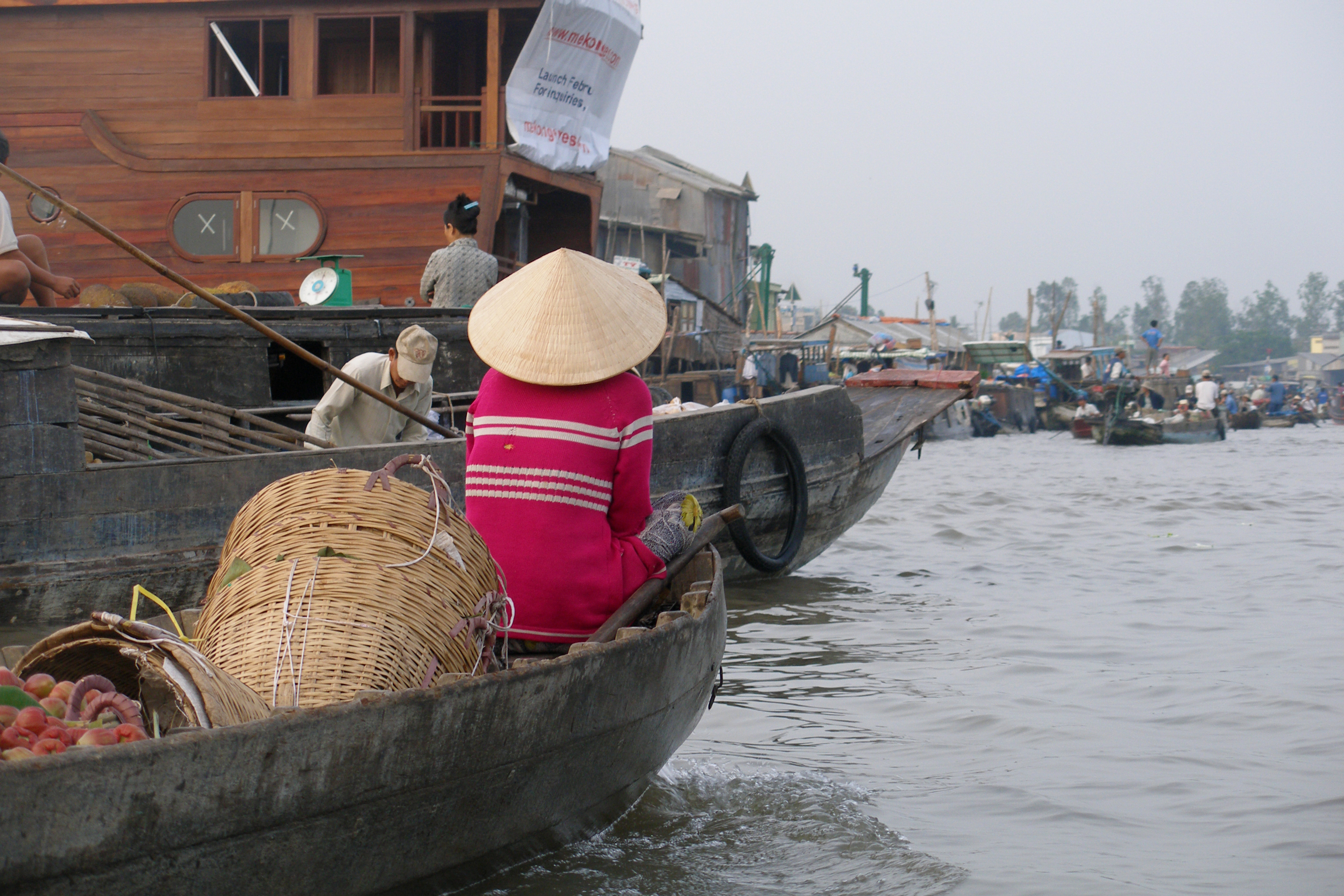
The delta's produce still moves by water, and the wholesale markets still convene at dawn with each boat advertising its cargo on a pole above the mast — a pineapple for pineapples, a cabbage for cabbages.
Cần Thơ was the Republic's IV Corps headquarters and the administrative centre of the delta, and it surrendered on the 30th of April 1975 without fighting. The corps commander, General Nguyễn Khoa Nam, shot himself in his office rather than surrender; so did his deputy. Five ARVN generals killed themselves that day.
The market is the other half of the picture: eleven months a year, through twenty years of war, the boats came in at five in the morning and the rice moved.
Châu Đốc · Vietnam
The Cambodian border

On the Bassac river against the Cambodian border, with Sam Mountain rising out of flat paddy behind it and the Hòa Hảo Buddhist heartland around it.
The reason it is here is what happened after 1975. Khmer Rouge units crossed the border repeatedly from 1975 to 1978, and at Ba Chúc, twenty kilometres from here, killed 3,157 Vietnamese villagers in April 1978 — nearly the entire population. A memorial ossuary holds the skulls.
That massacre is the immediate cause of Vietnam's invasion of Cambodia in December 1978, which ended the Khmer Rouge regime and led to a Chinese punitive invasion of Vietnam in February 1979. The wars in this book did not stop when the Republic did.
Gio Linh · Vietnam
Trường Sơn cemetery

Vietnam's largest war cemetery, holding more than ten thousand graves of North Vietnamese soldiers and volunteers who died on the Hồ Chí Minh trail, arranged by home province across a hillside of pine.
Around 300,000 Vietnamese are still officially missing from the war, on both sides, which in a culture where the ancestral grave matters as much as it does here is a continuing grief rather than a statistic. Families still come looking, and the practice of consulting mediums to locate remains is widespread enough to have its own state-tolerated industry.
It belongs in a guide to South Vietnam because the dead here were mostly conscripts from northern villages who walked south and did not come back, and because no honest account of this war can present only one set of graves.
Nha Trang · Vietnam
Po Nagar

Brick towers of the eighth to eleventh centuries, built by the Cham — a Hindu and later Muslim maritime kingdom that ruled central Vietnam for over a thousand years and was progressively annexed by the Vietnamese moving south, finally in 1832.
It is here for perspective. The Republic of Vietnam lasted twenty years and its loss is felt as a national wound by those it belonged to. Champa lasted fifteen centuries and was extinguished by the Vietnamese state, and its descendants are a minority of about 160,000 people with grievances of their own.
Nha Trang was also a major American base and R&R centre, and is now a resort city of high-rise hotels, mostly serving Korean and Russian package tourism.
Hanoi · Vietnam
Hỏa Lò

Built by the French in 1896 as Maison Centrale and used to hold Vietnamese political prisoners, including much of the future North Vietnamese leadership. From 1964 it held American aircrew, who named it the Hanoi Hilton; John McCain spent five and a half years in the system, two of them in solitary.
The museum devotes most of its space to French colonial cruelty, which is thoroughly documented, and a smaller section to the American prisoners, which presents them playing chess and decorating a Christmas tree. The treatment described by the prisoners themselves — including sustained torture between 1965 and 1969 — does not appear.
It is worth an hour precisely because it is a mirror image of the War Remnants Museum in Saigon. Both are true in what they show and shaped by what they leave out.
Quảng Trị · Vietnam
The citadel that was erased

Quảng Trị was a provincial capital of some 30,000 people with a nineteenth-century citadel at its centre. It was taken by North Vietnamese forces in the Easter Offensive of 1972 and retaken by South Vietnamese marines after eighty-one days of the heaviest bombardment of the war.
Nothing survived. Photographs from September 1972 show a grid of streets with no buildings on it. The town was rebuilt afterwards a few kilometres away, and the citadel site is now a memorial park with a fragment of wall, a museum and a great deal of grass.
The Thạch Hãn river beside it is where relatives still float paper lanterns for the dead. An inscription there, written by a veteran, asks anyone rowing on the river to row gently, because his friends are lying under the water.
Trường Sơn range · Vietnam
The trail

Not a trail but a system: by 1973 some twenty thousand kilometres of road, track, fuel pipeline and river crossing running through Laos and Cambodia, with truck parks, hospitals, workshops and anti-aircraft belts, built and maintained by tens of thousands of workers, many of them women.
The Americans dropped more bombs on Laos than were dropped on Germany and Japan combined in the Second World War, mostly on this. They seeded it with sensors, sprayed it, mined it and bombed it continuously for eight years, and never closed it. Traffic increased every year.
That is the central military fact of the war. An insurgency that can be resupplied indefinitely through territory the enemy will not invade cannot be defeated in the field, and everything else in this volume follows from it. The modern Hồ Chí Minh Highway runs along part of the route and is a spectacular drive.
Cam Ranh · Vietnam
The great harbour

A deepwater bay sheltered by a peninsula, and one of the best natural harbours in Asia. The Russian Baltic Fleet coaled here in 1905 on its way to be destroyed at Tsushima. The Japanese used it in 1941 to stage the invasion of Malaya. The Americans built a vast base and airfield here from 1965, and Thiệu met Nixon here in 1969.
After 1975 the Soviet Union took it over and ran its largest overseas naval facility outside the Warsaw Pact from it until 2002.
Vietnam now operates it as an international service port open to any navy that pays, including the American, Indian and Chinese, which is a precise expression of the country's foreign policy: no alliances, no foreign bases, and everybody welcome to buy fuel.
Vũng Tàu · Vietnam
The last airfields

A seaside town at the mouth of the Saigon river, a French resort called Cap Saint-Jacques, an Australian logistics base during the war, and one of the last points of departure in April 1975.
The evacuation offshore is the part usually left out. Some seventy South Vietnamese helicopters reached American ships in the fleet, more than the decks could hold, and were pushed over the side into the sea to clear space for the next. A South Vietnamese major landed a Cessna on the deck of the USS Midway with his wife and five children aboard, having no other option; the ship's captain ordered helicopters ditched to give him room, and he made it.
Around 130,000 people left in those two weeks. Vũng Tàu is now where Saigon goes at the weekend.