The religious system of the Inca state had two distinguishable layers. The first layer was the imperial state religion — the Sun cult, headquartered at the Coricancha temple in Cuzco, with the Sapa Inca as the principal earthly representative of the Sun deity Inti. The second layer was the indigenous Andean religious tradition of the huacas — sacred places, objects, and ancestors that each Andean community recognised and worshipped — which the Inca state did not abolish but rather absorbed into its religious system by ranking the huacas of the subject communities under the supremacy of the imperial Sun cult. The combination was a particular form of religious imperialism that allowed extensive local autonomy of practice within an overarching framework of imperial reverence.

Inti and the Sun cult
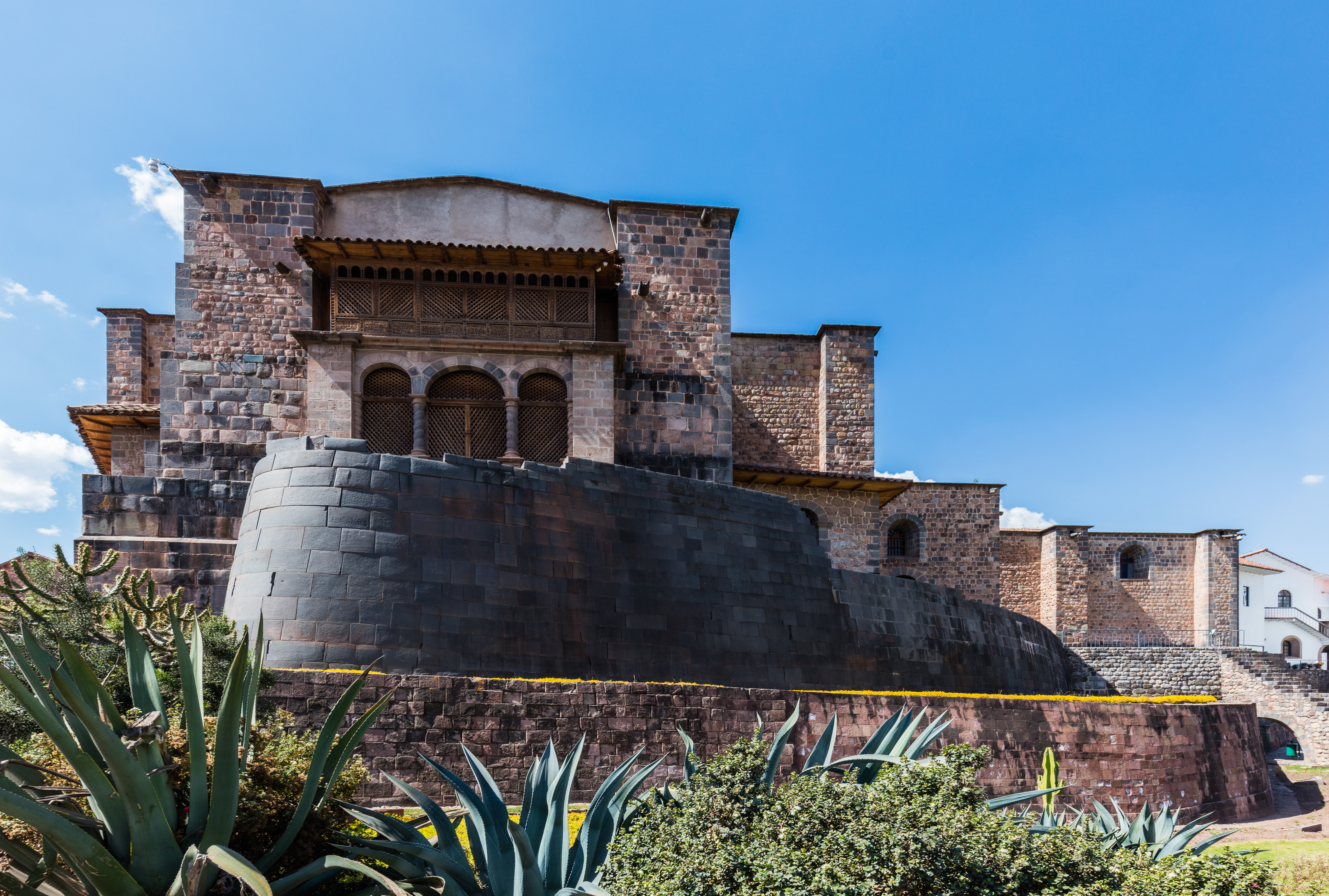
The principal state deity was Inti, the Sun. The official imperial cosmology held that the Inca ruling lineage descended directly from Inti, through the founder Manco Cápac (who was, in the chronicle tradition, said to have emerged from Lake Titicaca with his sister-wife Mama Ocllo and to have walked north to found Cuzco). The Sapa Inca was therefore not merely a human king but a divine descendant of the Sun, with religious as well as political authority over his subjects. The Coricancha — the Sun Temple — in central Cuzco was the principal physical centre of the cult; its principal cult image was a great gold sun-disc that the Spaniards stripped from the temple and melted down during the conquest. The Coricancha also housed the mummies of all the previous Sapa Incas, who continued to participate in religious ceremonies and to receive offerings as the ancestors of the present ruling family.
The state religion involved a yearly cycle of major festivals tied to the agricultural and astronomical calendar. The most important were Inti Raymi (the Festival of the Sun, at the winter solstice on the 21st of June by the Cuzco-area observation; this festival is the subject of a major modern reconstruction at Cuzco each year on the 24th of June, an event with considerable touristic and cultural-political resonance), Capac Raymi (the summer solstice festival at the 21st of December, which marked the beginning of the new year and the initiation of young noblemen into adulthood), and Cápac Hucha (the great offering, a periodic empire-wide ritual involving substantial offerings at huacas across the empire, including the controversial practice of child sacrifice on the highest mountain summits — the high-altitude burials of which several have been recovered in well-preserved condition since the 1990s).
The huacas
The local religious tradition of the Andes recognised huacas — sacred entities — in extraordinary profusion. Any natural feature could be a huaca (a particular rock, spring, hilltop, cave, ancient tomb), and so could particular objects (mummies of ancestors, sacred bundles, idols). A 1572 Spanish census of the Cuzco area alone identified about 350 named huacas in a few hundred square kilometres. The huacas were organised, by Inca religious administration, into ranked lines (the ceque system) radiating from the Coricancha in Cuzco, with specific lineages and officials responsible for the maintenance of particular huacas. The system has been substantially reconstructed by the ethno-historian Tom Zuidema and his collaborators from a 1653 Spanish source (Bernabé Cobo's Historia del Nuevo Mundo) that preserves a detailed account of the ceques.
The mountain peaks — the apus — were particularly powerful huacas. The highest mountains of the central and southern Andes (Ausangate, Salkantay, Vilcanota, Coropuna) were considered sentient beings, with personalities and preferences, who controlled the weather, the water sources, and the well-being of the surrounding communities. The cult of the apus has persisted, in modified Christian form, through the colonial period into the present; the annual pilgrimage to Qoyllur Rit'i (the great glacier pilgrimage on the slopes of Ausangate, attended by tens of thousands of pilgrims each year on the date of the Catholic Trinity Sunday) is a continuous Andean ceremonial tradition whose form is recognisably pre-Columbian.
The ayllu and the social structure
The basic unit of Andean rural society — pre-Inca, Inca, and post-Inca — was the ayllu: a kinship unit (typically several hundred to a few thousand individuals) sharing a putative common ancestor (often a particular ancestral huaca), holding land in common, and organising agricultural and ceremonial activities collectively. The ayllu was simultaneously a kinship group, a religious community, a landholding entity, and a labour-organising unit. The traditional Quechua greeting "ayllumasi" — "fellow ayllu-member" — captures the unit's combined social meaning.
The Inca state did not abolish the ayllu but rather built its administrative system on top of it. The local ayllu leadership — the kurakas, hereditary lineage chiefs — were integrated into the imperial bureaucracy as the lowest level of officialdom; they collected the mita labour for the state, supervised local agricultural production, and represented their ayllus in dealings with the higher imperial authorities. The arrangement gave the empire a substantial infrastructure of local administration that operated, in everyday terms, in the indigenous social forms of the conquered populations.
Above the ayllu were the larger ethnic-territorial units (the llaqta, town; the various regional polities — Wanka, Chanka, Chimú, Lupaqa, and so on), which had typically been independent before Inca conquest and which retained considerable internal organisational autonomy after incorporation. The Inca system, in this sense, was an empire of conquered chiefdoms rather than a direct administration of individual subjects.
The four classes
The Spanish chroniclers describe a four-tier social hierarchy in the Inca state. At the top, the imperial ruling lineage — the Cuzco panaqas, the descendants of the previous Sapa Incas, who held the senior administrative positions and the principal religious offices. Below them, the broader Cuzco aristocracy of orejones ("big-ears," referring to the elongated earlobes produced by their distinctive heavy gold earrings, marking them as members of the imperial military and administrative class). Below them, the kurakas — the hereditary leadership of the conquered provinces, integrated into the imperial system as semi-autonomous local rulers. At the bottom, the mass of the population — the hatun runa, the "great people," the subject peasants and craftspeople who owed mita labour to the state.
This four-class structure was not, in the Inca conception, a strict hierarchy of social mobility (the boundaries between classes were largely hereditary), but it was also not impermeable. Particularly skilled craftspeople (the kamayuq) were elevated to specialist roles supported directly by the state; outstanding warriors could be elevated by imperial grant; women of the conquered nobility could be brought to Cuzco as chosen women (aklla) and educated for ceremonial or marital roles. The system had, within its hierarchies, real channels of advancement.
The Sapa Inca
At the apex of the system stood the Sapa Inca — "the unique Inca." His person was ritually treated as semi-divine: he wore garments of the finest vicuña wool that had been spun and woven by chosen women specifically for him, and that were burned after a single use; he ate from gold plates, off finely woven cloths; he drank from gold cups; he was carried on a litter when travelling rather than walking; he was attended at all times by a corps of personal servants drawn from the noble lineages; his words were treated as having quasi-divine authority. His political role was simultaneously chief executive of the imperial administration, supreme military commander, chief priest of the Sun cult, and principal religious figure of the entire imperial system.
The Sapa Inca's principal wife — the Coya — was traditionally his full sister, in a marriage pattern that preserved the lineage's solar descent without genealogical dilution. The marriage of full siblings was forbidden to commoners on pain of execution but was the legal norm for the imperial lineage. The arrangement was, in this respect, comparable to the brother-sister royal marriages of the Egyptian pharaonic family; it served similar dynastic purposes.
The Sapa Inca's death produced, as Chapter VI describes, a recurring political crisis — the succession dispute. Huayna Capac's death produced the worst such crisis in Inca history. The next chapter takes it up.
End of Chapter V