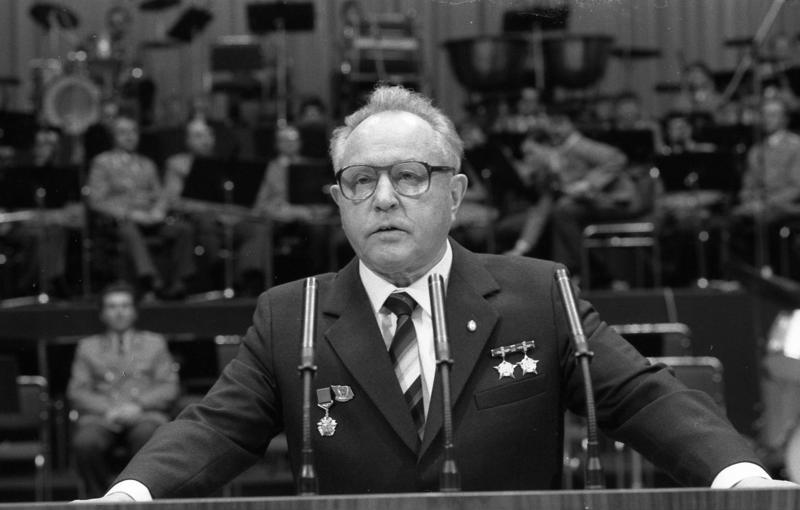
The Ministerium für Staatssicherheit — usually shortened to Stasi — was founded on the 8th of February 1950 as the GDR's internal security service. It was modelled on the Soviet NKVD and was supervised, at every stage of its history, by the KGB. Its first head was Wilhelm Zaisser. From 1957 to its dissolution in 1990 it was run by Erich Mielke, an old German Communist who had served in the Spanish Civil War, fled to the Soviet Union during the Nazi years, and returned in 1945 with the Ulbricht group. Mielke was, by general account, an extraordinarily intelligent, paranoid, and politically devoted man. He left office at the age of 82, after thirty-two years in his post — perhaps the longest tenure of any chief of an internal security service in the modern world.
The Stasi grew remarkably over its forty-year existence. In 1950 it employed perhaps 4,000 staff. By 1989 it employed 91,000 full-time officers — roughly one for every 180 citizens of the country. Beyond the formal staff, it operated a network of informal collaborators, the Inoffizielle Mitarbeiter (IMs), recruited from across East German society — workers, professors, journalists, athletes, clergy, dissidents themselves. By the 1980s perhaps 173,000 East Germans were active IMs at any given time, and around 600,000 had served as IMs at some point in their lives. The total number of dossiers maintained on East German citizens — and on West Germans, and on foreign visitors — reached around six million by 1989, in a country of seventeen million.
What the Stasi did
The Stasi's methods were exhaustive. It intercepted telephone calls on an industrial scale (the famous "department 26" employed several thousand stenographers). It opened mail — perhaps 90,000 letters a day at peak — through a network of cover postal facilities. It planted hidden cameras and microphones, kept a smell archive of suspect individuals (small jars of fabric scraps acquired from interrogation chairs), conducted physical surveillance with full teams of pursuit officers, and ran a network of false-flag operations against suspected dissidents.
The most distinctive feature of Stasi practice, however, was the technique it called Zersetzung — "decomposition." Where the KGB or Soviet-era security services would arrest a dissident outright, the Stasi often preferred to attack the dissident's life by quieter means. The target's marriage would be undermined by carefully placed disinformation about an alleged affair. The target's career would be subtly sabotaged. The target's friends would be approached and turned. The target's reputation would be slowly poisoned. The technique was psychologically devastating, harder to detect than overt repression, and — particularly important for the regime — politically deniable. Many people targeted by Zersetzung did not realise it was happening until they read their Stasi files after 1990.
The dissident landscape
East Germany never produced the kind of mass dissent that emerged in Poland under Solidarity, or in Czechoslovakia after Charter 77. The reasons are partly demographic — the dissident-minded part of the population had been leaving for the West for decades — and partly cultural: the small visible dissident scene was distinctly intellectual, often based in artistic and ecclesiastical circles, and not connected to the industrial working class.
The intellectual focus of dissent in the 1970s was the singer-songwriter Wolf Biermann. Biermann had emigrated from West Germany to the GDR in 1953 as a young committed Communist, but his songs — sharp, sceptical, melodically beautiful — had increasingly criticised the regime through the 1960s. In 1976 the SED, after Biermann gave an unauthorised concert in Cologne while on a brief Western tour, revoked his East German citizenship. A petition of protest was signed by twelve prominent East German cultural figures — Sarah Kirsch, Christa Wolf, Volker Braun, Heiner Müller, Stephan Hermlin — and then by more than a hundred. The Biermann affair was the most consequential public conflict between the SED and the country's intelligentsia. Several of the signatories were later expelled themselves or pushed into permanent emigration.

The churches
The principal organised space for dissent was the Lutheran Church. The GDR had, perhaps surprisingly, never closed the churches — Marxism-Leninism's official position was that religion would wither away under socialism, and the SED preferred a managed coexistence to a confrontational one. The result was that the Evangelical Lutheran Church of the GDR retained a national network of buildings, clergy, and members (about a quarter of the population in 1989). It also retained, crucially, internal independence: the SED did not control church appointments and had limited surveillance penetration of church meetings.
The result, from the late 1970s, was that the church became the principal meeting place of East German civil society. Peace prayers in Leipzig's Nikolaikirche, starting in 1981 as small services around the European missile crisis, would grow to hundreds and then thousands of attendees by the late 1980s. Environmental groups, peace groups, human rights groups, gay rights groups, and feminist groups all found shelter under church umbrellas. The church was a fragile space — the Stasi penetrated it heavily through clerical IMs — but it was the only space the regime had not eliminated.
"The Stasi may have informers in this congregation. They may even be sitting next to you. But what matters is that we are here, in our own building, talking about what we are not allowed to talk about anywhere else." — Pastor Christian Führer, Nikolaikirche Leipzig, October 1988
The 1980s opening
The arrival of Mikhail Gorbachev in 1985 transformed the dissident calculation. Glasnost and perestroika, with their tacit acceptance of reform Communism, made the East German regime look increasingly anachronistic. The SED — particularly Honecker — quietly opposed Soviet reforms and tried to prevent their dissemination in the GDR; the East German edition of the Soviet news magazine Sputnik was banned in November 1988 for publishing pro-Gorbachev material. The ban itself was understood, by every reader in East Germany, as evidence that the regime was now to the right of Moscow.

The Stasi grew more nervous, not less, as the decade progressed. Mielke, in increasingly long internal memoranda, warned that the situation was unstable. He proposed crackdowns. Honecker, in his last years, became increasingly remote and unwell — he was operated on for gallstone cancer in August 1989 and was effectively absent from the political crisis that followed. The man supposed to be running the country was, at the most critical moment of its history, lying in a hospital bed under sedation.
By the summer of 1989 the country was about to break. The next chapter takes up the autumn that ended it.
End of Chapter VI