Walter Ulbricht was, by temperament, the perfect Stalinist. He was sixty-six years old in 1953, when Stalin died, and had spent essentially every adult day of his life since 1912 as a member of the German communist movement. He had served in the Kaiser's army, deserted in 1918, become a founding member of the Communist Party of Germany, served in the Reichstag in the 1920s, lived in exile in Moscow from 1933, attended the founding of the Cominform in 1947, and now ran East Germany. He was a small, neat, bald man with a high-pitched voice and a Saxon accent. He was honest and entirely without humour. He was the first General Secretary of the SED and would hold that office, in various titles, from 1950 until 1971.

What he set out to do in the first decade of the new republic was to construct, in the Soviet zone, a textbook Stalinist economy. The First Five-Year Plan (1951-55) emphasised heavy industry — steel, brown coal, chemicals, machine tools — at the expense of consumer goods. New industrial cities were founded: Eisenhüttenstadt ("Iron-Foundry City"), built from 1950 onward in Brandenburg as a steel town and as a showpiece of socialist urbanism; Hoyerswerda and Schwedt, expanded as petrochemical centres. Agricultural collectivisation, modelled on Soviet practice, began in 1952. By 1960, eighty-five per cent of agricultural land had been collectivised into Landwirtschaftliche Produktionsgenossenschaften (LPGs). The old smallholders — many of them the same refugee families who had received land in the 1945 reform — were forced into cooperatives or pushed off the land.
The uprising of 17 June 1953
Three months after Stalin's death in March 1953, the country experienced its first major political crisis. The SED, anxious to demonstrate revolutionary zeal, had announced in May an increase in industrial work norms — effectively a ten per cent wage cut — to be implemented from the 30th of June. The construction workers on the new Stalinallee in central East Berlin, building the showpiece socialist housing complex of the regime, responded by going on strike on the 16th of June. By the morning of the 17th the strike had spread to industrial cities across the country. Some 400,000 workers in around 700 factories joined. In Leipzig, Dresden, Halle, Magdeburg, and East Berlin itself, crowds in the streets called for free elections, the resignation of Ulbricht, and reunification with West Germany.

The Soviet occupation authorities, perceiving an insurrection, declared martial law in 167 of the country's 217 administrative districts at noon on the 17th. Soviet tanks moved into the streets of East Berlin. The protests were broken up by 9 p.m. that evening. Casualty figures are still debated; the most credible recent research puts the death toll at around fifty-five, with some sources higher. Hundreds were arrested; nineteen ringleaders were executed by Soviet military tribunals. The uprising was the first of the great Eastern European anti-Soviet revolts — Berlin 1953, Hungary 1956, Czechoslovakia 1968, Poland 1980-81 — and the only one outside Hungary in which the Soviet army intervened.
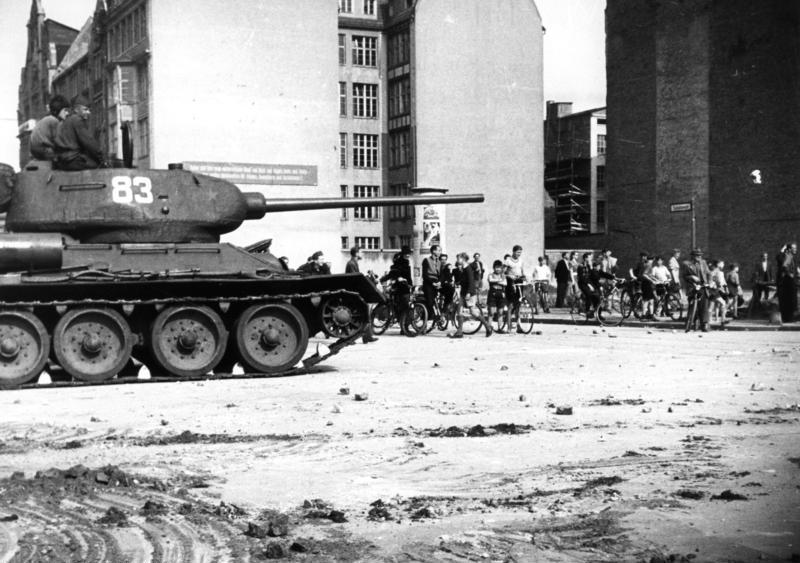
Ulbricht, who had been ordered to Moscow shortly before the uprising and had been preparing for his own removal by Beria, was, paradoxically, saved by the events. The Soviet leadership concluded that political reform in East Germany would only encourage further unrest, and that a hardline figure like Ulbricht was the safest option. He returned to East Berlin on the 18th with the backing he had not had a week earlier. He remained in office for another eighteen years.
"It now appears that the Government of the German Democratic Republic has failed to win the trust of the working population. We are sorry, but the working population has chosen — for the moment — to vote with its feet. We must regain its trust by working harder." — Walter Ulbricht, address to the SED Central Committee, 21 June 1953
The exodus
The defining problem of the next eight years was demographic. East Germany was losing citizens to the West at an unsustainable rate. The border between the two German states had been formally closed since 1952 — barbed wire, watchtowers, mined zones — but the four sectors of Berlin had remained open to travel within the city. A West Berlin subway ride or a walk across the Brandenburg Gate transferred an East German citizen, in twenty minutes, into the Federal Republic, where they were automatically granted citizenship and resettlement assistance under the West German constitution.
Between 1949 and August 1961, around 3.5 million East Germans — roughly one in five of the entire population — left the country in this way. The departures were disproportionately young, educated, and professional. Doctors, engineers, scientists, and skilled workers were leaving at rates that made the planned economy impossible to staff. By the spring of 1961 the exodus had reached around 4,000 people a day. The country was, in any realistic forecast, going to run out of working-age citizens within a generation.
Ulbricht had been begging Moscow for permission to close the Berlin border since 1958. Khrushchev, initially reluctant, agreed in mid-1961. The plans for the closure had been drawn up by the East German Minister of State Security, Erich Mielke, and the Minister of the Interior, Karl Maron, over the previous spring. The pretext was a Warsaw Pact decision to "secure" the border.
13 August 1961
At one minute past midnight on Sunday the 13th of August 1961, East German police and border troops began stretching barbed wire along the entire 156-kilometre boundary between East and West Berlin. The closure was conducted in the early hours of a quiet summer Sunday morning to minimise the chance of crowd resistance or Western military reaction. By dawn the border was sealed. By the end of the week the barbed wire had been replaced with concrete blocks. By the end of August, with a concrete wall — first 1.8 metres high, then progressively taller — that would, in successive generations, become the most iconic political structure of the Cold War.
The wall closed the demographic hemorrhage. It also, in a single morning, ended the possibility that East Germany could be understood as a normal state that its citizens chose to belong to. From the 13th of August 1961 onward, the country was, in the eyes of its own citizens and of the world, a country whose existence was confirmed by the wall around it.
Ulbricht said publicly, in the speech announcing the closure, that the wall was a defensive measure against "fascist infiltration" from the West. The state propaganda would maintain this position until 1989. Almost no one believed it. The wall stopped no fascists. It stopped East Germans.
The next chapter takes up the country that the wall created.
End of Chapter II