The calendar year 1864 was the year in which the war became, in the modern sense, total. The Union strategy under Grant — promoted to General-in-Chief of all Union armies on the 9th of March 1864, the first lieutenant general's commission since George Washington — was a coordinated offensive across all theatres: Grant himself with Meade against Lee in Virginia, Sherman against Joseph E. Johnston's Army of Tennessee in Georgia, Butler against Richmond from the east, Sigel up the Shenandoah, and Banks up the Red River in Louisiana. The objective was no longer the seizure of strategic geographic points, which the war's first three years had shown could not by themselves produce a Confederate collapse, but the destruction of the Confederate armies — the operational priority that Lincoln had been urging on his commanders since 1862. The cost of this strategy in casualties was unprecedented in American military history.
The Overland Campaign
Grant's Overland Campaign opened on the 4th of May 1864 with the Army of the Potomac crossing the Rapidan into the Wilderness, the same densely wooded countryside in which Hooker had been defeated a year earlier. The Battle of the Wilderness on the 5th-7th of May was a two-day infantry slugging match in the difficult terrain, with approximately 18,400 Union casualties to 11,000 Confederate; tactically indecisive. The previous pattern of Union commanders under such circumstances had been to withdraw across the Rapidan to refit. Grant did the opposite: on the night of the 7th of May he marched south-east toward Spotsylvania Court House. The Army of the Potomac, marching in column past the Wilderness intersection, knew it was not retreating and cheered. The campaign would not pause for fighting.
The Battle of Spotsylvania of the 8th-21st of May produced approximately 18,000 Union casualties to 12,000 Confederate, including the celebrated and terrible eighteen-hour fight at the "Bloody Angle" of the 12th of May, in which men fought in continuous rain at 10–20 yards distance until the surrounding parapets were piled with bodies. After Spotsylvania Grant sidestepped again to the south-east. The Battle of Cold Harbor on the 3rd of June — Grant's frontal assault on entrenched Confederate positions — was the campaign's worst Union tactical mistake: approximately 7,000 Union casualties in twenty minutes, including a substantial number of men who pinned identification papers to their tunics before the assault, expecting to die. Grant later said the only attack he regretted ordering in the war was the second one at Cold Harbor.
Cumulative Union casualties in the Overland Campaign from the 4th of May to the 12th of June: approximately 55,000 (killed, wounded, missing) — roughly equal to the entire size of Lee's army at the campaign's opening. The Confederate casualties of approximately 33,000 were proportionally heavier, given Lee's smaller force. The political reaction in the Union was substantial. Grant was nicknamed "the Butcher" in some of the Democratic press; the casualty lists in the New York papers ran to multiple pages daily. But Lincoln defended Grant and continued to provide reinforcements. The campaign continued.
Petersburg
After Cold Harbor, Grant disengaged on the 12th of June and moved south-east across the James River, with the objective of seizing Petersburg — the rail junction twenty miles south of Richmond through which all Confederate supplies into the capital flowed. The initial Union assaults on Petersburg on the 15th-18th of June were poorly coordinated and were repulsed; Grant then settled into a siege that would run for nine and a half months. The siege lines extended for approximately 30 miles around Petersburg's southern and eastern perimeter, with continuous trench warfare that anticipated, in many of its tactical features, the Western Front fifty years later. The Battle of the Crater on the 30th of July — the explosion of a Pennsylvania-engineered mine under a Confederate redoubt, followed by the disastrous Union infantry assault into the resulting hole — was the siege's most famous engagement; Union casualties approximately 3,800, Confederate 1,500.
The Atlanta Campaign
The Atlanta Campaign in Georgia was conducted by William Tecumseh Sherman with the Union Military Division of the Mississippi (the combined Armies of the Tennessee, Cumberland, and Ohio, approximately 100,000 men) against the Confederate Army of Tennessee under Joseph E. Johnston (approximately 60,000), opening from Chattanooga on the 7th of May 1864. The campaign was substantially different in operational character from the Virginia campaign: Sherman fought a series of flanking manoeuvres rather than head-on assaults, repeatedly forcing Johnston to abandon defensive positions by threatening to cut his supply lines. Sherman's casualties through the campaign were a relatively low 31,000 across four months; Johnston's were comparable in absolute terms but proportionally heavier.
Johnston, criticised by the Confederate government for retreating without delivering battle, was replaced on the 17th of July by John Bell Hood, an aggressive corps commander with a reputation for casualty-heavy frontal assaults. Hood's three offensive battles around Atlanta in July 1864 — Peach Tree Creek, Atlanta proper, and Ezra Church — produced approximately 15,000 Confederate casualties to 6,000 Union, and substantially weakened the Confederate field army without producing any strategic gain. Sherman's siege of Atlanta tightened across August; the city fell on the 2nd of September 1864.
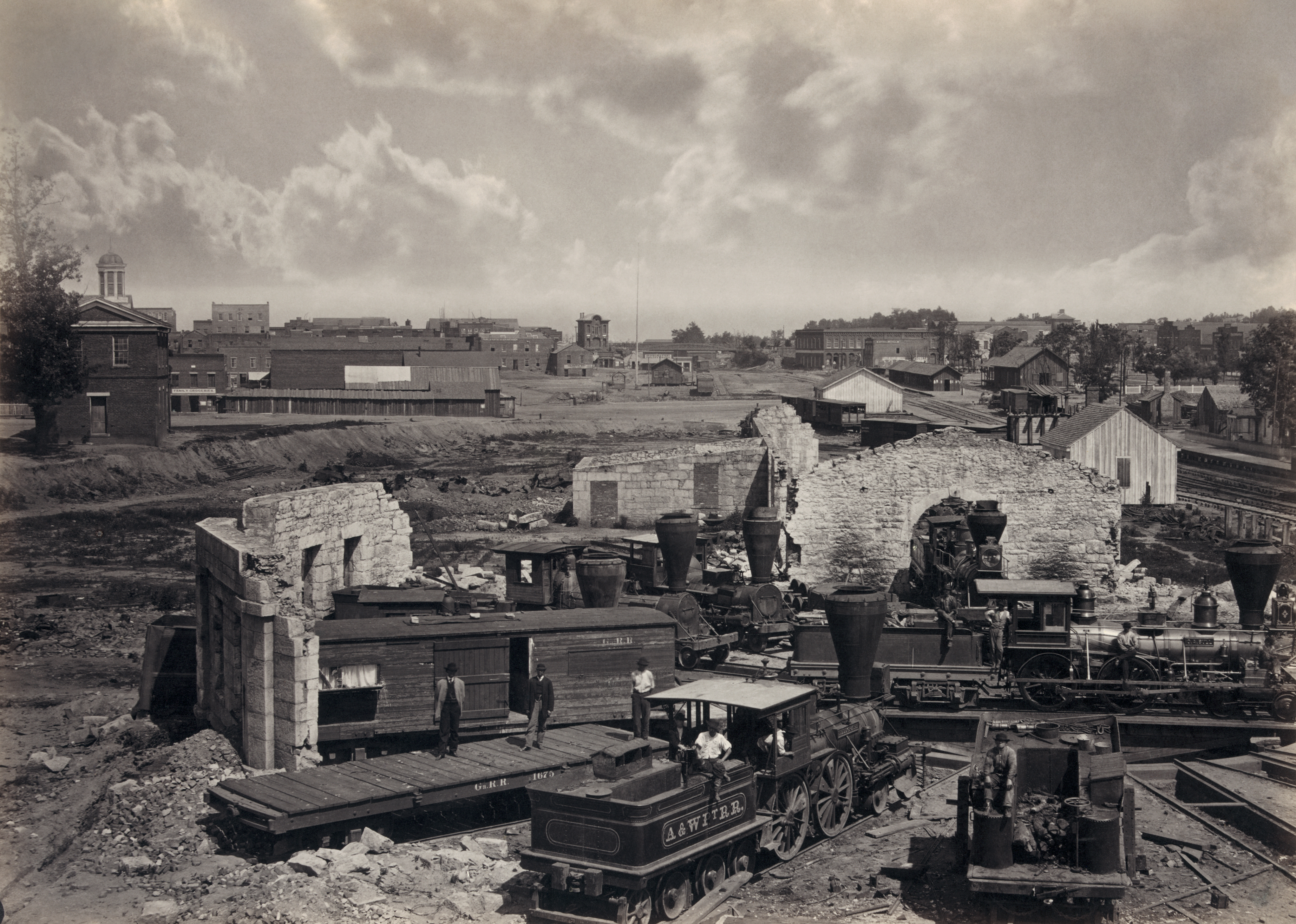
The fall of Atlanta was politically decisive. The Union presidential election was scheduled for the 8th of November 1864; the Democratic Party had nominated George B. McClellan on a peace platform; the election was, on most Republican assessments through July and August, a probable Lincoln defeat. Atlanta restored Republican confidence and substantially carried the November election: Lincoln won 55 per cent of the popular vote and 212 of 233 electoral votes. The political question had been definitively answered.
The march to the sea
Sherman's March to the Sea — the famous campaign from Atlanta to Savannah, beginning on the 15th of November 1864 — was the most controversial operation of the war. Sherman's force of approximately 62,000 men, divided into two parallel columns, marched without supply lines through central Georgia, living off the country and systematically destroying railroad track, factories, supplies, and the property of Confederate sympathisers. The campaign's instrumental objective was to convince the Confederate population that the war could not be won and that further resistance would only prolong destruction. The campaign reached Savannah on the 22nd of December 1864 (Sherman sent Lincoln, on Christmas Eve, the famous telegram offering the city as a Christmas present). The damage to civilian property was substantial — estimated at approximately $100 million in 1864 dollars — though contemporary and modern scholarship has substantially scaled back the most extreme Lost Cause estimates of casual violence against southern civilians by Sherman's troops.

The March to the Sea was followed by Sherman's Carolinas Campaign of January-April 1865, which traversed South Carolina with substantially greater destruction (the war's emotional centre, where secession had begun) and entered North Carolina by mid-March. Joseph E. Johnston, recalled to command, fought the rearguard Battle of Bentonville (19th-21st of March 1865) and would surrender his army to Sherman near Durham, North Carolina, on the 26th of April 1865 — three weeks after Lee's surrender at Appomattox. The end of the war is the next chapter.
End of Chapter VII