The four months between Lincoln's election on the 6th of November 1860 and his inauguration on the 4th of March 1861 are known to United States constitutional history as the Secession Winter. In that period seven states withdrew from the Union by sovereign convention vote, organised themselves into a new confederate government with a written constitution, seized federal forts and arsenals across the Deep South, swore the oath of office to their new president, and conducted themselves as a sovereign state. The Buchanan administration — Lincoln's predecessor, in office until the 4th of March — declined to use federal military force to prevent any of this, on grounds that the executive lacked constitutional authority to coerce a state. Lincoln, until his inauguration, was a private citizen with no executive power. The Union, in effect, had no functioning federal authority for sixteen weeks during a constitutional emergency. The interval determined the war that would follow.
The seven states
The chronology of secession was as follows. South Carolina seceded on the 20th of December 1860, the convention vote 169–0. Mississippi on the 9th of January 1861 (84–15). Florida on the 10th of January (62–7). Alabama on the 11th of January (61–39). Georgia on the 19th of January (208–89). Louisiana on the 26th of January (113–17). Texas on the 1st of February (166–8, subject to popular ratification, which followed on the 23rd of February with 76 per cent in favour). The Texas case is significant because the popular ratification was the only one held; the other six states seceded by convention vote alone, on the constitutional theory that the conventions exercised the same sovereign authority that had ratified the original constitution.
The eight remaining slave states did not initially secede. Virginia, North Carolina, Tennessee and Arkansas held secession conventions that voted against secession through January and February 1861, on the calculation that the constitutional crisis might still be resolved by federal compromise. Maryland, Delaware, Kentucky, and Missouri did not call conventions. The upper South would secede only after the Fort Sumter exchange and Lincoln's call for volunteers in April 1861 — four further states — bringing the Confederacy to its full eleven-state membership. Maryland and Missouri would remain contested and substantially divided; Delaware and Kentucky would stay nominally Unionist throughout.
The Montgomery convention
Delegates from the seven seceded states met at the Alabama state capitol in Montgomery on the 4th of February 1861. The convention had three tasks: to draft a provisional constitution, to elect a provisional government, and to establish the political-administrative apparatus of a new sovereign state. The provisional constitution, drafted between the 4th and 8th of February, was modelled closely on the United States Constitution with substantive modifications: it explicitly protected slavery in all Confederate territory; it prohibited Congress from passing any law impairing the right to property in enslaved persons; it limited the president to a single six-year term; it prohibited tariffs intended for the protection of domestic industry; it reserved to the states the powers not explicitly delegated to the central government. The permanent constitution, drafted across the next month and adopted on the 11th of March 1861, retained these features.
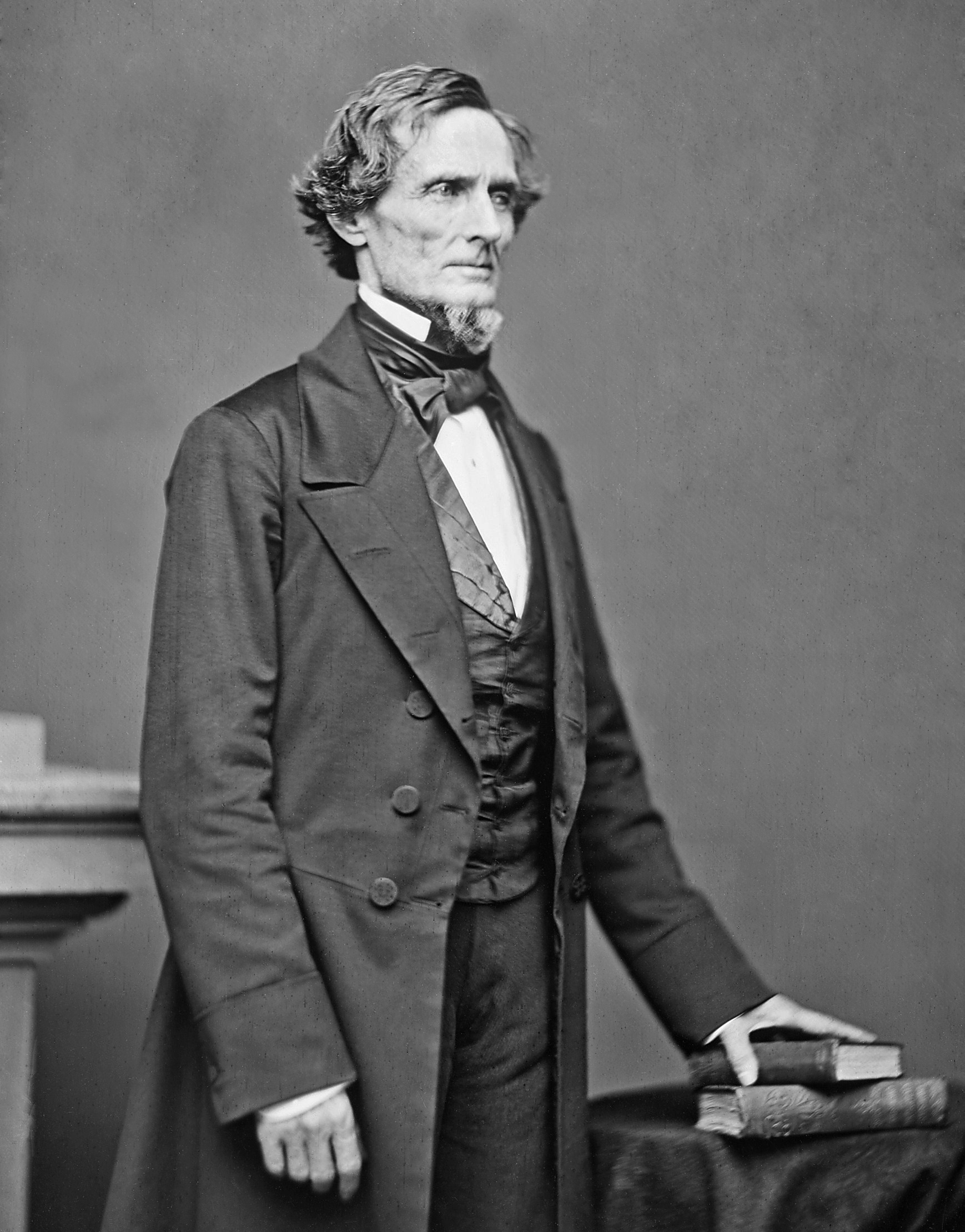
The presidential election produced Jefferson Davis (Mississippi, former United States Secretary of War under Pierce, then senator) as president, and Alexander Stephens (Georgia) as vice-president. Davis was inaugurated on the steps of the Alabama State Capitol on the 18th of February 1861. The cabinet — Robert Toombs at State, Christopher Memminger at Treasury, Leroy Pope Walker at War, Stephen Mallory at Navy, John Reagan at Post Office, Judah P. Benjamin at Justice — was drawn from the seven states' political leadership. The capital was at Montgomery; it would move to Richmond, Virginia, after Virginia's secession, on the 29th of May 1861.
The seized federal property
The new Confederate government immediately moved to take possession of federal property within its territory. The federal arsenals at Fayetteville, Augusta, Mount Vernon and Charleston; the federal mints at New Orleans, Charlotte and Dahlonega; the federal customs houses at every Confederate port; the federal post offices, courthouses, and revenue stations were taken over without resistance in most cases, since federal officials in those positions were generally local appointees who either resigned and joined the Confederate service or simply transferred their loyalty. The principal exceptions were the federal forts: Fort Sumter in Charleston harbour, Fort Pickens at Pensacola, Fort Taylor at Key West, and Fort Jefferson in the Dry Tortugas. Of these, Sumter was the most politically prominent — its garrison of about 80 men under Major Robert Anderson had been transferred to it from the more vulnerable Fort Moultrie on the 26th of December 1860, and the South Carolina state authorities had treated the transfer as a hostile act. The siege of Sumter — initially political and logistical, eventually military — would continue for nearly four months.

The compromise efforts
The major attempt at federal compromise during the Secession Winter was the Crittenden Compromise, proposed by the Kentucky senator John J. Crittenden in December 1860. It proposed six constitutional amendments: the Missouri Compromise line of 36°30' would be restored and extended to the Pacific, slavery would be permanently protected in slave states, the federal government would compensate slaveholders for unrecovered fugitive slaves, and several less consequential provisions. The compromise was endorsed by southern moderates and by Buchanan, but failed in committee on the 22nd of December 1860 when the five Republican members of the Senate Committee of Thirteen — acting on Lincoln's instruction, delivered in a private letter to William H. Seward — voted against it. Lincoln's reasoning was straightforward: the Republican Party had been elected on a platform of no extension of slavery; conceding the extension of slavery to win back the seceded states would have destroyed the party's reason for existing. The compromise's failure produced the further secessions of January and February 1861.
The Washington Peace Conference of February 1861, presided over by former President John Tyler, similarly failed to produce a settlement Lincoln could accept. By the time Lincoln took the oath on the 4th of March, no compromise was available; the seven seceded states had organized themselves as a sovereign government; and the constitutional question — whether secession was legally possible — could only be resolved by force. Lincoln's first executive task would be the military relief of Fort Sumter. That story is the next chapter.
End of Chapter II