The Great Terror — also known by the name of its principal NKVD operator as the Yezhovshchina ("Yezhov-time") — was the most intense single episode of state violence in the Soviet Union's peacetime history. Its core period ran from August 1936 to November 1938. In those twenty-seven months, the security organs of the Soviet state arrested approximately 1.5 million people, executed approximately 680,000 of them, sentenced most of the rest to long terms in the camp system, and effectively destroyed the political, military, scientific, and intellectual leadership of the country as it had existed at the start of the period.
The opening event was the assassination of Sergei Kirov, the Communist Party leader of Leningrad and a Politburo member, on the 1st of December 1934. Kirov was shot in the corridor of the Smolny Institute (the Bolshevik headquarters in 1917) by a lone gunman named Leonid Nikolaev, who had recently lost his party card. The assassination remains historically controversial: contemporary suggestions that Stalin had orchestrated it to provide a pretext for the terror have been argued by some historians (Robert Conquest, Roy Medvedev) and rejected by others (J. Arch Getty, Matthew Lenoe, whose 2010 archival study is the most thorough recent treatment and concludes that Stalin was probably not directly responsible). What is not in dispute is that Stalin used the assassination immediately, in a decree issued on the same evening, to authorise summary trials of accused terrorists with no right of appeal and no public proceedings. The legal infrastructure of the Terror was now in place.
The show trials
The Moscow show trials of 1936, 1937, and 1938 were the public face of the terror. The defendants — most of them members of the senior Bolshevik leadership of the 1917–1924 generation — were charged with elaborate conspiracies of treason, espionage, sabotage, and assassination on behalf of foreign powers (Germany, Japan, Britain, France) and exiled rivals (Trotsky). The August 1936 trial of the so-called Trotskyite-Zinovievite Terrorist Centre convicted and shot Zinoviev, Kamenev, and fourteen others. The January 1937 trial of the so-called Parallel Anti-Soviet Trotskyite Centre convicted Radek, Pyatakov, Sokolnikov, and fourteen others (Pyatakov and twelve others executed; the rest given long camp terms). The March 1938 trial of the so-called Anti-Soviet Bloc of Rights and Trotskyites convicted Bukharin, Rykov (the former premier), Yagoda (the former head of the NKVD), and eighteen others; eighteen were shot.
The trials were public. Foreign journalists and diplomats were admitted. The defendants — almost all of whom had, in private interrogation, signed extensive confessions to crimes they had not committed — repeated their confessions in open court, often with extraordinary self-abasement. The reasons for the public confessions have been variously explained: torture (extensively employed, though formal authorisation came only in 1937); psychological coercion involving threats to family members; the residual party loyalty of the defendants, who accepted that their public confession was a "last service to the party" against whose general line they could no longer credibly dissent; and in some cases the prospect (consistently violated) of saved family members or commuted sentences. The trials' formal proceedings have been published in full in Russian and English; they make difficult reading, both for the content of the confessions and for the visible deterioration of the defendants over the trial weeks.
The mass operations
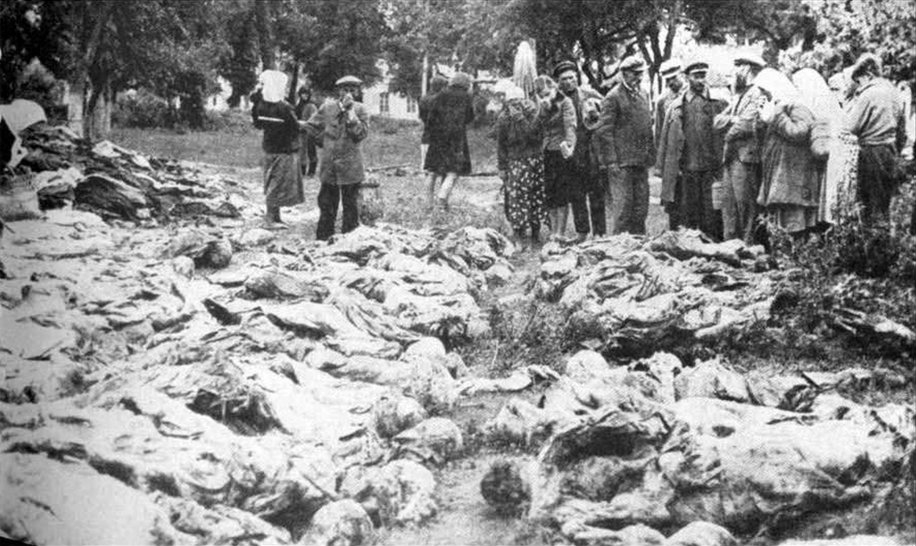
The show trials affected, at most, several hundred named defendants. The substantive terror was the so-called mass operations, conducted by the NKVD under quotas issued from Moscow to provincial offices, with each oblast given a "limit" of how many people to execute and how many to send to the camps, distributed by class category (kulaks, former tsarist officials, members of national minorities considered politically suspect, returnees from foreign countries, religious officials). NKVD Order No. 00447 of the 30th of July 1937 — the founding document of the mass operations — set initial all-union quotas of 75,950 executions and 193,000 camp sentences; the limits were subsequently raised, repeatedly, by central decision. By the end of 1938 the actual executions had reached approximately 680,000 and the camp sentences approximately 800,000.
The national operations — separate quota-based campaigns directed at particular ethnic groups whom the regime considered potential fifth columns — included the Polish Operation (about 144,000 arrests, 111,000 executions), the German Operation (about 56,000 arrests, 42,000 executions), and similar operations against Latvians, Finns, Greeks, Iranians, Estonians, and Romanians. In proportional terms, the Polish-speaking Soviet minority — including both ethnic Poles and Soviet citizens with Polish-sounding surnames — suffered the most severe per-capita losses of any group in the Terror.
The military purge
The destruction of the Red Army officer corps in 1937–1938 was a discrete operation conducted by the NKVD in parallel with the mass operations. The proximate trigger was a German intelligence operation in late 1936 — the so-called "Tukhachevsky affair," in which the SD (the Sicherheitsdienst, the SS intelligence service) appears to have fabricated and leaked, through Czech intermediaries, documents purporting to show that the senior Soviet commander Mikhail Tukhachevsky was conspiring with the German general staff. Whether Stalin believed the documents or used them as a convenient pretext for a purge he had already decided on is debated. What is not debated is the scale. Eight of the nine senior Soviet generals were executed in June 1937; over the next eighteen months, approximately three-quarters of the Soviet senior officer corps — all three marshals (out of five), thirteen of fifteen army commanders, fifty-seven of eighty-five corps commanders, 110 of 195 divisional commanders, and 220 of 406 brigade commanders — were arrested. Most were executed. The Soviet armed forces entered the period 1939–1941 with a junior and inexperienced command structure that bore substantial responsibility for the early Soviet defeats in the Second World War (the 1939 Winter War with Finland, the catastrophic 1941 retreats).

The end of the Yezhovshchina
The Terror ended almost as abruptly as it had begun. In November 1938, Nikolai Yezhov — the head of the NKVD since September 1936 — was relieved of his position. He was replaced by Lavrenti Beria, a Georgian colleague of Stalin who had been deputy chairman of the NKVD since August. The mass operations were formally ended; the NKVD was substantially purged of Yezhov's operatives (many of them, in turn, arrested and shot); some of the more egregious cases of the Terror were quietly reversed and the survivors released. Yezhov himself was arrested in April 1939, accused of espionage and treason at a closed proceeding, and shot in February 1940. The pattern of the Terror — the substitution of its principal architect for its responsibility for the deaths — became a standard feature of subsequent Soviet political life.
The damage to the country was enormous. The senior leadership of the Bolshevik party, the senior officer corps of the army, the senior management of the industrial economy, the senior scientific community, and the senior figures of Soviet cultural life had been substantially destroyed. Of the 1,966 delegates to the 1934 Seventeenth Party Congress, 1,108 were arrested in the Terror; of the 139 members and candidates of the Central Committee elected at that congress, 98 were arrested. Of the Bolshevik leadership of October 1917, only Stalin himself, Molotov, Bukharin (executed 1938), Trotsky (assassinated 1940), and a handful of others remained alive by 1939. The next chapter takes up the Soviet entry into the Second World War, fought under the radically diminished leadership the Terror had left.
End of Chapter IV