The first Five-Year Plan ran officially from the 1st of October 1928 to the 31st of December 1932 (it was declared complete nine months early, in twelve quarters rather than twenty). It set targets — most of which were not met, although the official statistics claimed otherwise — for steel production, coal production, electrical generation, machine tools, tractors, oil, and a dozen other sectors. The plan's substantive achievement was the construction, almost from nothing, of a heavy industrial base in the Urals and western Siberia, with new cities founded on greenfield sites (Magnitogorsk, Stalinsk/Novokuznetsk, Komsomolsk-on-Amur) and the expansion of existing industrial centres (Dnepropetrovsk in Ukraine, Stalingrad on the Volga). The plan's substantive cost was the agricultural transformation that financed it.

The collectivisation campaign
Collectivisation — the forced reorganisation of rural smallholdings into state-owned collective farms (the kolkhoz) and large state farms (the sovkhoz) — was announced as a policy at the Fifteenth Party Congress in December 1927 and accelerated dramatically in late 1929. The formal policy involved the merger of village smallholdings into a single collective entity, with ownership of land, livestock, and equipment transferred to the collective and the peasants paid in kind from the residual production after state procurement quotas had been met. The practical implementation involved sending tens of thousands of urban party activists (the "25,000ers," named for the initial volunteer figure) to rural areas to enforce the policy, dispossess or deport peasants who resisted, and supervise the new farm structures.
Resistance was widespread. The official policy of "liquidating the kulaks as a class" was used to identify and deport — to special settlements in Siberia, Kazakhstan, and the far north — any peasants who resisted the policy, with the kulak designation in practice applied to anyone the local party committee chose to identify. About 1.8 million peasants were deported to special settlements between 1930 and 1933; perhaps an additional 600,000 were sent to the camp system (Gulag) during the same period. Peasants slaughtered their livestock rather than turn it over to the collective: the Soviet cattle herd fell by about half between 1928 and 1933, the horse herd by about a third. Armed peasant resistance occurred in several regions — particularly the North Caucasus, Ukraine, and the Volga — with at least 13,000 separate "mass disturbances" recorded by the OGPU in 1930 alone.
The pace of collectivisation was such that, by the end of 1932, about sixty percent of peasant households were collectivised; by 1937 the figure was ninety-three percent. The traditional Russian rural commune — the obshchina or mir, the unit of village social and economic life since the medieval period — was extinguished.
The famine of 1932–1933
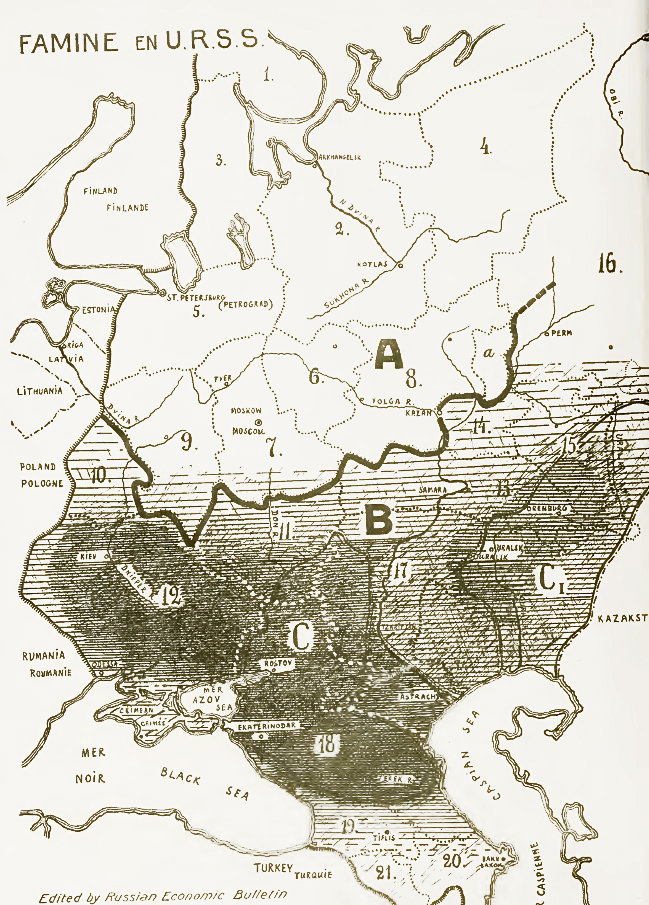
The famine of 1932–1933 was the demographic catastrophe of the collectivisation period. It killed perhaps six million people — the figure is contested, with estimates ranging from four to eight million — concentrated in Ukraine, the Volga region, Kazakhstan, and the North Caucasus. The Ukrainian portion of the famine has been recognised by Ukraine and by twenty-six other countries as a genocide (the Holodomor, "killing by starvation"); the Russian Federation has not accepted that designation, taking the position that the famine affected multiple regions and ethnic groups and was the result of policy failure rather than ethnic targeting. The historical debate continues. What is not in dispute is that the famine was caused by the combination of state grain procurement at quotas that exceeded available production, the deportation of substantial fractions of the most productive peasant labour, the destruction of livestock during collectivisation, and the regime's deliberate decision not to release grain reserves or accept foreign aid during the worst months of 1932–1933 (Soviet grain exports continued throughout the famine, on the explicit grounds that interrupting them would damage the country's foreign currency position and the industrialisation plan).
The famine in Kazakhstan was, in proportional terms, even more severe than the famine in Ukraine: the traditionally nomadic Kazakh population was forcibly settled and collectivised, with the destruction of the herding economy producing the death of perhaps 1.5 million Kazakhs (about forty percent of the ethnic Kazakh population at the time). The Kazakh demographic recovery would take three decades.
The industrial transformation
Against this rural catastrophe, the industrial achievement of the first two Five-Year Plans (1928–1937) was, in its specific terms, real. The Soviet Union's industrial output grew at an average rate of about ten percent per year through the period — faster than any other industrialising economy of the twentieth century, though from a low starting base. The new heavy-industrial cities of the Urals and Siberia were built on greenfield sites with imported Western machinery (the United States provided much of the design and equipment for the Magnitogorsk steel complex; Ford provided the technology for the Gorky automobile plant; American and German engineers were extensively employed) and Soviet labour (free workers, paid workers, deported peasants, and increasingly Gulag prisoners). The Soviet workforce was educated rapidly: literacy rose from about forty percent in 1928 to about eighty percent by 1937. Universities, technical institutes, and engineering schools were founded in numbers unprecedented in any educational system of the period.
The transformation was, by any measure, real. The Soviet Union in 1937 had a heavy industrial base capable of producing modern aircraft, modern artillery, modern tanks, and modern locomotives — capacity that did not exist in any meaningful sense in 1928. The same industrial base would, in 1941–1945, produce the military equipment with which the Soviet Union won its part of the Second World War.
The political consequences
The collectivisation and industrialisation campaigns transformed Soviet political life as well as Soviet economic life. The party apparatus expanded dramatically: from about 1.5 million members in 1928 to about 2.5 million by 1933. The security services (OGPU, after 1934 the NKVD) doubled in size and became, in the special settlements and the Gulag, the supervisors of an enormous forced-labour economy. The Stakhanovite movement of the mid-1930s — promoting individual workers who massively over-fulfilled production norms (named for the coal miner Aleksei Stakhanov, who in August 1935 reportedly cut fourteen times his shift's quota; the achievement is disputed, but the publicity campaign was effective) — was the regime's effort to extract additional labour intensity from the workforce. The cult of personality around Stalin was intensified in this period: his sixtieth birthday in December 1929 was the first occasion on which the term "leader of genius" appeared in Pravda, and from the early 1930s his portrait was officially required in workplaces, schools, and party offices throughout the country.
The political pattern that the next chapter takes up — the descent into terror that consumed not only the regime's opponents but most of its leadership — was prepared in this period. The contradiction between the achievements claimed and the human costs hidden produced, by 1934, a political environment in which any open discussion of the latter was treasonable. The death of Sergei Kirov on the 1st of December 1934 was the proximate trigger of the Great Terror. It is the subject of the next chapter.
"There are no fortresses Bolsheviks cannot storm." — Stalin, 1931. The slogan was widely posted on Soviet construction sites through the 1930s.
End of Chapter III