The reform campaign against the Free State regime is one of the most successful single international human-rights campaigns of the modern period. In the decade between 1899 and 1908, a coalition of journalists, missionaries, diplomats, and humanitarian activists produced sufficient public pressure in Britain, the United States, and (eventually) Belgium itself to end Leopold's personal control of the Congo. The campaign succeeded against a determined and well-financed defence by the Free State administration. It is the founding episode of the modern international human-rights movement, in many of the same institutional senses that the abolitionist campaign of the 1830s-1860s had been for the earlier nineteenth century.

Conrad
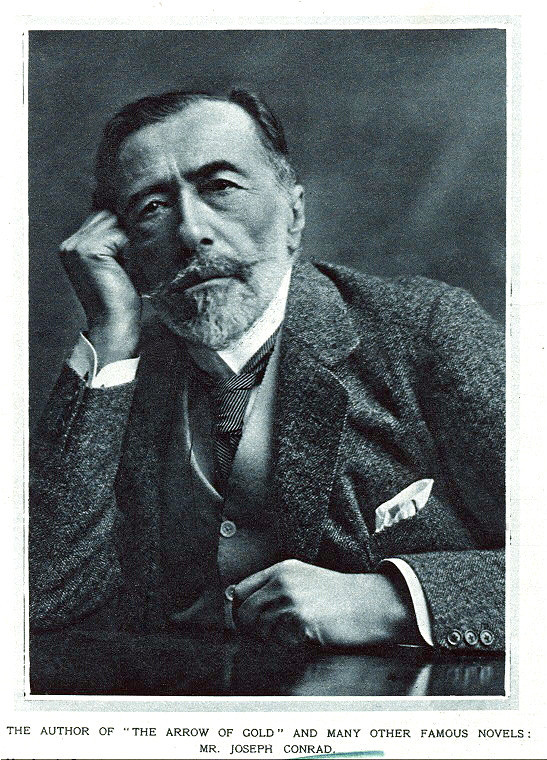
The first widely read European account of the Free State conditions was Joseph Conrad's novella Heart of Darkness, published in serial form in Blackwood's Magazine in 1899 and as a book in 1902. Conrad had been a riverboat officer in the Free State in 1890, employed by the Société Anonyme Belge pour le Commerce du Haut-Congo to take a steamer up the Congo river to Stanley Falls. The experience produced both a substantial deterioration of Conrad's physical and mental health (he suffered persistent malaria, dysentery, and depression for years afterwards) and a writer's material that would, a decade later, become the principal early English-language indictment of the Free State system.
Heart of Darkness is not, strictly, an account of the Free State — Conrad uses the framing devices of fiction, names no specific people, and describes events that are partly composites of his own experience and partly invented. But the substantive critique — that the European "civilising mission" had produced, in the African interior, a brutal system of forced labour and routine violence operated by men whose moral life had collapsed in conditions of unaccountable power — was immediately recognised by contemporary readers as a reference to the Free State. The novella was widely read in English-speaking literary circles and contributed substantially to the moral climate in which the more specific journalistic and diplomatic critique would be heard.
Morel
The single most consequential figure of the reform campaign was Edmund Dene Morel, an Anglo-French clerk at the Liverpool shipping firm Elder Dempster, which held the principal contract for shipping Free State goods between Antwerp and the African coast. Morel, in 1900, noticed a striking discrepancy in the company's shipping records: the goods being shipped from the Free State to Antwerp (rubber and ivory in substantial quantities) were not being balanced by any comparable shipment of trade goods in the opposite direction. The Free State was extracting commodities and not paying for them in any normal commercial sense — which meant, on the only available interpretation, that the labour producing the commodities was either uncompensated or compensated only in derisory tokens. Morel pursued the question through his own employer's records, through public-domain shipping data, and through his contacts in West Africa, and concluded that the Free State was operating on a forced-labour basis.
Morel resigned from his shipping company in 1901 and began a full-time campaign against the Free State. He founded the journal West African Mail in 1903 (which became the principal English-language periodical of the reform campaign) and the Congo Reform Association in March 1904. He wrote a series of substantial books — King Leopold's Rule in Africa (1904), Red Rubber (1906), Great Britain and the Congo (1909) — that documented the system in detail, drawing on missionary reports, diplomatic correspondence, photographic evidence, and the witness statements of African and European participants. The campaign mobilised a substantial British religious and humanitarian network (the Aborigines Protection Society, the Society for the Protection of Aborigines, the Foreign and Commonwealth Society, various missionary societies) and, by 1906, was producing systematic public-meeting attendance figures in Britain comparable to those of the abolitionist campaigns of the 1830s. The American writer Mark Twain published King Leopold's Soliloquy in 1905 — a satirical piece in which Leopold was given a fictional monologue defending his regime — that brought the American public into the campaign.
Casement
The decisive single document of the reform campaign was the 1904 report of the British consul Roger Casement on the conditions in the Free State. Casement had been the British consul at Boma from 1901; he was, by personal temperament and Irish nationalist political background, unusually sympathetic to colonised populations. Following sustained pressure from the British humanitarian community for an official investigation, the British Foreign Office authorised Casement in 1903 to conduct an inspection tour of the principal rubber-producing regions and to report on the conditions.
Casement's tour, in mid-1903, took him up the Congo river to the central rubber districts. He spent three months interviewing missionaries, African villagers, Force Publique troops, and Free State officials. His report — submitted to the British Foreign Office in December 1903 and published as a parliamentary paper in February 1904 — was a forty-page document with substantial appendices, written in the dry official style appropriate to a British consular report and detailing, with specific dates, names of officials, names of victims, and photographic evidence, the operation of the quota system, the use of hostage-taking, the amputation practices, and the demographic effects on the affected populations. The report's authority derived from Casement's official status, from the specificity of his evidence, and from the absence of polemical rhetoric in its presentation. It was, by any reasonable measure, the central single piece of evidence on which the reform campaign rested.
Casement was, in private life, a complicated figure — homosexual at a time when homosexuality was criminal in the British Empire, an Irish nationalist who would, in 1916, be hanged for treason after attempting to organise German support for the Easter Rising. The combination of his official authority on the Congo and his subsequent political eclipse produced an unusual archive: Casement's so-called "Black Diaries," seized by British authorities at his arrest in 1916, contain explicit homosexual material that the British government used to undermine American and Irish-American support for his commutation, and which remained the subject of authentication controversy until DNA testing in 2002 confirmed their authenticity. The relevance to the Free State is that Casement's homosexuality may have substantially shaped his receptiveness to the suffering of the colonised populations he interviewed — a connection that has been substantially developed in recent biographical work.
The defence
The Free State's response to the reform campaign was substantial and well-financed. Leopold's personal press operation in Brussels — directed by his chamberlain Baron Auguste Goffinet and supported by a network of lobbyists, paid journalists, and friendly diplomats — produced a steady stream of public-relations material defending the regime. A Belgian commission of inquiry was convened in 1904 (the so-called Janssens-Schumacher Commission) that produced a report (the so-called Rapport de la Commission d'Enquête, 1905) substantially confirming most of the British critiques, though in a more diplomatic register. Leopold rejected the commission's findings, sponsored a counter-commission of his own (which produced a refutation in 1906), and continued to maintain that the Free State conditions were essentially benign and that the reform campaign was driven by British and American economic interests hostile to Belgian commercial success.
The defence was, by 1906, increasingly untenable. The substantive evidence — the Casement Report, the missionary photographs, the testimony of returning European officials, the documentary record of Free State revenue compared to its claimed expenditures — was conclusive in the judgement of most informed European and American observers. Belgian public opinion, which had been largely indifferent to the Congo through the 1890s, was now substantially hostile to the regime. The Belgian Socialist Party, the Catholic political establishment, and major figures of the Belgian academic and journalistic community had turned against Leopold. The pressure for annexation — the transfer of the Free State from the king's personal sovereignty to the Belgian state — was substantial.
The 1908 settlement
The annexation was approved by the Belgian parliament in August 1908. The transfer of sovereignty took effect on the 15th of November 1908. The Free State ceased to exist on that date and was replaced by the Belgian Congo, governed as a Belgian colony under the Belgian Ministry of Colonies. The administrative system was substantially reorganised; the quota system was formally abolished (though local variations of forced-labour systems continued in modified form for decades); the Force Publique was reorganised as a Belgian colonial military unit; the concession companies were nationalised or restructured. Leopold himself retained a substantial personal compensation package — about 50 million Belgian francs (perhaps 750 million 2026 dollars) in cash plus various royal estates — as the agreed price for the transfer. He died fourteen months later, on the 17th of December 1909, of natural causes, aged seventy-four. He was buried in the Royal Crypt at Laeken with full national honours. The Belgian press, on his death, was substantially divided between hostile and reverential accounts. The substantive judgement of subsequent historiography has been that the Free State regime was, in its operating practice, one of the worst documented colonial systems of the modern period, and that Leopold's personal responsibility for it was direct and substantial.
The annexation, and the subsequent Belgian Congo period, are the subject of the next chapter.
End of Chapter V