The decade between the Brussels Geographical Conference of 1876 and the Berlin Conference of 1884-1885 saw Leopold's African project advance from a paper proposal to a recognised sovereign state. The mechanism by which the transformation was accomplished involved three parallel activities: the physical establishment of stations and forts in the Congo basin (under the direction of Henry Morton Stanley, who entered Leopold's employment in 1878 after the conclusion of his trans-African expedition); the diplomatic recognition campaign in the European capitals; and the legal negotiation of "treaties" with the African chiefs whose territory the project intended to occupy. All three were under way by 1879. By 1884, all three had produced sufficient results that Leopold could plausibly claim a sovereign territorial position.

Stanley's expeditions
Henry Morton Stanley — born John Rowlands in Wales in 1841, raised in a workhouse, emigrated to the United States as a young man, served in both the Union and Confederate armies during the American Civil War, became a journalist for the New York Herald, conducted the 1871-1872 expedition that found Livingstone at Ujiji, completed the 1874-1877 east-west crossing of Africa — was the principal European explorer of the Congo basin. His expedition of 1874-1877 had descended the Congo river from its headwaters in the central African plateau to its mouth at Boma, mapping the river's course for the first time and identifying the rapids of the lower Congo (the Inga and Livingstone Falls) that prevented direct ocean access to the navigable upper river. The expedition's account was published in 1878 and substantially shaped European understanding of the region's geography.
Leopold recruited Stanley after the publication of the 1878 account, on the basis of a personal interview at Brussels. Stanley entered Leopold's employment in 1879 and operated, for the next five years, as the principal agent of the project on the ground. His mission was to establish a chain of stations along the navigable Congo river, to negotiate territorial concessions from the chiefs whose territory the river crossed, and to make the geographical and political case for the Association's sovereign claim. The stations established by Stanley in this period — Vivi (the first station, near the mouth of the river), Manyanga, Léopoldville (now Kinshasa, founded December 1881), Stanley Pool, and a series of further stations upstream — constituted the physical infrastructure of the early colonial occupation.
The treaties
The legal basis of the Association's territorial claim was a series of "treaties" negotiated by Stanley and his agents with the chiefs of the African polities through which the Congo river ran. Approximately 450 such treaties were negotiated between 1879 and 1884, covering territories ranging from a few square kilometres to substantial regional principalities. The treaties were typically drafted in French or English (occasionally in Portuguese), signed by the African chief and an Association agent, and authenticated with an X-mark or thumbprint by the chief. They typically granted the Association sovereign rights over the chief's territory in exchange for various forms of compensation — a few bolts of cloth, a quantity of trade goods, a personal salary, a flag.
The treaties' legal validity has been the subject of substantial subsequent commentary. The principal objections are: that the African chiefs in most cases did not understand the European legal concept of sovereignty they were ceding, having no comparable concept in their own political traditions; that the texts were not, in the great majority of cases, presented to the chiefs in their own language; that the compensation was, in most cases, derisory compared with the territorial sovereignty being claimed; and that the chiefs' authority to cede territory at all — much of the area was held in collective community ownership rather than under chiefly sovereignty — was, by the African political traditions, doubtful. These objections were noted at the time by various critics (Sir Travers Twiss, the British international lawyer, was among them) and have been substantially developed in subsequent legal historiography. The treaties were, however, accepted by the European powers at Berlin as legitimate evidence of consensual transfer of sovereignty.
The diplomatic recognition
The campaign for European diplomatic recognition was conducted, between 1880 and 1884, in parallel with the territorial occupation. Leopold's principal strategy was the deliberate exploitation of inter-European rivalries: the British and the French were the major existing colonial powers in West Africa, and were locked in disputes over the lower Congo (the Portuguese held the river's mouth at the bottom of an old colonial claim; the French had been expanding from Gabon under Brazza's expeditions; the British had unofficial trading interests at Boma and elsewhere). Leopold's proposition — that the Association should be recognised as a neutral sovereign authority, with free trade for all European traders and protection from any single power's monopolistic exploitation — appealed to the powers that did not want their rivals to acquire the Congo basin.
The decisive single recognition was that of the United States, on the 22nd of April 1884. The Senate's foreign relations committee, advised by Henry Shelton Sanford (a former American ambassador to Belgium who had become a personal agent of Leopold's), endorsed the Association's claim to sovereignty in the Congo basin on the grounds that the new state would protect free trade and would, by its anti-slavery commitment, advance the humanitarian interests of the United States. The American recognition came before any European power had recognised the Association as a state and provided the precedent on which the European recognitions followed: Germany (8 November 1884), Britain (16 December 1884), France (23 February 1885), Portugal (14 February 1885 after specific border arrangements), and the remaining European powers in sequence over the following months.
The Berlin Conference
The Berlin Conference (officially the Conference of Berlin on West African Affairs) was convened by the German Chancellor Otto von Bismarck on the 15th of November 1884 and ran until the 26th of February 1885. Fourteen European powers were represented (the major European states plus the Ottoman Empire and the United States as an observer). The conference's nominal purpose was the establishment of rules for further European acquisition of African territory — the principle of "effective occupation" requiring that colonial claims be backed by demonstrable territorial control; the obligation of colonising powers to suppress the slave trade and to protect missionary activity; the establishment of free navigation on the Congo and Niger rivers.
The conference's substantive achievement, however, was the political settlement of the African scramble. The Congo basin was recognised, in the General Act of Berlin, as the territory of the International Association of the Congo, with the Association recognised as a sovereign state under Leopold's personal rule. The borders of the new state were drawn to give it approximately two million square kilometres of central African territory (larger than the entire European Belgium by a factor of about seventy-five). Free trade was guaranteed in principle. The state's sovereign status — distinct from any European colonial sovereignty — was formally acknowledged.
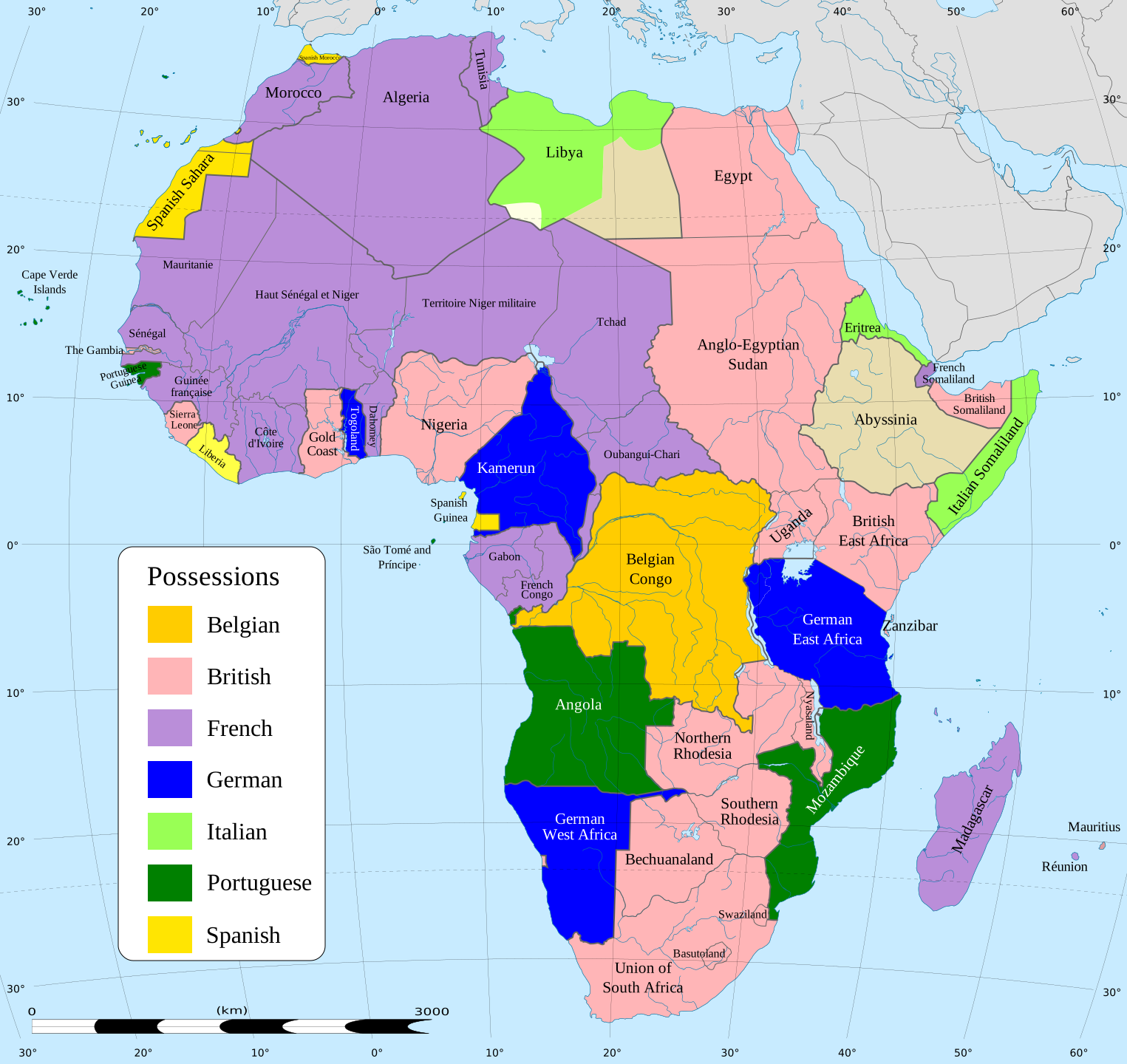
The Belgian parliament, asked to authorise the personal union with the new state, did so on the 28th of April 1885, on the explicit understanding that the Free State's finances would be entirely separate from those of the Belgian state and that Belgian taxpayers would not be required to support the venture. Leopold became, on that date, the sovereign of an African state ten times the size of his European kingdom. The new state was officially proclaimed on the 1st of August 1885 as the État indépendant du Congo. Its flag — a blue field with a single gold star — was the same flag that the Association had used since 1878. Its capital was at Boma, near the Atlantic coast. Its government, in its entirety, was the personal staff of King Leopold II of the Belgians.
The decade of preparation had succeeded. The actual administration of the new state — the subject of the next chapter — would, however, prove substantially harder than the diplomatic establishment of it.
End of Chapter II