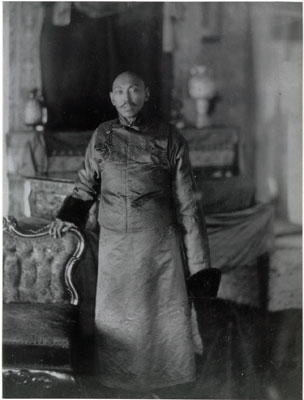
The twenty years of Thubten Gyatso's personal rule between his February 1913 return to Lhasa and his death in December 1933 are the constitutive period of the modern Tibetan state. The Thirteenth Dalai Lama is the only figure of the Ganden Phodrang line, between the Fifth (d. 1682) and the Fourteenth (still living at the time of writing), to have exercised personal political authority over an extended adult reign. His political instincts were substantially shaped by the two exile periods — Mongolia and China in 1904–09, India in 1910–12 — that had given him direct knowledge of the late-Qing collapse, of the post-Meiji Japanese state, and of the British Indian administration. He returned to Lhasa intending to reform the Tibetan state into a modern enough institution to survive in the twentieth-century international system. The reform programme was a substantial undertaking. Its outcome was a substantial failure, defeated by the monastic estate that had restored him to power.
The new army
The principal reform of the post-1913 period was the construction of a standing army on a recognisable European model. The 1904 catastrophe at Chumi Shengo had demonstrated the inadequacy of the existing levée system; the Lama's exile observations of British, Indian and Japanese forces produced a determination to build a regular force capable of garrisoning the eastern frontier and resisting any future Chinese, British or Russian intrusion. The army project was prosecuted from 1913 under Tsarong Dazang Dramdul — the Lhasa storming commander of 1912, raised to the Kashag and to the rank of commander-in-chief of the army (magji) — with British equipment, British and Japanese training officers, and a substantial budget that consumed an increasing share of the central government's revenue.
The peak strength was approximately 10,000 men in twenty regular battalions by 1924, with British-supplied Lee-Enfield rifles, mountain howitzers (Vickers ten-pounders) purchased through the Indian government, a small Lewis-gun complement, and a planned aviation programme that was never executed. The British training mission at Gyantse — Major George Sherriff and his successors — instructed Tibetan units in conventional drill, musketry and small-unit tactics. The army was used to garrison the eastern frontier at Chamdo and Markham, to suppress monastic-aristocratic disturbances in 1918 and 1924, and to maintain order in Lhasa during periods of political tension between the Dalai Lama's government and the monastic establishment.
The monastic resistance
The political fact that defeated the reform programme was the structural dominance of the great Gelug monasteries — Drepung (approximately 10,000 monks in 1930), Sera (8,000) and Ganden (4,000), the "three seats" — over the Lhasa political economy. The monasteries together owned approximately one-third of the agricultural and grazing land of central Tibet; they administered tax exemptions, judicial privileges and corvée-labour rights over substantial peasant populations; their monastic intake was approximately 15 per cent of the male population of the country; their delegates in the National Assembly (tsongdu) constituted the dominant voting bloc in the consultative apparatus of the state. Any reform programme that diverted resources from monastic budgets to the new army, or that raised the political authority of the secular bureaucracy and the military against the religious estate, was structurally opposed by the monastic interest.
The opposition was conducted, in the period 1918–24, through a sequence of disturbances and political confrontations that progressively limited the reform programme's scope. The principal incident was the 1924 crisis: a confrontation between the army (under Tsarong) and the Drepung monastic militia over the question of corporal punishment of monks who had assaulted the Lhasa police chief, which the Lama resolved in favour of the monasteries — dismissing Tsarong from the army command and progressively wound down the military expansion programme. By 1930 the army had been reduced from 10,000 to approximately 5,000 men, the planned modernisation of artillery and signals had been abandoned, and the British training mission had been formally terminated at Tibetan request.
The English schools
The educational reform programme of 1923 attempted to establish two English-language secondary schools — at Gyantse and at Lhasa — for the sons of the official and aristocratic classes, with the intention of producing a Tibetan technical and administrative cadre capable of operating in the international system. The Gyantse school opened in 1923 under Frank Ludlow, a British schoolmaster recruited through the Indian government, with an initial enrolment of approximately twenty boys. The Lhasa school never opened.
The Gyantse school closed in 1926, after three years of operation, on the substantial political opposition of the great monasteries — which argued (correctly, as a matter of substantive social effect) that an English-language secular education would create a westernising elite whose interests would diverge from those of the Buddhist establishment. The closure was, in retrospect, the symbolic moment at which the reform programme's broader cultural ambition collapsed. Subsequent attempts in the 1940s to establish a similar institution in Lhasa under the Tibetan-British political officer Hugh Richardson produced similar opposition and similar abandonment.
The administrative reforms
The administrative reforms of the 1913–25 period had more lasting effect than the educational ones because they did not directly threaten the monastic estate. The principal reforms were: the codification of the existing common-law tradition into a written code (a project pursued intermittently through the period without ever producing a fully published text); the reorganisation of the central tax administration through the Office of the Treasurer (chikyab khenpo); the establishment of a national postal service (1912), a national currency (the Tibetan srang, struck at the Lhasa mint from 1909 onwards), Tibetan passports (issued from the late 1920s, recognised intermittently by Britain, India, Nepal and a small number of other states); and the establishment of a foreign-office function within the Kashag to handle the regularised diplomatic correspondence with the British Indian government, the Nepalese, the Mongolian and the Republic of China.
The Panchen Lama dispute
The most consequential internal dispute of the Thirteenth Dalai Lama's reign was the breakdown of the relationship with the Ninth Panchen Lama, Thubten Choekyi Nyima, the senior religious figure of Shigatse and the second-ranking incarnate in the Gelug hierarchy. The dispute arose principally from the Lhasa government's 1922 imposition of a substantial military-budget tax on the Panchen Lama's estates at Tashilhunpo — estates that had been customarily exempt from the central government's taxation. The Panchen Lama protested, refused payment, and in late 1923 fled with a substantial retinue across the eastern frontier to Mongolia and subsequently to China, where he lived in exile in Inner Mongolia and at the Chinese-republican capitals until his death at Jyekundo in December 1937. The political loss to the Lhasa government was substantial: the Panchen Lama's exile produced a sustained and well-funded Chinese-republican propaganda critique of Lhasa's reform programme, and the eventual Chinese sponsorship of an alternative Panchen reincarnation became the basis for Chinese leverage on the succession of the Tenth Panchen and the Fourteenth Dalai Lama in the 1940s and 1950s.

The Last Testament
The Thirteenth Dalai Lama issued, eighteen months before his death, a political testament — known as Lung-ten, "the prediction" — that has become one of the most-quoted twentieth-century Tibetan documents. The text, dated the eleventh month of the Water-Bird year (December 1932), warned in unusually explicit terms of the danger of Communist conquest of Tibet:
"The conduct of affairs by the new officials of these new states, with their imposing manners, will be quite different from the ways of the conscientious officers of the religious states. They will be in a state of fear and the day and the night will pass with difficulty. ... Furthermore, this present era is rampant with the five forms of degeneration, in particular the red ideology. In Outer Mongolia, the search for the reincarnation of Jetsun Dampa was banned; the monastic properties and endowments were confiscated; the lamas and the monks were forced into the army; and the Buddhist religion destroyed, leaving no trace of identity. Such a system, according to reports still being received, has been established in Ulan Bator. In future, this system will certainly be forced either from within or without on this land. ... If, in such an event, we fail to defend our land, the holy lamas, including the Triumphant Father and Son [the Dalai and the Panchen Lamas], will be eliminated without trace of their names remaining; the properties of the reincarnate lamas and of the monasteries, along with the endowments for religious services, will all be seized."
The testament was substantially ignored at the time. The Thirteenth died on the 17th of December 1933, aged fifty-seven. The cause of death was given as cerebral haemorrhage; persistent rumours (encouraged by a 1934 investigation that the regency convened) attributed it to poisoning by the Chamberlain Kunpela, who was tried, convicted of mismanagement, and exiled. The succession arrangements, the seventeen-year interregnum under regents, and the consequences of those years are the subject of chapter V.
End of Chapter III