The Ganden Phodrang government — the temporal administration of the Dalai Lama, instituted in 1642 — had been governed by a sequence of regents through most of the nineteenth century, because four successive Dalai Lamas (the Ninth, Tenth, Eleventh and Twelfth) had died young, in the period 1815–1875, under circumstances that contemporary observers found suspicious. The Thirteenth, Thubten Gyatso, born in 1876 and enthroned in 1879, was the first Dalai Lama in a century to assume his majority and exercise personal rule. He did so against a background of intense external pressure on the late-Qing administrative system that nominally guaranteed Tibetan autonomy under the patron-priest relationship of the Qing emperor and the Lama institution. By 1900 that system had collapsed under the dual weight of the Qing's post-Boxer institutional incapacity and the Great-Game competition between the British Indian and Russian empires for influence over the plateau.
The patron–priest arrangement
The constitutional relationship between Lhasa and Beijing — the cho-yon, the patron-priest arrangement — had been established by the Fifth Dalai Lama and the Qing Shunzhi emperor at the Manchu capital in 1652–53, formalised by the Kangxi emperor's 1720 expedition that expelled the Dzungar Mongol occupation of Lhasa and installed the Seventh Dalai Lama, and reorganised by the Qianlong emperor in 1793 through the Twenty-Nine-Article Imperial Ordinance issued after the Qing repulse of the Gurkha invasions of 1788–92. The 1793 arrangement provided for two imperial commissioners (amban) resident in Lhasa with co-signing authority over Tibetan foreign relations, a Qing garrison of approximately two thousand troops at Lhasa and the trade routes, and an imperial role in the recognition of high-incarnation lamas — including, controversially, the Golden Urn lottery procedure for selecting the Dalai Lama himself. The form of the relationship was a religious patronage by the emperor of the Tibetan Buddhist institution; the substance, by 1793, was a Qing protectorate.
By the late nineteenth century the substance had wasted. The Qing garrison was a token force of a few hundred. The amban administration in Lhasa was understaffed, underfunded and substantially captured by Tibetan officials who handled the routine business. The Tibetan government conducted its own external relations with the Himalayan kingdoms and the Mongol religious institutions without amban participation. The constitutional fiction of co-signature continued, but it was, by 1890, an arrangement that satisfied no party — least of all the Qing court at the moment when Russian expansion in Central Asia and British expansion in the Himalayas were producing direct pressure on the plateau.
The Russian rumours
The Russian-Tibetan question of the 1890s arose from the activities of Agvan Dorzhiev, a Buryat-Mongolian monk who had risen in the monastic hierarchy at Drepung and become a confidant and tutor to the young Thirteenth Dalai Lama. Dorzhiev — who held Russian citizenship and made repeated journeys to St Petersburg in 1898, 1900 and 1901 — was widely understood by the Indian government and by the British political officers in Sikkim and at Gyantse to be advancing a Russian diplomatic interest in Lhasa. The precise reality of Dorzhiev's mandate has been argued about by historians for a century: there are documentary indications of Russian foreign-ministry contacts at the Buddhist temple in St Petersburg (consecrated in 1909), and there is evidence of Russian goodwill toward the Tibetan project, but no evidence that the tsarist government ever intended a formal protectorate. What mattered, in 1900, was that Lord Curzon — the British viceroy of India from 1899 to 1905 — believed otherwise. Curzon's intelligence assessment was that Russia intended a Tibetan presence comparable to its Persian and Afghan positions, and that the British Indian government had a security interest in pre-emption.
The Younghusband Expedition
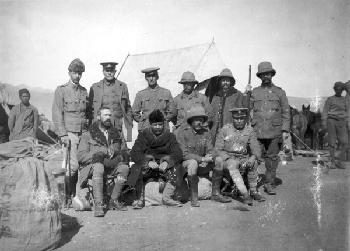
The Tibet Frontier Commission under Colonel Francis Younghusband crossed the Jelep La pass from Sikkim into Tibetan territory in July 1903 with a small escort and the ostensible mission of negotiating a trade treaty in response to Tibetan refusals to receive earlier British missions. The Tibetan government's refusal to negotiate — Younghusband was kept waiting for five months at the Khamba Jong frontier post — produced the conversion of the commission into a military expedition. Brigadier-General James Macdonald's column, which followed Younghusband across the frontier in December 1903, comprised approximately 3,000 British and Indian troops with seven thousand porters, four mountain guns and two Maxim machine guns. The Tibetan response was the deployment of a militia army of approximately 3,000 men, mostly armed with matchlock muskets, swords and slings, under the command of officials with no recent military experience.
The military operations of 1903–04 were almost entirely one-sided. The principal engagement at Chumi Shengo on the 31st of March 1904 — sometimes called the Massacre of Chumi Shengo — produced between 600 and 700 Tibetan dead in approximately four minutes of British machine-gun fire, against five British wounded. The Tibetan army's reliance on what it understood as a religiously-protective amulet to be effective against bullets was tragically misplaced. Subsequent engagements at Gyantse Dzong (May–July 1904), the Karola Pass and the bridges at Nyang produced similar disparities. The British column reached Lhasa on the 3rd of August 1904. The Thirteenth Dalai Lama had fled north through Mongolia to Urga (Ulaanbaatar) ten days earlier.
The Anglo-Tibetan Convention of the 7th of September 1904, negotiated by Younghusband with the regent left at Lhasa, provided for a Tibetan indemnity of 7.5 million rupees, the opening of three trade marts (Yatung, Gyantse, Gartok), and a Tibetan undertaking not to enter into relations with any third foreign power without British consent. The convention was repudiated by London on its terms — the indemnity was reduced and the protectorate clauses softened — and renegotiated with the Qing court at Peking on the 27th of April 1906 as the Anglo-Chinese Convention, which the British and the Chinese signed without Tibetan participation. The 1906 convention thereby reaffirmed the form of Qing suzerainty in exchange for substantively new British commercial access to the plateau.
The Anglo-Russian Convention of 1907
The Anglo-Russian Convention of the 31st of August 1907 — concluded at St Petersburg by Sir Arthur Nicolson and Alexander Izvolsky — formally ended the Great Game in Central Asia. The Tibet section of the convention provided that both powers would respect Tibetan territorial integrity, would not seek concessions in Tibet, and would communicate with the Lhasa government only through the Qing Chinese intermediary. The convention was a substantial diplomatic concession by Russia — the closure of the Dorzhiev avenue — in exchange for British recognition of Russian primacy in northern Persia and other quid-pro-quos. The price, for Tibet, was the codification in a major-power treaty of the formal Qing suzerainty that the Lhasa government had spent two centuries quietly disregarding.
The Qing intervention of 1910
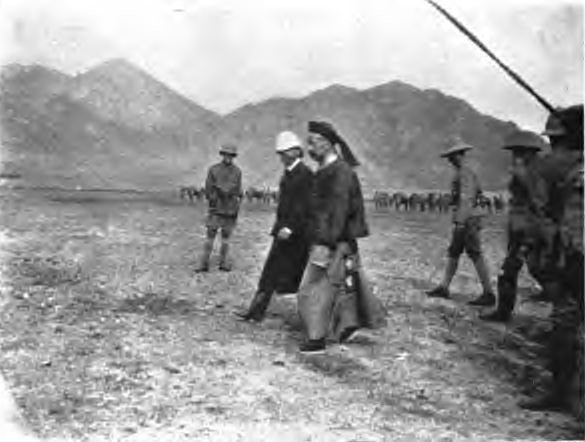
The Qing court drew its own conclusion from the 1904 expedition: that the formal suzerainty was inadequate to defend the Qing imperial frontier against further British or Russian penetration. The post-Boxer reform programme of the Qing therefore included, from 1906, a substantial expansion of direct Qing administrative and military presence in Kham (the eastern Tibetan-speaking region between the upper Yangtze and the Tibetan plateau proper). Zhao Erfeng, the Qing official appointed Frontier Commissioner for Sichuan-Tibet in 1906, conducted a four-year campaign of administrative incorporation in Kham, suppressing the monastic estates, abolishing the local hereditary chieftainships, and pushing Qing administration progressively westward toward Lhasa.
The Zhao Erfeng campaign culminated in February 1910 in the Qing's direct military entry into Lhasa: approximately 2,000 Qing troops under General Zhong Ying occupied the city, declared the Dalai Lama deposed, and announced direct Qing administration. The Thirteenth Dalai Lama, who had returned to Lhasa from his Mongolian exile in late 1909, fled south again — this time to British India, arriving at Darjeeling in February 1910 and remaining as the personal guest of the Indian government for two years.
The Qing Lhasa occupation lasted seventeen months. The Xinhai Revolution of October 1911 against the Qing dynasty produced, within weeks, the mutiny of the Sichuan units of the Lhasa garrison, the withdrawal of remaining Qing troops east toward Sichuan along the eastern caravan road, and the collapse of Qing authority across Kham. By April 1912 the Qing dynasty had abdicated. The political situation on the Tibetan plateau was, for the first time in two centuries, unconstrained by any external imperial sovereignty. The Dalai Lama returned across the Sikkim frontier in late 1912. The independence declaration that followed in February 1913 is the subject of the next chapter.
End of Chapter I