Caracas, and the Venezuelan heart
Venezuela is where the republic began and where it first broke, and it holds the best Bolivarian sites anywhere. It is also, at the time of writing, the hardest country in this series to travel in: most Western governments advise against all or all-but-essential travel, the currency situation changes faster than any guidebook can track, and independent travel outside Caracas requires local arrangements. None of what follows assumes you will go tomorrow. It assumes you would like to know what is there.
Caracas · Venezuela
Casa Natal del Libertador

A single-storey colonial house off the Plaza San Jacinto, reconstructed in the 1920s and furnished as a shrine rather than as a home. Bolívar was born here on the 24th of July 1783 into the Creole aristocracy of the Caracas valley — a family with cacao estates, copper at Aroa, town houses and several hundred enslaved people.
That inheritance is the necessary context for everything else. The independence movement in Venezuela began as a project of the white Creole landowning class, who wanted the colony's government without the colony's Spanish officials, and whose first republic in 1811 restricted the vote by property and did nothing for the enslaved majority of the coast. It took the catastrophe of 1814, and Pétion's terms in Haiti in 1816, to turn it into something else.
The Museo Bolivariano next door holds the better collection. Both are free, both are propaganda of a kind, and both are worth an hour.
Caracas · Venezuela
The Panteón Nacional

A converted church at the top of the old town, made the national pantheon in 1874 by Guzmán Blanco, who understood the political value of a tomb. Bolívar's remains arrived in 1842, repatriated from Santa Marta by a government that had, twelve years earlier, forbidden him to enter the country on pain of death.
The building is the physical centre of the Bolivarian cult, and the cult is the thing to watch rather than the architecture. Every Venezuelan government since 1842 has claimed him — conservative, liberal, military, democratic and Chavista in turn — and the 1999 constitution renamed the country the Bolivarian Republic of Venezuela. In 2010 the government exhumed and examined the remains, on the theory that he had been murdered; the commission reported no conclusive evidence for it.
A vast adjoining mausoleum, opened in 2013, now holds the sarcophagus. It cost a great deal of money at a moment when the country had very little.
Campo de Carabobo · Venezuela
The field of Carabobo

Open rolling ground south-west of Valencia where, on the 24th of June 1821, Bolívar's army broke the last Spanish field force in Venezuela. The decisive move was made by the British Legion — some of whom had been in the country for two years and most of whom were dying of fever — holding a ridge under fire while Páez's llanero cavalry came round the flank through broken ground the Spanish had thought impassable.
Carabobo secured Venezuela for the republic that had been proclaimed at Angostura eighteen months earlier, and it is the founding military event of the Venezuelan state. The site was turned into a ceremonial park in 1921 for the centenary, with a triumphal arch, an enormous monument and a permanent honour guard, and it is used for national ceremonies to this day.
The park is grand and the ground is legible: you can see the ridge, and you can see why the flanking route was not expected.
Ciudad Bolívar · Venezuela
Angostura

The narrows of the Orinoco — angostura — four hundred kilometres upriver, and the improbable place from which the republic was actually founded. Bolívar took the town in 1817 and made it his base because it was the one thing the Spanish navy could not easily reach, and because the river gave him a route to the llanos and to the arms dealers of the Caribbean.
The Congress of Angostura opened on the 15th of February 1819 in a building that still stands on the main square. Bolívar's address to it is his central political text: a republic for a people he described as neither European nor Indian, a warning against copying the United States constitution, a plea for a strong executive, and a proposal for a hereditary senate, which the delegates declined. In December, on news of Boyacá, the same congress proclaimed the Republic of Colombia — a state comprising territories that were still mostly in Spanish hands.
The town was renamed Ciudad Bolívar in 1846 and the old riverfront survives in colour-washed rows above the water. It is also where Angostura bitters were invented, by a German army surgeon in Bolívar's service, and the company left for Trinidad in 1875.
The llanos
The flooded grasslands of the Orinoco basin decided the war twice: for the king in 1814, and for the republic after 1816. Nothing else in the volume explains as much about why the independence struggle was also a civil and a racial war.
Apure · Venezuela
Los Llanos

A plain the size of Britain, under water from May to October and cracked dry from November to April, carrying cattle, capybara, caiman and one of the great concentrations of birds in South America. It is superb country to travel in and the reason to come is not only historical.
The llaneros — mixed-race cattlemen, expert lancers, contemptuous of the coastal Creole aristocracy — were the decisive military population of the war. Under the Asturian José Tomás Boves in 1813 and 1814 they fought for the Spanish king, and destroyed the second republic in a campaign of deliberate terror against whites that killed a part of the Creole population and drove the survivors east. Boves was not defending Spain so much as leading a social revolt that the royalist cause was happy to arm.
After Boves's death the republicans learned the lesson. Páez, himself a llanero, brought the same men over with promises of land and a share of the spoil, and the cavalry that had destroyed the republic remade it. The war in Venezuela killed perhaps a quarter of the population, and most of that happened here.
Achaguas · Venezuela
Achaguas and the Apure
Páez's base in the Apure, and the closest thing the llanero war has to a headquarters. The church holds the image of the Nazarene of Achaguas that his troops carried, and the town square carries the usual statue.
Two episodes belong here. At the Queseras del Medio in April 1819, Páez took a hundred and fifty horsemen against a much larger royalist force, feigned flight, turned, and destroyed it — the manoeuvre that produced Bolívar's citation "valientes, seguid mi ejemplo" and a good deal of subsequent myth. And in 1818 the same cavalry captured a Spanish gunboat flotilla on the Apure by swimming their horses out to it, which is the sort of thing that happened in this war and would be dismissed as invention if it were not documented.
It is also where the republic began to come apart. Páez's personal authority over these men was the real power in Venezuela, and when he turned it against Bogotá in 1826 there was nothing the constitution could do about it.
The Andes, and the foundation
The campaign of 1819 crossed a flooded plain and then a freezing páramo to arrive behind the Spanish army in New Granada, and the republic was proclaimed four months later. The route is drivable and the two ends of it are ninety minutes apart by road.
Boyacá · Colombia
Páramo de Pisba

A high, wet, treeless moor at close to four thousand metres, crossed by Bolívar's army in the first week of July 1819 after six weeks wading through the flooded Casanare. The army came up from the llanos in cotton, with llanero cavalry who had never seen frost. Estimates of the loss vary and the lower ones are bad enough: most of the horses, all of the cattle, and somewhere between a hundred and two hundred men dead of cold on the crossing itself.
What made it work was precisely that it was a stupid route. The Spanish had not garrisoned it because no competent commander would bring an army that way in the rainy season. Bolívar arrived in the Sogamoso valley with an exhausted force, was resupplied and reinforced by a population that had been under Spanish occupation since 1816, and fought Barreiro three weeks later.
The páramo can be walked as a two- or three-day trek from Socha, and it is genuinely demanding: altitude, rain and cold, with the usual páramo weather of four seasons in an afternoon. Frailejones everywhere. Go with a guide.
Boyacá · Colombia
Puente de Boyacá

A modest stone bridge over the Teatinos, a stream you could jump across in places, on the main road between Tunja and Bogotá. On the 7th of August 1819 Bolívar's army caught Barreiro's column here in the early afternoon, cut it in two at the bridge, and destroyed it in about two hours for the loss of some sixty men.
The consequence was immediate and total. The viceroy Sámano fled Bogotá within days, leaving the treasury behind; the capital fell without a fight; and the Congress of Angostura proclaimed the Republic of Colombia four months later on the strength of it. Very few battles of that size have produced a state.
The site is a national ceremonial park with an 1819 centenary monument, a triumphal arch, a colossal Bolívar and a great deal of flag. It is busy at weekends with Colombian families, which is the right way to see it.
Tunja · Colombia
Tunja
The colonial town twenty minutes north of the bridge, where Bolívar concentrated before the battle and where the Spanish had their forward base. It is one of the best-preserved colonial centres in Colombia and almost entirely ignored by visitors heading for Villa de Leyva an hour away.
The Casa del Fundador Suárez Rendón on the main square has the extraordinary painted ceilings of the sixteenth century — a mixture of Renaissance, Moorish and frankly pagan imagery that somehow passed the Inquisition. The churches are exceptional: Santo Domingo's Rosary chapel is as good as anything in South America.
Tunja also hosted the Congress of the United Provinces during the first New Granadan republic, the one Bolívar dismissed as the patria boba — the foolish fatherland — whose federalist squabbling he blamed for the Spanish reconquest of 1815. His critique of it is the argument that runs through the whole volume.
Villa del Rosario · Colombia
The Congress of Cúcuta
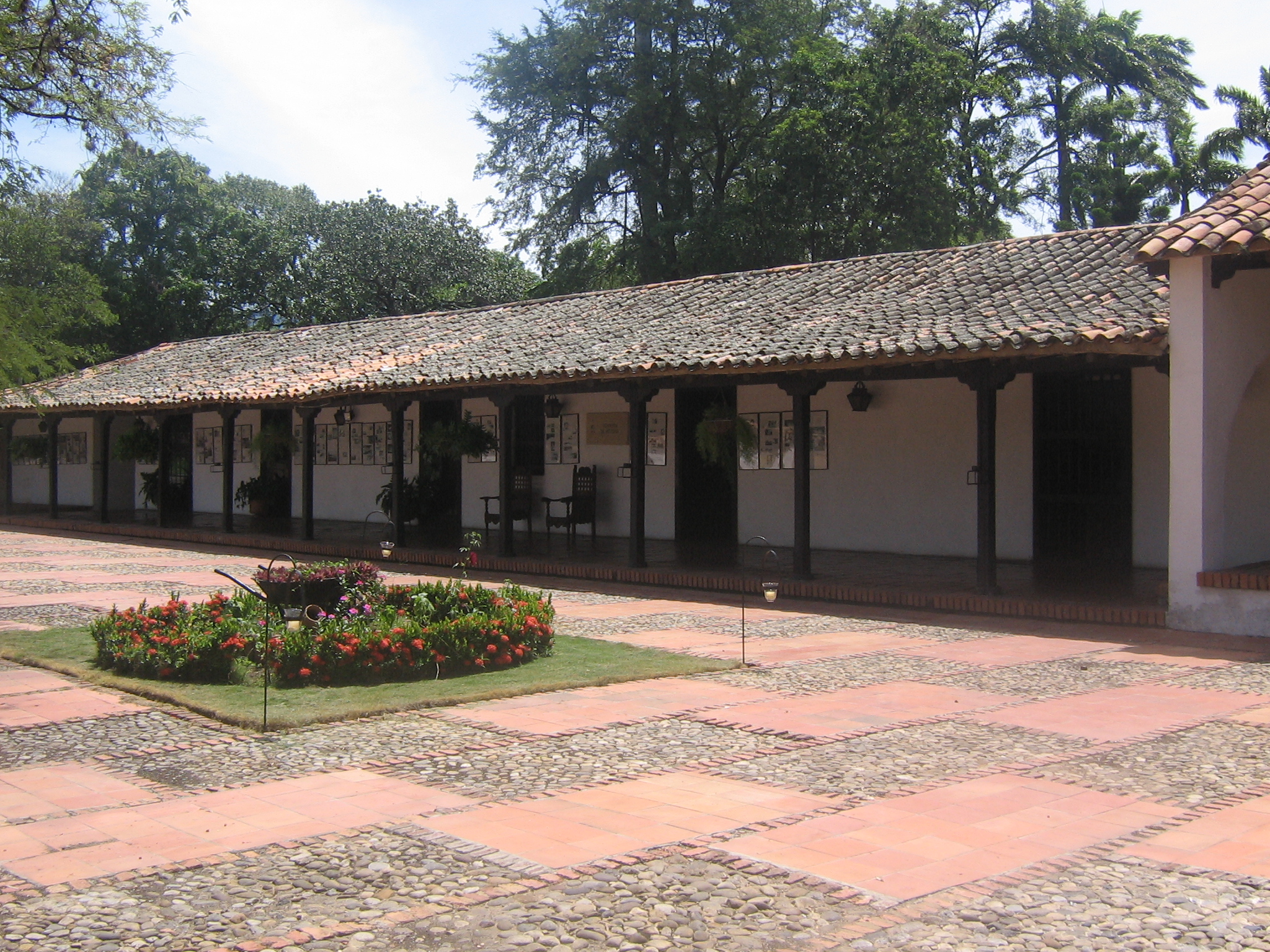
The republic proclaimed at Angostura in 1819 was given a constitution here in 1821, at a small town on the border chosen precisely because it sat between Venezuela and New Granada and could be reached from both.
The Congress of Cúcuta sat from May to October and produced a centralist constitution: a single national government at Bogotá, provincial governors appointed from the centre, a ten-year moratorium on constitutional amendment, Bolívar president and Santander vice-president. It also passed the free-womb law, which freed the children of enslaved women — at eighteen, later raised to twenty-one — and set up manumission juntas that were never funded properly. Slavery itself lasted until 1851 in New Granada and 1854 in Venezuela.
The Parque Gran Colombiano holds the roofless shell of the church where the congress met, the house where Santander was born, and the enormous tamarind under which Bolívar is supposed to have rested. The border is a few minutes away and the crossing has been closed, open, and partly open repeatedly in recent years; check locally before planning anything that depends on it.
Bogotá
The capital of a republic that could not reach its own provinces. Everything Bolívarian in the city is within a short walk of the Plaza de Bolívar, in the Candelaria.
Bogotá · Colombia
Quinta de Bolívar

A white country house with a garden of hydrangeas below Monserrate, given to Bolívar by the republic in 1820 and lived in, in scattered periods, for perhaps a year in total — which is itself the point. The president of Colombia spent most of his presidency several countries away, campaigning in Ecuador, Peru and Bolivia, and governed a state he was almost never in.
The museum is the best-curated Bolivarian site anywhere and notably the least reverent: it is willing to discuss his slaveholding, his authoritarian turn and the contested question of what he actually believed. The rooms are furnished to the 1820s and the labelling is bilingual.
It is also where Manuela Sáenz lived when she was in Bogotá, and where a good deal of the political life of the republic happened away from the formal institutions down the hill.
Bogotá · Colombia
Plaza de Bolívar and the Candelaria

The main square, with the 1846 Bolívar at the centre — the first public statue of him raised anywhere — and the Capitolio, the cathedral and the mayoralty around it. The Casa del Florero on the corner, now the Museo de la Independencia, is where the vase-borrowing quarrel of the 20th of July 1810 set off the Bogotá junta, and it tells the story of the first republic properly.
The Palacio de San Carlos, a block away on Calle 10, is where the conspirators came for Bolívar on the night of the 25th of September 1828. Manuela Sáenz delayed them at the door long enough for him to go out of a window into the street — an episode that earned her the title Libertadora del Libertador and that ended with fourteen executions, Santander exiled, and whatever remained of the republic's political legitimacy gone.
The Museo Nacional, fifteen minutes north in a converted panopticon prison, holds the best collection of the period. The Museo del Oro is not about this volume at all and you should go anyway.
The Caribbean coast
The coast was the republic's link to the world: its arms came in here, its loans were landed here, and its founder died here on the way to an exile he never took.
Cartagena de Indias · Colombia
Cartagena

The great fortified port of the Spanish Main, with eleven kilometres of wall and the vast fortress of San Felipe de Barajas above the town, and much the most beautiful city in this volume.
Two things happened here that matter. In December 1812 Bolívar, a refugee from the collapse of the first Venezuelan republic, published the Cartagena Manifesto — his first political statement, and an unsparing autopsy of his own side: that the federal system had made government impossible, that the republic had relied on militias instead of an army, and that clemency towards the enemy had been fatal. The centralism of everything he did afterwards starts in that document.
And in 1815 Pablo Morillo's expeditionary force — some ten thousand men, the largest army Spain ever sent to the Americas — besieged the city for a hundred and six days. Something like a third of the population died of hunger and disease before it fell. The reconquest that followed, with its Council of War and its executions of the Creole leadership, is what turned a quarrel about self-government into a war for independence.
Mompox · Colombia
Santa Cruz de Mompox
A colonial river port on an arm of the Magdalena, stranded when the main channel shifted in the nineteenth century and consequently preserved almost whole. Whitewashed streets, filigree silver workshops, extraordinary churches, and very few people.
Mompox declared independence from Spain on the 6th of August 1810, the first town in New Granada to do so outright rather than swearing loyalty to a junta in the king's name. In 1812 it gave Bolívar the two hundred men with whom he began the Magdalena campaign that cleared the river and led to the Admirable Campaign into Venezuela. The line attributed to him — that to Caracas he owed his life and to Mompox his glory — may or may not be authentic and is on a plaque regardless.
It is the loveliest place in this volume and the one most worth an extra day.
Santa Marta · Colombia
Quinta de San Pedro Alejandrino

A sugar and rum estate outside Santa Marta, owned by a Spanish royalist who offered it when Bolívar arrived on the coast too ill to go further. He died in a small room here at one in the afternoon on the 17th of December 1830, aged forty-seven, of what was diagnosed as tuberculosis.
The last months are worth holding in order. He had resigned in March. Venezuela had seceded and its congress had forbidden him to enter the country on pain of death. Ecuador had gone in May. Sucre — his best general, the victor of Ayacucho, thirty-five years old — was murdered in a forest in southern Colombia in June. The letter to Flores of the 9th of November contains the sentence everybody quotes: he had ploughed the sea.
The house is preserved with the camp bed, the estate buildings and an unexpectedly good modern museum of Latin American art in the grounds. It is a quiet, shaded, entirely unpompous place, which given everything else in this volume is a relief.
Ecuador and the south
The third department of the republic, taken in 1822 and gone by 1830, and the easiest part of the whole itinerary to travel. Quito and Guayaquil are ninety minutes apart by air and about four centuries apart in character.
Quito · Ecuador
Cima de la Libertad

The battle of Pichincha was fought on the 24th of May 1822 on the eastern flank of the volcano, above the city, at around three and a half thousand metres — high enough that both sides were fighting the altitude as much as each other. Sucre, twenty-seven, outmanoeuvred the royalist Aymerich overnight and took Quito the same day, which delivered the whole Audiencia to the republic.
The monument and museum sit on the slope with one of the great views over the old city. It is run by the army, so bring a passport, and the display is frankly nationalist in the way military museums are everywhere.
Sucre is the figure to take away from this volume. He was the most capable soldier of the war and much the most decent man in its leadership — scrupulous about prisoners, uninterested in personal power, the only one of them who consistently did what he said he would. He was shot from ambush at Berruecos in June 1830, at thirty-five, and the crime was never satisfactorily solved.
Quito · Ecuador
The centro histórico

The largest and least altered colonial centre in the Americas, inscribed on the very first UNESCO list in 1978, and a genuinely extraordinary place to walk. La Compañía is one of the most completely gilded interiors anywhere; San Francisco is the oldest and largest religious complex on the continent.
For this volume, the relevant places are the Plaza Grande, where independence was proclaimed, and the Museo de la Ciudad in the old hospital. Quito's own first junta of August 1809 — the Luz de América — predates every other on the continent, and it ended in August 1810 with the massacre of its imprisoned leaders by the royalist garrison, an event the city has not forgotten.
Manuela Sáenz was born here in 1797, the illegitimate daughter of a Spanish official, and she met Bolívar on the balcony of a house on the Plaza Grande when he entered the city after Pichincha. She died in poverty in Paita, on the Peruvian coast, in 1856, and her effects were burned as a precaution against diphtheria — including, so far as anyone knows, most of his letters to her.
Guayaquil · Ecuador
La Rotonda
On the 26th and 27th of July 1822 the two liberators of South America met in this city, alone, for something over four hours in total. San Martín had freed Argentina and Chile and had taken Lima; Bolívar had taken everything north of it and had just annexed Guayaquil to Colombia over local objections. No reliable record of what they said survives.
Within weeks San Martín resigned his protectorate of Peru, left public life entirely, and sailed for a European exile from which he never returned, leaving the completion of the war to Bolívar. Everything written about why — that he was outmanoeuvred, that he was refused troops, that he proposed a monarchy and was refused, that he simply judged Bolívar the better man for it — comes from partisan accounts written later, several of them demonstrably tampered with. It is the great blank in the history of the continent.
The monument on the Malecón shows the two men clasping hands. It was put up in 1938 and it is a fine piece of wishful thinking: whatever happened in that room, they did not part as equals.
Cuenca · Ecuador
Cuenca

A handsome colonial city in the southern Andes, on the Tomebamba river, and the third point of the Ecuadorian triangle. It declared independence in November 1820 in the wave of risings that followed Guayaquil's, was retaken by the royalists within months, and was finally freed by Sucre's campaign of 1822.
It is worth the detour for its own sake — the blue-domed new cathedral, the flower market, the Inca and Cañari ruins at Pumapungo on the edge of the centre — and because it makes the point that the highland south was a different country from the coast. Conservative, clerical, Quito-facing, and suspicious of Guayaquil's liberal merchants: that division survived the republic, outlived Gran Colombia, and is still the basic fault line of Ecuadorian politics.
The Panama hat, which is made here and in Montecristi and has never been made in Panama, got its name because the ones sold to the diggers on the isthmus were the ones the world noticed.
The reach beyond
Gran Colombia's armies liberated Peru and founded Bolivia, and its founder tried to build a league of the new republics on the isthmus. All four sites are outside the country's own borders, which is the point of including them.
Panama City · Panama
The Salón Bolívar

Panama joined the republic voluntarily in November 1821, remained part of Colombia after the break-up, and separated only in 1903 with American encouragement and an American warship offshore. For eighty years it was a Colombian province, which is why it is in this volume.
The Congress of Panama opened on the 22nd of June 1826 in the chapter house of the Franciscan convent in the old city, and it was Bolívar's largest idea: a permanent league of the Spanish American republics, with common defence, common diplomacy and a standing assembly. Four states sent delegates. Mexico, Central America, Peru and Colombia signed a treaty of union; only Colombia ratified it. Brazil and Chile did not attend; the United States sent two delegates, of whom one died on the way and the other arrived after everyone had gone home; Britain sent an observer and was quietly pleased.
The room survives as the Salón Bolívar, kept as a monument and inscribed on the World Heritage list. It is small, empty and rather moving, which is the correct effect.
Junín · Peru
The pampa of Junín
A high plain beside the Lago de Junín at around four thousand metres, where on the 6th of August 1824 about thirteen hundred republican and twelve hundred royalist cavalry fought for roughly three quarters of an hour without a shot being fired. Everything was done with lance and sabre; the powder was useless in the wet and the altitude, and it would not have mattered much at that range anyway.
The republicans were losing until a Peruvian squadron under Isaac Rázuri took the royalists in the rear, and the Spanish broke. Casualties were light by the standards of this war — a few hundred — but the royalist field army abandoned the central Andes and the road to Cuzco was open. Ayacucho followed four months later.
There is an obelisk and very little else, at an altitude where walking uphill is an undertaking. The drive up from Tarma is spectacular.
Quinua · Peru
The pampa de Ayacucho

The battle that ended the Spanish empire in South America, fought on a sloping plain below Condorcunca on the 9th of December 1824. Sucre had about fifty-eight hundred men against roughly ninety-three hundred under the viceroy La Serna, on ground the royalists had chosen, and he won it in something under two hours. La Serna was wounded and captured. The capitulation signed that evening surrendered all royalist forces in Peru.
Bolívar was not there. He had been stripped of his Peruvian command by the Colombian congress under the constitution's prohibition on commanding outside the national territory, and had handed the army to Sucre — so the decisive battle of his life was won by somebody else while he waited on the coast.
A forty-four-metre obelisk stands on the pampa, one metre for each year of the war. Ayacucho city, forty minutes away, is one of the finest colonial towns in Peru, with thirty-odd churches and the best Holy Week in the country. It was also the birthplace of Sendero Luminoso in 1980, and the region suffered worse than anywhere in the conflict that followed; the memorial museum in the city addresses it directly.
Sucre · Bolivia
Casa de la Libertad

Upper Peru declared independence in this building on the 6th of August 1825 — the anniversary of Junín — and named itself Bolivia after the man who had not especially wanted it to exist. Bolívar had favoured attaching the territory to Peru or to Argentina; Sucre, commanding on the spot, convened an assembly that decided otherwise, and the flattery of the name settled the argument.
Bolívar wrote its first constitution, and it is the clearest statement of what he had come to believe: a president for life with the power to nominate his own successor, a hereditary-tending legislature in three chambers, and an electoral franchise restricted to the literate. He regarded it as his best work. It survived in Bolivia for about two years.
The Casa is a well-kept museum with the declaration itself on display, and Sucre — white-walled, mild, at 2,800 metres — is the most agreeable city in Bolivia. It remains the constitutional capital; the government left for La Paz after a civil war in 1899 and never came back.